Why Has the Broader Market Weakened?
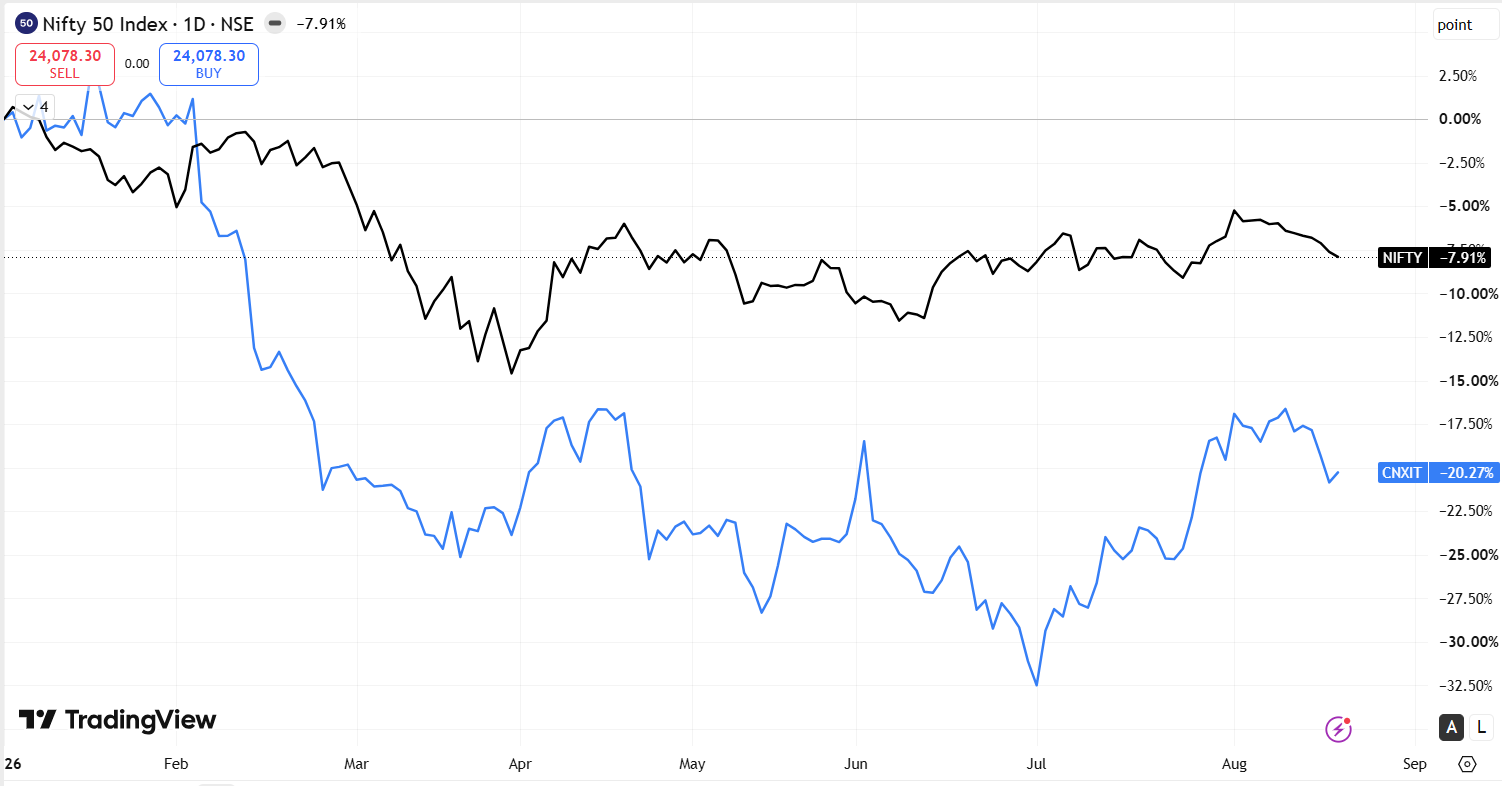
The broader market has faced pressure from tariff concerns, sustained FII selling, higher crude oil prices, rupee depreciation and weaker earnings. FIIs have withdrawn around ₹3.50 trillion as of August 19, 2026, through cash market transactions, while domestic inflows have provided some support. As per AMFI, SIP inflows stood at nearly ₹32,000 crore in July 2026.
Why Has Nifty IT Fallen More?
IT companies have faced additional headwinds from AI-driven changes in outsourcing, cautious global technology spending and uncertainty in the U.S. market, their largest revenue source. As of August 19, 2026, the weakness remained broad-based, with TCS down about 29% YTD, Infosys around 32% and Wipro about 33%. Meanwhile, the Nasdaq Composite had gained around 13% until August 18, 2026, suggesting India's IT underperformance was not solely linked to global technology trends.
For investors, the key focus remains on how AI adoption, softer discretionary spending, and evolving outsourcing models could influence future growth and valuations.
Top IT Stocks in India 2026—Full List with Market Cap, P/E and 1-Year Return
The IT sector stocks list below covers 10 major listed technology companies, along with their market capitalization, P/E and one-year return as of August 19, 2026.
Company
| Market Cap (₹ crore)
| P/E Ratio
| 1-Year Return
|
Tata Consultancy Services
| 8,21,867
| 15.3
| -24.40%
|
Infosys
| 4,55,273
| 14.6
| -22.60%
|
HCL Technologies
| 3,54,201
| 19.6
| -12.10%
|
Wipro
| 1,77,291
| 13.4
| -27.90%
|
Tech Mahindra
| 1,55,540
| 29.3
| 6.37%
|
LTM Ltd (LTIMindtree)
| 1,36,446
| 24.3
| -10.70%
|
Oracle Financial Services Software
| 1,01,854
| 29.8
| 35.20%
|
Persistent Systems
| 86,650
| 43.5
| 3.93%
|
Coforge
| 79,814
| 41.6
| 7.28%
|
Mphasis
| 46,207
| 23.9
| -11.30%
|
Key growth drivers for the IT sector in FY27
The IT sector outlook for 2026 remains closely linked to global technology spending, with demand increasingly concentrated around AI, cloud, cybersecurity, engineering services and efficiency-led projects rather than a broad revival in discretionary spending.
1. AI and automation
Artificial intelligence is becoming a larger part of enterprise technology spending. Indian IT companies are increasingly working on AI integration, data modernization, automation and related digital projects. At the same time, AI is changing traditional delivery models by reducing the manpower required for some routine technology work.
2. Cloud and cybersecurity
Businesses are constantly trying to modernize old software and migrate their applications and data to cloud-based platforms. The investment in cybersecurity is increasing due to a greater digital footprint.
3. Engineering R&D
Engineering Research and Development is another important growth area. As stated by NASSCOM, the world will invest $2.5 trillion in ER&D, creating opportunities for companies in the domains of automotive engineering, semiconductors, embedded systems design and industrial engineering.
4. Cost Optimization and GCC-Led Technology Demand
Global companies remain focused on improving efficiency and reducing technology costs, supporting outsourcing, automation and vendor consolidation. At the same time, India’s expanding GCC ecosystem is taking on more engineering, digital and technology work, increasing demand for specialized skills and higher-value services.
Together, these indicate that FY27 growth will be more dependent on high-value technology-enabled services and efficiencies rather than outsourcing volumes.
IT Sector Valuation: P/E, P/B and EV/EBITDA vs 5-Year Median
The steep correction in the industry has compressed the valuations of Indian IT stocks. As of August 19, 2026, comparisons of current valuation ratios with historical levels highlight the shift in investor sentiment. P/E measures the relationship between a stock’s price and earnings, while P/B compares its market value with book value.
Company
| FY26 P/E
| 5-Yr Median P/E
| FY26 P/B
| 5-Yr Median P/B
| FY26 EV/EBITDA
| 5-Yr Median EV/EBITDA
|
TCS
| 15.3
| 29.8
| 7.76
| 13.2
| 10.5
| 20
|
Infosys
| 14.6
| 25.7
| 5.6
| 8
| 10.4
| 16
|
HCL Technologies
| 19.8
| 23.8
| 4.7
| 5.4
| 11.7
| 14.1
|
Wipro
| 13.4
| 20.2
| 2.13
| 3.3
| 8.49
| 12.6
|
Tech Mahindra
| 29.2
| 30.3
| 5.27
| 5.1
| 15.9
| 16.8
|
LTM
| 24
| 33.5
| 5.67
| 8.3
| 15.1
| 22.2
|
Oracle Financial Services Software
| 29.8
| 24.3
| 13
| 7.8
| 20.2
| 15.6
|
Persistent Systems
| 43.7
| 52
| 11.1
| 11.6
| 28
| 31
|
Coforge
| 41.9
| 45.8
| 6.35
| 9.4
| 22.9
| 24.8
|
Mphasis
| 23.8
| 29.2
| 4.31
| 5.7
| 13.8
| 17.5
|
The table demonstrates that the phenomenon of valuation compression has been widespread; however, it is inconsistent. Both TCS and Infosys are trading at multiples much lower than their five-year median values for each metric considered, but HCL Technologies and Tech Mahindra are trading at multiples close to historical medians. Middle-tier companies like Persistent Systems have multiples that remain relatively high, but their FY26 multiples are still below five-year median levels.
What must be understood is that a reduced multiple does not necessarily mean that a stock is cheap. Besides the multiple, investors must evaluate the growth rate, margins, transaction rate, and possible impact of AI on future growth rates.
Government Policy and Regulation Shaping the Sector
1. Safe Harbour Reform for IT Services
Budget 2026-27 made provisions for categorizing software development, IT-enabled services, KPO and contract software R&D into one IT Services category. The standard safe harbour margin for this category is 15.5% and the eligibility criteria margin is likely to increase from ₹300 crore to ₹2,000 crore.
2. IndiaAI Mission
The IndiaAI Mission has an approved outlay of ₹10,371.92 crore over five years. By early 2026, the IndiaAI Mission had onboarded more than 38,000 GPUs and 1,050 TPUs, with GPU access available at around ₹65 per hour.
3. Cloud and data-centre incentives
Budget 2026-27 proposed a tax holiday until 2047 for eligible foreign companies providing global cloud services through data centres in India. A 15% safe harbour on cost has also been proposed for certain related-party data-centre arrangements.
4. Data Protection Guidelines
Digital Personal Data Protection Regulations, 2025, are related to issues such as consent, reasonable security practices, data breach reporting and user rights. Any failure to implement reasonable security practices may be liable to a penalty of up to ₹250 crore.
5. India-UK CETA
The India-U.K. Comprehensive Economic and Trade Agreement, which came into effect on July 15, 2026, provides access to 137 sub-sectors of U.K. services, including IT services. The social security agreement that accompanies this deal is estimated to help Indian companies save over ₹4,000 crore.
Both these initiatives will improve the business environment for IT companies.
Risks Investors Should Price In
There are certain factors that could affect the performance of Indian IT companies in FY27, including selective customer spending, pricing impacts by artificial intelligence and profitability.
1. Caution in Discretionary Spending
The use of money by customers in purchasing enterprise technologies is cautious. This is because the focus is on cost optimization and efficiency. Large project approvals may delay growth.
2. AI and Pressure on Pricing
AI has helped increase efficiency, but it has also changed how companies outsource work. Since clients are now choosing to pay for results and require fewer people to complete some of the jobs, IT companies could face pressure on their pricing model unless they increase revenue through other more profitable areas.
3. Margin and Talent Costs
Employee expenses form a large part of the costs in the IT sector. Increased wages, subcontracting and attrition may lead to margin pressures where revenue growth is poor. According to NASSCOM, attrition during Q1 FY26 was at about 15% - 18%.
4. Currency, Regulation and Cybersecurity
Since a substantial proportion of revenues is derived from foreign markets, changes in exchange rates can impact revenues and profits. Moreover, firms face stricter laws regarding information security and any breach will cost them both financially and reputationally.
For investors, deal conversion, margins, AI monetization and client spending remain important indicators alongside headline revenue growth.
How to Invest in IT Stocks: Direct Equity vs Sector Funds vs ETFs
Investors looking for exposure to the Indian IT sector can broadly choose between individual stocks, sectoral mutual funds and exchange-traded funds. Each route provides exposure to the same industry, but the level of diversification, control and portfolio concentration differs.
Route
| Example
| How It Works
|
Direct Equity
| TCS, Infosys, HCL Technologies
| Investors directly select and invest in individual IT companies.
|
IT Sector Fund
| ICICI Prudential Technology Fund, Tata Digital India Fund, SBI Technology Opportunities Fund
| An actively managed mutual fund invests mainly across technology companies.
|
IT ETF
| Nippon India ETF Nifty IT, ICICI Prudential Nifty IT ETF, Mirae Asset Nifty IT ETF
| Passively tracks an IT index such as Nifty IT and trades on the stock exchange
|
Direct equity offers greater freedom in stock selection and portfolio weightage, but it is riskier. Sectoral mutual funds give professional management with diversification in the IT sector, while ETFs give passive investing in the IT index. As per the guidelines of SEBI, the minimum investment in the sector or the theme is 80%.
All three routes remain concentrated in the IT sector. Their performance can therefore be influenced by common factors such as global technology spending, currency movements, outsourcing demand and changes brought about by AI.
Deal Wins and TCV: The Real Demand Indicator for Indian IT
Quarterly revenue shows what an IT company has already delivered, while deal wins indicate the business that may convert into revenue over the coming quarters. This makes Total Contract Value, or TCV, an important measure of underlying demand in Indian IT.
TCV refers to the aggregate value of contracts signed during a period. However, the big deals do not generate similar revenues right away as contracts may take several years to generate the maximum impact.
Q1 FY27 numbers highlight these trends. TCS reported a TCV of $9.5 billion, including several AI-led transformation wins and an $800 million deal with SKF. Infosys reported $3.6 billion of large-deal TCV, of which 61% was net new. Wipro reported total bookings of $3.4 billion, including $1.6 billion from 13 large deals.
For investors, the quality of TCV matters as much as the headline number. A higher share of net-new deals can indicate fresh business wins, while renewals mainly support revenue visibility. TCV should therefore be read alongside deal duration, ramp-up schedules and revenue conversion. Strong bookings are more meaningful when they begin translating into sustained revenue growth.
AI and GCC Pressure: Threat or the Next Revenue Leg?
AI and the growth of Global Capability Centres are redefining the conventional process of outsourcing for Indian IT firms.
Use of generative AI can automate aspects of software development, testing, application maintenance and customer support, thereby decreasing manpower needs in certain cases. According to NASSCOM, a trend towards outcome-based agreements is expected whereby the clients will pay for the achievement of business outcomes and not resource usage.
GCCs add a further level of pressure on India due to their increasing tendency to bring more IT work in-house. India presently has over 1,700 GCCs, employing 1.9 million professionals with revenues exceeding $64.6 billion. By the year 2030, the system will grow to 2,400 centers with revenues exceeding $105 billion.
The opportunity lies in the type of work these trends create. Enterprises and GCCs still require external expertise in AI implementation, cloud migration, cybersecurity, data modernization and engineering services.
For investors, the key question is whether Indian IT companies can replace slower manpower-led outsourcing growth with higher-value AI, cloud, engineering and digital revenue as client delivery models evolve.