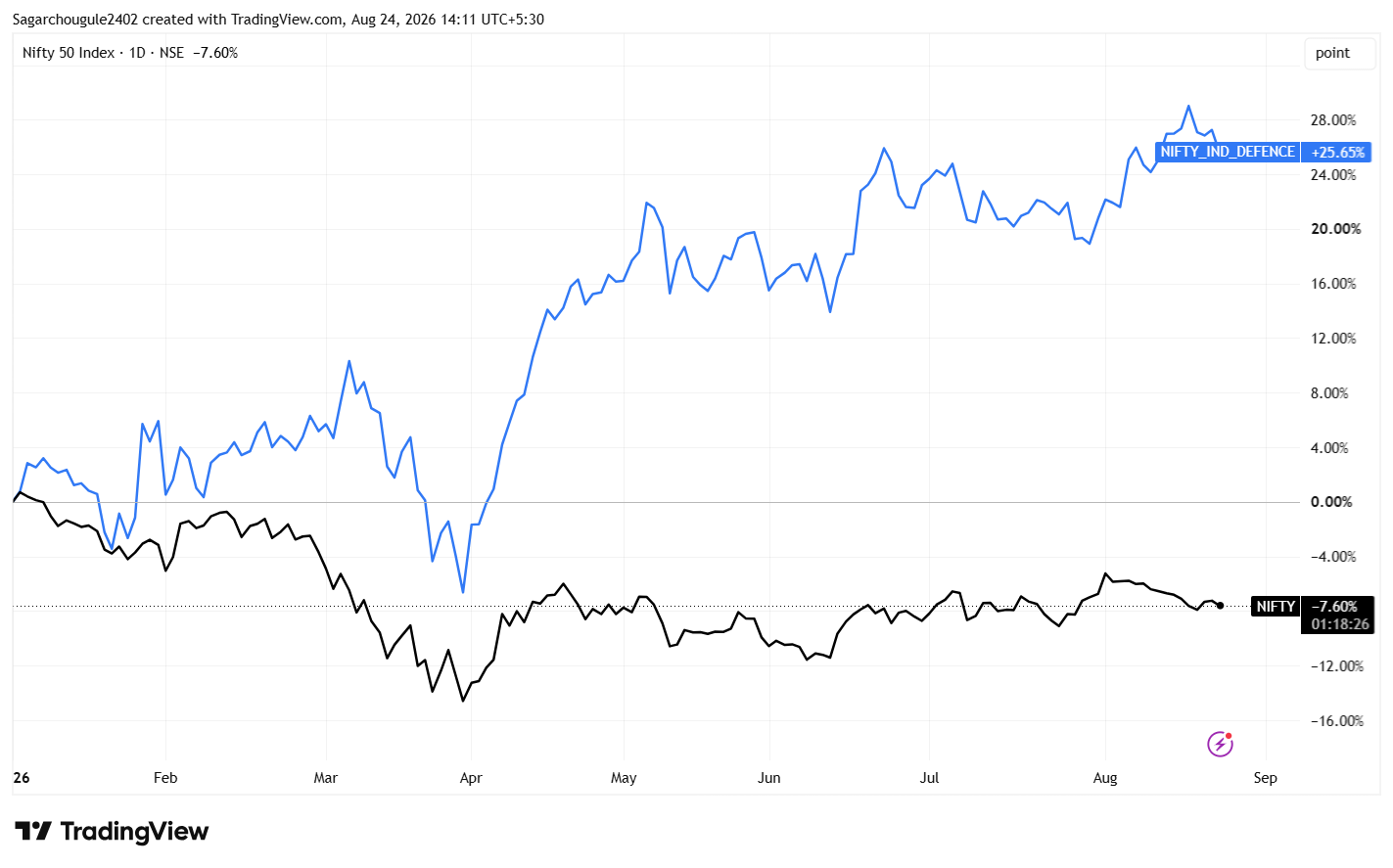
The Nifty India Defence Index has had quite a remarkable run so far in 2026, giving gains of roughly 25.65% YTD as of August 24, 2026. That's a stark contrast to the Nifty 50, which slipped around 7.60% over the same period. What makes this even more impressive is that defence stocks held up well despite a fairly rough broader market backdrop; FII outflows, global headwinds, swinging crude prices and nagging concerns about corporate earnings were all working against the market at the same time.
So what's been driving this?
The rally is largely supported by two key factors: a strong defence order pipeline and the government’s continued focus on military modernisation. The FY26 Defence Budget estimate of roughly ₹6.81 lakh crore is indicative of the change towards capital expenditure and indigenously developed technology.
The export opportunity further adds to the positive prospects in the industry, as India plans to make ₹50,000 crore worth of defence exports annually by 2029. Private companies are also gaining a larger role, contributing nearly 22% of India’s ₹1.54 lakh crore defence production in FY25, compared with a much smaller presence earlier.
Top Aerospace & Defence Stocks in India 2026: Full List with Market Cap, P/E and 1-Year Return
As of August 24, 2026, India’s listed Aerospace and Defence sector spans aircraft manufacturing, defence electronics, shipbuilding, ammunition, missiles and specialised technologies. While large public sector companies dominate market capitalisation, private players are expanding through niche capabilities and technology-driven businesses.
Company
| Core Business Area
| Market Cap (₹ Crore)
| P/E Ratio
| 1-Year Return
|
Hindustan Aeronautics Ltd
| Aircraft, helicopters and aerospace systems
| 3,27,533
| 35.1
| 12%
|
Bharat Electronics Ltd
| Defence electronics, radars and communication systems
| 2,98,678
| 48.5
| 10%
|
Solar Industries India Ltd
| Defence explosives and ammunition
| 1,78,085
| 89.4
| 34%
|
Mazagon Dock Shipbuilders Ltd
| Warships and submarine construction
| 1,02,545
| 35.8
| -8%
|
Bharat Dynamics Ltd
| Missiles and defence systems
| 49,600
| 95.2
| -11%
|
Data Patterns India Ltd
| Defence electronics and aerospace systems
| 26,514
| 98.2
| 85%
|
Paras Defence & Space Technologies Ltd
| Optics, anti-drone systems and defence electronics
| 12,137
| 131
| 124%
|
Source: Screener, Mordor Intelligence, Press Information Bureau (PIB), Ministry of Defence (MoD)
Among the listed defence firms, HAL and BEL remain among the leading companies in the defence sector in terms of market capitalisation. HAL has a market capitalisation of around ₹3.27 lakh crore with a P/E ratio of 35.1. BEL, on the other hand, has a market capitalisation of nearly ₹2.98 lakh crore with a higher P/E ratio of 48.5, driven by its defence electronics portfolio.
Among other players, Solar Industries India has gained around 34% over the past year, supported by expectations around defence explosives and ammunition demand. Data Patterns India and Paras Defence & Space Technologies have performed well with gains of 85% and 124%, respectively; however, their stock valuations are quite high with P/E ratios exceeding 98.
The sector’s rally has been uneven, with performance varying across companies. Going ahead, order execution, revenue growth and valuation comfort will remain key factors for investors.
Key Growth Drivers for the Aerospace & Defence Sector in FY27
India’s Aerospace and Defence sector is expected to benefit from rising defence spending, indigenous manufacturing, export expansion and increasing private sector participation. Government initiatives focused on modernisation and self-reliance are creating opportunities across aircraft, defence electronics, naval platforms, drones and specialised components.
1. Increased Defence Spending and Military Modernisation
While the FY27 defence budget was ₹7.85 lakh crore, the crucial part is where the money is being spent. The capital expenditure for FY27 stood at ₹2.19 lakh crore, as per the Press Information Bureau, which includes all the funding towards hardware, platforms and technologies and not operating costs. This is precisely what sustains orders for firms in sectors like aircraft manufacturing, missile systems, navies and defence electronics.
2. Expansion of Domestic Defence Manufacturing
Not only a slogan anymore, the Aatmanirbhar Bharat policy also shows a rise in domestic manufacturing in India's defence sector, which stood at ₹1.78 lakh crore as per PIB in FY26, with around 24% contribution from private players in the industry's total production. The introduction of 405 defence products in the Positive Indigenisation List has strengthened the above strategy, where the above defence items have been asked to be manufactured locally instead of being imported.
3. Rising Defence Exports
With an increase in India's defence exports from ₹686 crore in FY14 to ₹38,424 crore in FY26 and being exported to over 80 countries, the trend is quite evident of a different kind of presence in the international defence market. The target of ₹50,000 crore in defence exports by CY29 by the government is making export demand a second source of growth for domestic defence companies alongside home procurement.
4. Growing Role of Private Companies and Defence Technology
Private players have found meaningful ground in faster-moving segments like drones, sensors, optics, cybersecurity and defence electronics. India's defence ecosystem today includes 16 Defence PSUs, around 500 licensed private companies and nearly 17,000 MSMEs, reflecting how broadly participation has spread across the value chain compared to even a few years ago.
Aerospace & Defence Sector Valuation: P/E, P/B and EV/EBITDA Compared with Historical Levels
The strong rally in defence stocks has resulted in a significant valuation re-rating, driven by expectations of higher defence spending, strong order pipelines, exports and domestic manufacturing growth. However, premium valuations make earnings execution critical.
According to market data for the Nifty India Defence Index, the index was trading at a P/E ratio of around 56 and a P/B ratio of nearly 12 in August 2026, with a market capitalisation of approximately ₹12.76 lakh crore, reflecting the premium valuation assigned to the sector.
Company
| FY26 P/E
| 5-Yr Median P/E
| FY26 P/B
| 5-Yr Median P/B
| FY26 EV/EBITDA
| 5-Yr Median EV/EBITDA
|
Hindustan Aeronautics Ltd
| 35
| 30
| 7.97
| 7.3
| 20.2
| 17.8
|
Bharat Electronics Ltd
| 48.6
| 40.5
| 12.5
| 9.6
| 33.1
| 26.6
|
Bharat Dynamics Ltd
| 95.9
| 66.8
| 11.7
| 9.4
| 57.1
| 39.8
|
Mazagon Dock Shipbuilders Ltd
| 35.9
| 32.7
| 10.5
| 9.4
| 24.3
| 18.6
|
Garden Reach Shipbuilders & Engineers Ltd
| 37.3
| 36.2
| 11.4
| 6.8
| 23.4
| 14
|
Cochin Shipyard Ltd
| 67.2
| 42
| 6.7
| 4.9
| 38.2
| 24.8
|
Solar Industries India Ltd
| 90.2
| 76.9
| 28.7
| 21.8
| 56.2
| 44.8
|
Data Patterns India Ltd
| 98.6
| 71.2
| 15.4
| 10.6
| 66.7
| 48.5
|
Paras Defence & Space Technologies Ltd
| 132
| 83.4
| 16.8
| 7.7
| 82.9
| 46.6
|
Astra Microwave Products Ltd
| 83.5
| 58
| 12
| 6.6
| 44.8
| 30.1
|
Source: Screener, Mordor Intelligence, Press Information Bureau (PIB), Ministry of Defence (MoD)
Among major players, HAL traded at a P/E of 35 in FY26 compared with its 5 year median of 30, while BEL traded at 48.6 P/E against its median of 40.5. Companies such as Bharat Dynamics, Solar Industries India and Data Patterns India commanded higher valuations, with FY26 P/E ratios of 95.9, 90.2 and 98.6, respectively.
The valuation premium is driven by the change in perception in the market environment, with defence contractors now perceived as growth companies rather than the suppliers to the government they once were. Nevertheless, long duration of projects, project delays and order conversion continue to be major risks.
Government Policy and Regulation Shaping the Aerospace & Defence Sector
Government policy has played a key role in transforming India’s defence sector from an import-dependent ecosystem into a domestic manufacturing base. Policy reforms have focused on indigenous procurement, private sector participation and building export capabilities across the defence value chain.
1. Aatmanirbhar Bharat and Defence Indigenisation
The Aatmanirbhar Bharat scheme initiated by the government intends to enhance domestic manufacturing capabilities and decrease the reliance on imports of defence equipment. As part of the same, the government has introduced Positive Indigenisation Lists under which imports of certain defence equipment after the timelines will be discouraged and domestic manufacturers will be encouraged.
Procurement has been facilitated under the Defence Acquisition Procedure (DAP) 2020 under the Buy (Indian-IDDM) and Buy (Indian) categories.
2. Facilitation of Private Sector, MSMEs and Defence Startups
Schemes such as the SRIJAN portal, Innovations for Defence Excellence (iDEX) and defence industrial corridors have been initiated by the government to enable private players, startups and MSMEs to participate.
3. Defence Production and Export Expansion
Government policies have helped increase the volume of defence production and exports drastically. Defence exports rose from ₹686 crore in FY14 to ₹38,424 crore in FY26 as Indian defence goods were exported to more than 80 countries.
The government aims at getting an annual defence production of ₹3 lakh crore and export of ₹50,000 crore in CY29, which would be beneficial for defence manufacturing firms in the long run.
Risks Investors Should Price in While Analysing Aerospace & Defence Stocks
Aerospace and Defence sector has benefited due to the higher budget allocation, growth in domestic manufacturing and opportunities for exports. But at the same time, the following risks should also be considered by investors while analysing such stocks.
1. Long Execution Cycles and Order Conversion Risks
Defence business tends to have multiple phases in projects such as design, testing, approvals and delivery in phases. This creates a possibility of a lag between order wins and earnings generation. Delays in the process of execution, supply chain issues or changes in the cycle of procurement can affect cash flow and earnings.
2. Dependence on Government Orders
Government procurement programs are largely responsible for revenue generation for most defence companies. Any changes in priorities of defence, budget or approvals can affect order flow.
3. Premium Valuations
Due to investor optimism, valuation premiums are being seen in multiple defence stocks as most stocks trade above their respective levels. This premium requires earnings growth and order execution to be justified.
4. Technology and Supply Chain Challenges
Advanced capabilities like electronics, artificial intelligence, sensors and unmanned systems form an integral part of modern-day defence systems. Domestic players may have started developing these capabilities, but there are certain specialised technologies and components which are a challenge.
How to Invest in Aerospace & Defence Stocks: Direct Equity vs Sector Funds vs ETFs
Investors can gain exposure to India’s Aerospace and Defence sector through direct stocks, sector focused mutual funds or ETFs. Each option offers a different balance of control, diversification and risk.
1. Direct Investment in Defence Stocks
In the case of defence stocks, an investor will get the choice of investing in the stock of defence firms in segments like Aerospace Manufacturing, Defence Electronics, Ship Building, Missile and others. But direct investment requires investors to consider parameters like order book position, execution capability, valuations, profits and reliance on government orders, etc.
2. Defence Mutual Funds
Investors can access sector focused mutual funds which invest in a group of defence stocks and give investors exposure without taking company specific risk. These funds are still concentrated in one sector and subject to risks associated with the entire defence sector. One such fund is HDFC Defence Fund.
3. Defence ETFs and Index Funds
With the help of ETFs and index funds, investment can be made in the set of defence companies by means of sector indexing. The sector index funds allow broader investment in the whole defence sector without relying on the performance of individual firms. The risks related to the sector, including policy, execution and valuation risk, are still present in the sector investment.
It is up to individuals whether to invest in stocks directly or go with mutual funds or ETFs. It would depend upon the risk appetite, market knowledge and diversification needs of the individuals.
Order Book to Revenue Conversion: Why Defence Execution Lags Order Wins
The order book is generally perceived to be the growth driver of the defence business, but winning orders does not mean revenues right away. There is always an extended execution period required in the defence business because of the design approval process, testing and delivery phases.
1. Long Project Execution Timelines:
Longer projects like aircraft, ships and missiles are executed over many years. The revenue is recorded incrementally when companies meet the delivery milestones set, causing a difference between the order value and the revenue booked.
2. Manufacturing and Delivery Capability:
This will be influenced by the capacity to manufacture and deliver and the timing of the same. Failure to approve in time, component availability, or manufacturing may cause delays in revenue generation.
3. Order Book Quality Matters:
When you have big order pipelines, it means that there is visibility, but it does not mean that investors should base their considerations on the number of orders only.
4. Revenue Conversion as a Key Metric:
Order backlog to revenue, revenue conversion ratio and working capital needs are some of the metrics that give a better understanding of the capability of an organisation to convert opportunities to performance.
In the case of defence companies, sustainable growth does not only depend on securing orders, but also on converting the pipeline into revenues and profits.
Indigenisation Policy and the Domestic Defence Procurement Pipeline
The push towards indigenous manufacturing by India is a result of its attempt to reduce dependency on imports and create a domestic manufacturing ecosystem for aircraft, naval systems, defence electronics, missiles and other specialised items.
Key Policy Initiatives:
1. Positive Indigenisation Lists (PILs)
The Ministry of Defence has notified the sixth PIL covering 405 strategically important items.
These include components for aircraft, armoured vehicles, warships, missile systems and defence electronics.
The list represents an estimated business opportunity of around ₹3,070 crore for domestic manufacturers.
2. SRIJAN Portal and Private Sector Participation
The SRIJAN Defence Portal enables MSMEs, startups and private companies to develop indigenised defence products.
As of June 2026, more than 33,000 items were offered for indigenisation, with over 15,700 items developed domestically.
3. Defence Procurement Reforms
The proposed Defence Acquisition Procedure (DAP) 2026 aims to increase indigenous content and streamline procurement processes.
These measures create opportunities across the value chain, from large defence manufacturers to suppliers of components and specialised technologies.
However, converting policy support into revenue will depend on procurement timelines, manufacturing capacity and execution efficiency.