




















Open Your Free Demat Account
Access Research Backed Stock Recommendations
By Dalal Street Investment Journal (DSIJ)
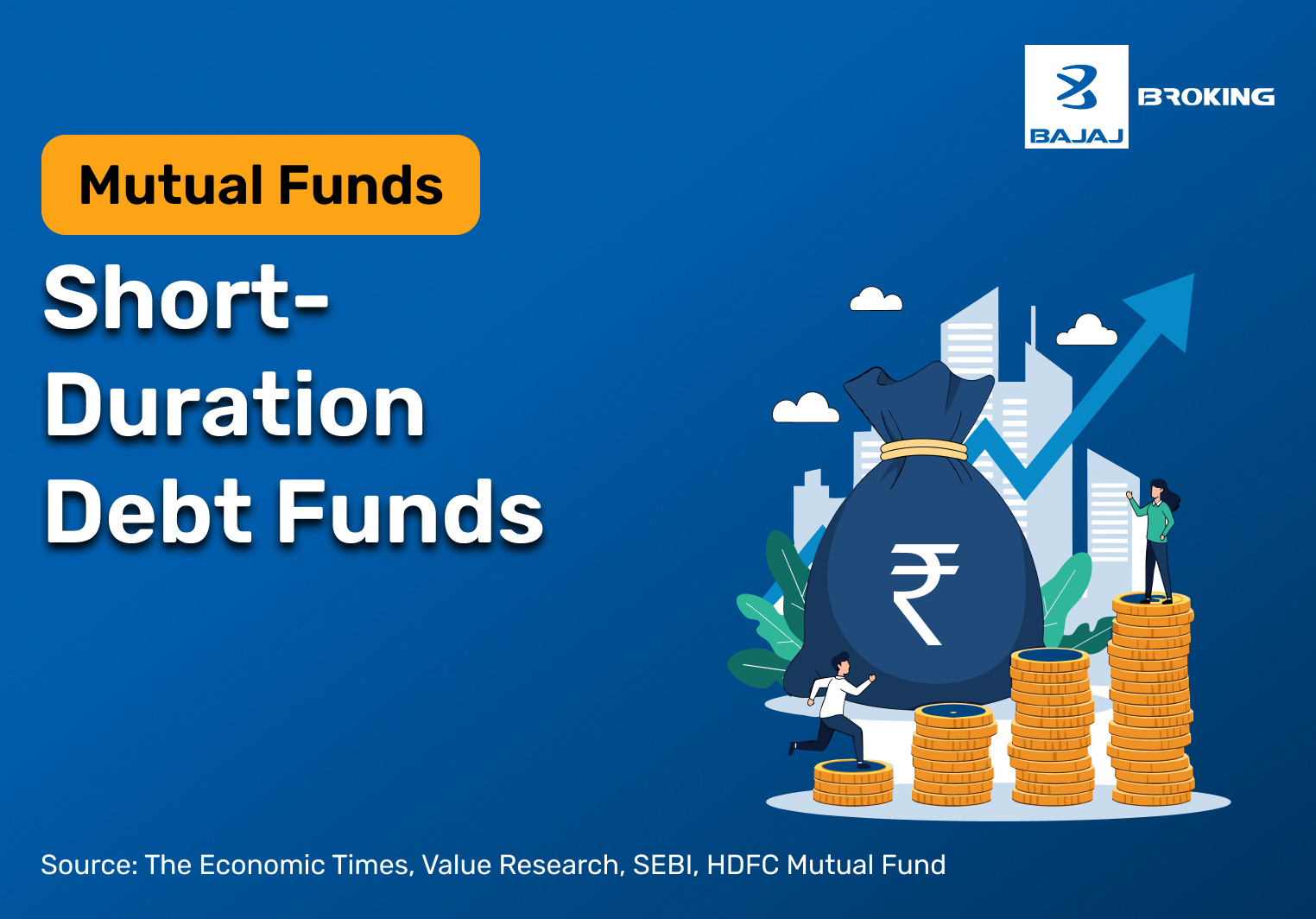
The Economic Times has shortlisted three short-duration debt mutual funds for November 2026: HDFC Short Term Fund, ICICI Prudential Short Term Fund and Axis Short Term Fund. This article compares their Regular Growth returns and portfolio characteristics and explains who may consider these schemes.
Investors saving for a financial goal that is a few years away often look for alternatives to equity investments. Short duration debt mutual funds are one such option. They invest primarily in fixed-income securities and money market instruments, seeking to generate income with relatively limited exposure to interest rate movements compared with long-duration debt funds.
However, lower volatility does not mean that the investment is risk-free. The quality of the bonds held by a scheme, its sensitivity to interest rates and the costs charged to investors can all influence returns. With this in mind, let us examine three short-duration debt mutual funds shortlisted for November 2026.
The Economic Times, in its November 27, 2026 report, retained HDFC Short Term Debt Fund, ICICI Prudential Short Term Fund and Axis Short Term Fund in its monthly shortlist. HDFC Mutual Fund now calls its scheme HDFC Short Term Fund, following a name change on August 26, 2026.
The publication considers the behaviour of returns over three years, consistency, losses during unfavourable periods, and performance relative to a benchmark. It also uses a minimum scheme asset size of ₹50 crore. The shortlist is not simply a ranking of the highest recent returns.
Under SEBI’s February 26, 2026 categorisation circular, these schemes fall under the Short Term Fund category. Their portfolio-level Macaulay duration must remain between one and three years. Individual bonds can have maturities outside this range.
The table compares Regular Growth plans using the same peer-comparison snapshot of the HDFC Short Term Fund page, which shows NAV data as of November 23, 2026. Returns over three years are annualised.
Mutual fund scheme | 1-year return | 3-year return |
HDFC Short Term Fund | 4.34% | 6.97% |
ICICI Prudential Short Term Fund | 4.62% | 6.91% |
Axis Short Term Fund | 4.67% | 7.08% |
(Source: The Economic Times, Value Research data, November 23, 2026 Snapshot)
The Axis Short Term Fund led this three-fund comparison over one and three years. Over five years, the ICICI Prudential Short Term Fund recorded 6.41% annually, ahead of Axis at 6.21% and HDFC at 6.18%. The modest differences underline why investors should examine more than returns alone.
Maturity refers to the time remaining until a debt instrument is due to repay its principal. A portfolio’s average maturity combines the maturities of its holdings. Macaulay duration instead reflects the weighted timing of a bond’s cash flows, including interest payments and principal repayment.
Modified duration is useful for estimating a bond portfolio’s sensitivity to changing yields. For instance, a portfolio with a modified duration of two years could lose roughly 2% of its value if yields rise by one percentage point, assuming other factors remain unchanged. This is only an approximation, not a prediction of the fund’s total return.
Yield to maturity (YTM) estimates the annualised yield implied by the prices of the underlying debt securities. Comparing it with average maturity gives investors a clearer view of how the funds are positioned.
Mutual fund scheme | Average maturity | Portfolio YTM |
HDFC Short Term Fund | 2.95 years | 8.44% |
ICICI Prudential Short Term Fund | 4.76 years | 8.54% |
Axis Short Term Fund | 2.74 years | 8.37% |
(Source: The Economic Times)
ICICI Prudential Short Term Fund has the longest average maturity and the highest reported YTM among the three. Axis has the shortest average maturity. HDFC’s November fund factsheet also reports a Macaulay duration of 2.44 years as of October 31. A higher yield does not necessarily translate into higher realised returns; credit events, expenses and market movements can change the outcome.
Based on the three-year annualised returns in the first table, an investment of ₹1 lakh in Axis Short Term Fund would have grown to about ₹1,22,779. The same amount invested in the HDFC Short Term Fund would have reached approximately ₹1,22,401.
Using the reported three-year return of 6.91%, ICICI Prudential Short Term Fund would have turned ₹1 lakh into approximately ₹1,22,195. The difference between the three outcomes is small compared with the potential impact of an unexpected credit or interest rate event.
These are illustrative values calculated by compounding the reported annualised returns over three years. They exclude investor-level taxes and any applicable charges. Actual investment values depend on transaction dates and NAVs, and future returns may differ substantially.
These funds may be worth examining for investors with goals roughly one to three years away who can tolerate fluctuations in NAV. Examples include saving for a planned expense or holding the debt component of a diversified portfolio. A fund should be chosen based on the date when the money will be needed.
Investors requiring funds immediately or within a few months may prefer to evaluate instruments with less interest rate sensitivity. Conversely, longer duration debt funds may be more sensitive to yield movements. Neither a higher duration nor a higher yield is automatically better.
Plan selection also matters. Regular and Direct Growth options have different expense structures, which can influence the returns received by investors. This comparison uses Regular Growth plans throughout; investors should compare their holdings with the corresponding plan rather than mixing plan types.
A debt fund should not be confused with a bank fixed deposit. Its NAV changes with the market value of its underlying securities, and neither the original capital nor the return is guaranteed. Investors who require a fixed maturity value should account for that distinction before allocating money.
Interest rate risk remains relevant even within this category. When market yields rise, existing fixed-rate bonds generally fall in value. A longer modified duration can amplify this effect, although interest income may offset some of the price movement over time.
Credit risk is another consideration. A bond issuer may be downgraded or fail to make scheduled payments. Investors should review the portfolio’s credit ratings, exposure to individual borrowers, and liquidity. A high reported portfolio yield should not be interpreted as a guaranteed return.
Costs and taxation can also affect the final amount received. Investors should read the latest scheme documents, check the applicable Riskometer, and assess whether the investment matches their financial goals and ability to tolerate losses. Past performance alone is not a sufficient basis for selection.
HDFC Short Term Fund, ICICI Prudential Short Term Fund and Axis Short Term Fund offer three alternatives within the short-duration debt category. Their historical returns are reasonably close, but their portfolio maturity and yield differ. Investors should prioritise credit quality, liquidity, duration and costs alongside past performance when selecting a scheme for their investment horizon.
Source: The Economic Times, Value Research, SEBI, HDFC Mutual Fund
SEBI Registered Research Analyst (INH000006396).
Founded in 1986, Dalal Street Investment Journal (DSIJ) brings decades of experience in India’s equity markets. DSIJ's research combines fundamental analysis with price action, guided by disciplined risk management and capital preservation. They follow a structured, data-driven approach designed to help investors and traders make informed decisions beyond short-term market noise.
Share Market Latest News
Disclaimer :
Investments in securities market are subject to market risk, read all related documents carefully before investing. This content is for educational purposes only. Securities quoted are exemplary and not recommendatory.
The information on this website is provided on "AS IS" basis. Bajaj Broking (BFSL) does not warrant the accuracy of the information given herein, either expressly or impliedly, for any particular purpose and expressly disclaims any warranties of merchantability or suitability for any particular purpose. While BFSL strives to ensure accuracy, it does not guarantee the completeness, reliability, or timeliness of the information. Users are advised to independently verify details and stay updated with any changes.
The information provided on this website is for general informational purposes only and is subject to change without prior notice. BFSL shall not be responsible for any consequences arising from reliance on the information provided herein and shall not be held responsible for all or any actions that may subsequently result in any loss, damage and/or liability. Interest rates, fees, and charges etc., are revised from time to time, for the latest details please refer to our Pricing page.
Neither the information, nor any opinion contained in this website constitutes a solicitation or offer by BFSL or its affiliates to buy or sell any securities, futures, options or other financial instruments or provide any investment advice or service.
BFSL is acting as distributor for non-broking products/ services such as IPO, Mutual Fund, Insurance, PMS, and NPS. These are not Exchange Traded Products. For more details on risk factors, terms and conditions please read the sales brochure carefully before investing.
Content Partner - Dalal Street Investment Journal Wealth Advisory Private Limited
This article is for educational purposes only and should not be considered investment advice. Market investments are subject to risks. DSIJ Wealth Advisory Private Limited is a SEBI-registered Research Analyst (Reg. No: INH000006396) and Investment Adviser (Reg. No: INA000001142). Please consult your financial adviser before investing.
For more disclaimer, check here : https://www.bajajbroking.in/disclaimer
Level up your stock market experience: Scan the QR to download the Bajaj Broking App for effortless investing and trading

Access Research Backed Stock Recommendations
|
Open Your Free Demat Account
Access Research Backed Stock Recommendations
|


