


Get Free Demat Account*











Open Your Free Demat Account
Enjoy low brokerage on delivery trades
By Dalal Street Investment Journal (DSIJ)
Eight Nifty 500 companies stand out for their attractive dividend yields in 2026. From Vedanta’s double-digit yield to consistent PSU and IT dividend payers such as Coal India, HPCL, BPCL, ONGC, ITC, REC and Wipro, here’s a look at their payout ratios, recent financial performance and shareholder returns.
When markets turn volatile and capital gains become harder to come by, dividend yield tends to take centre stage. For investors who want their portfolio to generate regular income rather than depend entirely on price appreciation, a well-chosen dividend stock can do a lot of the heavy lifting. With that in mind, here is a look at ten Nifty 500 names currently offering notable dividend yields, along with what their most recently reported financials suggest about the sustainability of those payouts.
Dividend yield is simply the annual dividend per share divided by the current market price, expressed as a percentage. A higher yield can mean generous shareholder returns, or it can show a stock price that has fallen significantly. The payout ratio, which shows how much of a company's earnings are being distributed as dividends, provides useful context. A payout ratio that consistently exceeds 100% raises questions about whether current dividend levels can be maintained from operating earnings alone.
Vedanta is one of India's largest natural resources conglomerates, with operations spanning zinc, aluminium, oil and gas, iron ore, and power. It has built a reputation as one of the most aggressive dividend payers in the domestic market.
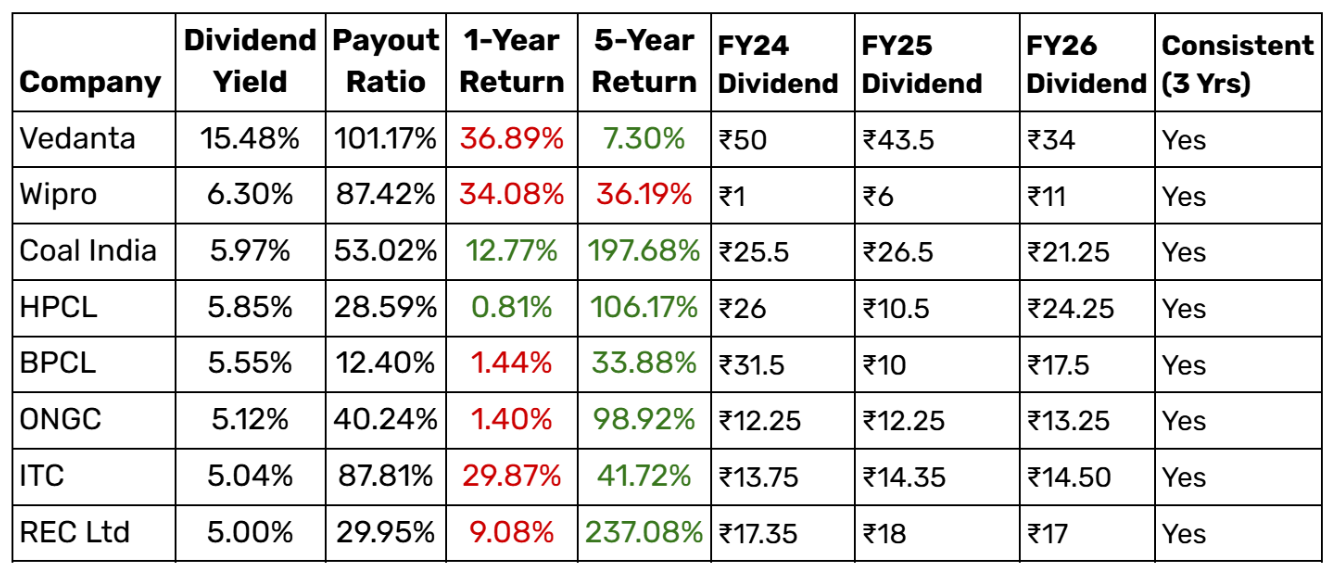
At a yield of 15.48%, Vedanta is the standout name on this list, though its payout ratio of 101.17% means dividends are currently exceeding reported earnings, which warrants close monitoring. The stock has declined 36.89% over the past year, while its five-year return of 7.30% reflects relatively modest long-term gains. Looking at the three-year dividend history, the company paid ₹50 in FY24, ₹43.5 in FY25, and ₹34 in FY26, consistently high, even if the absolute amount has been tapering. On the financials, Q4 FY26 was genuinely impressive: revenue rose 29% YoY to ₹51,524 crore, EBITDA grew 59% YoY to ₹18,447 crore, and net profit jumped 89% YoY to ₹9,352 crore. Total FY26 dividend payout stood at ₹34 per share.
Wipro is one of India's leading information technology services companies, offering a wide range of software, consulting, and business process solutions to clients across the globe. It has maintained a consistent dividend track record within the IT sector.
The 6.30% dividend yield and the 87.42% payout ratio make Wipro one of the better-paying dividend companies in the technology segment. What stands out from the three-year history is the trajectory: dividends rose from just ₹1 per share in FY24 to ₹6 in FY25 and ₹11 in FY26, a meaningful acceleration. Nevertheless, the share has returned -34.08% in the last year period and fallen by 36.19% in the last five-year period, indicating consistent underperformance of its stock price. The gross revenue in Q4 FY26 was ₹24,240 crore, growing 2.9% QoQ and 7.7% YoY.
Coal India is the world's largest coal producer and a key supplier to India's power, steel, and cement sectors, operating primarily as a government-owned enterprise. It has been one of the more reliable PSU dividend payers over the years.
With a yield of 5.97% and a payout ratio of 53.02%, Coal India sits at a more balanced position than most names on this list. The three-year history is reassuringly consistent: ₹25.5 in FY24, ₹26.5 in FY25, and ₹21.25 in interim payouts so far in FY26, with the final dividend still pending. Its five-year return of 197.68% is the second highest here, making it one of the strong all-round performers across both yield and capital appreciation. Q4 FY26 revenue came in at ₹46,490 crore, up 22.91% YoY and 33.12% QoQ. Net profit was ₹10,907.79 crore, up 13.71% YoY.
Hindustan Petroleum Corporation Limited is a government-owned oil refining and marketing company, operating two major refineries and a wide network of fuel retail outlets across India. It is one of the three listed downstream energy majors in the country.
HPCL's yield of 5.85% comes with a payout ratio of 28.59%, leaving meaningful room for the dividend to be sustained from earnings. The five-year return of 106.17% shows the significant re-rating the stock has seen. The three-year dividend history shows some variability: ₹26 in FY24, ₹10.5 in FY25, and ₹24.25 in FY26, largely reflecting swings in refining profitability across those years. Q4 FY26 revenue from operations was ₹1,23,602 crore, up 4.45% YoY. Net profit surged 77.6% YoY to ₹6,065.26 crore, driven by gross refining margins of $14.27 per barrel — sharply higher than $8.44 per barrel in Q4 FY25. The board recommended a final dividend of ₹19.25 per share.
Bharat Petroleum Corporation Limited is another government-owned downstream oil company, engaged in refining, fuel distribution, and natural gas marketing, with operations spanning across retail, LPG, and industrial segments. Like HPCL, it benefits from government ownership while operating in a margin-sensitive business.
BPCL offers a yield of 5.55% against a payout ratio of just 12.40%, the lowest among the energy names here, which suggests the dividend has strong earnings coverage. The stock has declined 1.44% over the past one year, but the five-year figure of 33.88% is more meaningful. The three-year dividend history reflects the sector's earnings volatility: ₹31.5 in FY24, ₹10 in FY25, and ₹17.5 in interim payouts so far in FY26, with the final yet to be declared. Q4 FY26 revenue from operations was ₹1,34,947.90 crore, up 6.33% YoY. Net profit rose 28.07% YoY to ₹5,624.54 crore, EBITDA grew 34.49% YoY to ₹8,035 crore.
Oil and Natural Gas Corporation is India's largest government-owned oil exploration and production company, with interests spanning upstream exploration, refining through subsidiaries, and petrochemicals. Its dividend payouts are closely watched, given the scale of government shareholding.
ONGC's dividend yield of 5.12% is on the basis of its dividend payout ratio of 40.24%. The five-year capital gain of 98.92% is indicative of almost doubling of its share price over the last five years. The three-year dividend history tells that story plainly: ₹12.25 per share in FY24, ₹12.25 in FY25, and ₹13.25 in FY26; near-identical for three consecutive years. The revenue from operations in Q4FY26 was ₹1,73,805 crore, which saw an increase of 3.6% YoY. The net profit grew by 52.6% YoY and came in at ₹13,678 crore due to the better performance of subsidiaries.
ITC is one of India's most diversified conglomerates, with businesses spanning cigarettes, FMCG, hotels, paperboards, and agri-products, making it one of the more resilient large-cap names on the domestic market. Its dividend history is long-standing. ITC's three-year dividend history is perhaps the cleanest on this list: ₹13.75 in FY24, ₹14.35 in FY25, and ₹14.50 in FY26, a slow, steady upward march that signals financial discipline rather than opportunistic payouts.
At a yield of 5.04% with a payout ratio of 87.81%, ITC is one of the few names here that has delivered meaningfully on both fronts: yield and price return. The stock has recorded a negative one-year return of 29.87%, while generating a healthy 41.72% return over the past five years. In Q4 FY26, consolidated net profit from continuing operations came in at ₹5,469.74 crore, with EBITDA rising 6.9% YoY. The board declared a final dividend of ₹8 per share, taking total FY26 dividend to ₹14.50 per share.
REC Limited is a government-owned non-banking financial company that provides long-term loans to the power sector, increasingly focused on renewable energy financing. It is one of the key conduits through which infrastructure lending flows in India's energy transition. The three-year dividend history shows consistent payments across FY24, FY25, and FY26, with the company maintaining a practice of regular interim distributions through the year.
REC's yield of 5.00% comes with a payout ratio of 29.95% and what is arguably the most impressive five-year return on this list at 237.08%. The Q4 FY26 headline numbers showed some pressure and net profit declined 21.69% YoY to ₹3,375.08 crore. However, the loan book reached an all-time high of ₹5.84 lakh crore, renewable energy loans grew 30% YoY to ₹75,347 crore, and net NPA remained near zero at 0.12%. Total FY26 dividend stands at ₹8.55 per share.
High dividend yield on its own tells only part of the story. Payout ratios, earnings quality, and the business cycle affecting each sector all matter before drawing any conclusions. The stocks above span mining, energy, technology, finance, and consumer goods, each with a different combination of yield, capital return, and financial health.
Source: Dalal Street Investment Journal, NSE, BSE.
SEBI Registered Research Analyst (INH000006396).
Founded in 1986, Dalal Street Investment Journal (DSIJ) brings decades of experience in India’s equity markets. DSIJ's research combines fundamental analysis with price action, guided by disciplined risk management and capital preservation. They follow a structured, data-driven approach designed to help investors and traders make informed decisions beyond short-term market noise.
Disclaimer :
Investments in the securities market are subject to market risk, read all related documents carefully before investing. This content is for educational purposes only. Securities quoted are exemplary and not recommendatory.
The information on this website is provided on "AS IS" basis. Bajaj Broking (BFSL) does not warrant the accuracy of the information given herein, either expressly or impliedly, for any particular purpose and expressly disclaims any warranties of merchantability or suitability for any particular purpose. While BFSL strives to ensure accuracy, it does not guarantee the completeness, reliability, or timeliness of the information. Users are advised to independently verify details and stay updated with any changes.
The information provided on this website is for general informational purposes only and is subject to change without prior notice. BFSL shall not be responsible for any consequences arising from reliance on the information provided herein and shall not be held responsible for all or any actions that may subsequently result in any loss, damage and or liability. Interest rates, fees, and charges etc., are revised from time to time, for the latest details please refer to our Pricing page.
Neither the information, nor any opinion contained in this website constitutes a solicitation or offer by BFSL or its affiliates to buy or sell any securities, futures, options or other financial instruments or provide any investment advice or service.
BFSL is acting as distributor for non-broking products/ services such as IPO, Mutual Fund, Insurance, PMS, and NPS. These are not Exchange Traded Products. For more details on risk factors, terms and conditions please read the sales brochure carefully before investing.
Content Partner - Dalal Street Investment Journal Wealth Advisory Private Limited
This article is for educational purposes only and should not be considered investment advice. Market investments are subject to risks. DSIJ Wealth Advisory Private Limited is a SEBI-registered Research Analyst (Reg. No: INH000006396) and Investment Adviser (Reg. No: INA000001142). Please consult your financial adviser before investing.
For more disclaimer, check here : https://www.bajajbroking.in/disclaimer
Level up your stock market experience: Download the Bajaj Broking App for effortless investing and trading

Open Your Free Demat Account
Enjoy low brokerage on delivery trades
|
Please Enter Mobile Number
Open Your Free Demat Account
Enjoy low brokerage on delivery trades
|


