
Get Free Demat Account*










Open Your Free Demat Account
Enjoy low brokerage on delivery trades
By Dalal Street Investment Journal (DSIJ)
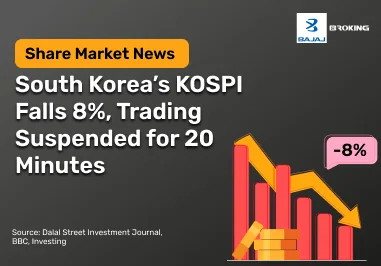
South Korea’s KOSPI index fell more than 8% on Monday, triggering a 20-minute trading halt to curb panic selling. The sharp decline was driven by a global technology stock sell-off, concerns over US interest rate hikes, and escalating Middle East tensions. Although the market recovered some losses later, investors remain cautious about further volatility in global markets.
The South Korean stock market faced a very difficult start to the week on Monday, 8 June 2026. On Monday morning, the KOSPI index saw a huge drop. The index fell by more than 8% just after the market opened. This massive fall caused a lot of worry among investors and forced the stock exchange to take quick action.
When you look at a flag pattern correctly, you stop chasing moves and start reading structure. You see where early participants pause, where late participants prepare, and where the market decides whether continuation still makes sense.
This is why the flag pattern shows up repeatedly across equities, indices, futures, and currency charts. It reflects how markets digest fast information before moving again.
To stop the panic, the Korea Exchange used a special safety tool called a circuit breaker. This tool automatically stops all trading when stock prices drop too fast. The exchange put a temporary trading halt on all KOSPI stocks for 20 minutes.
There are three main reasons why the market fell so hard on Monday.
The first reason is a big drop in technology stocks around the world. On Friday, 5 June 2026, technology shares in the United States fell sharply. This was especially true for companies that make computer chips and work with artificial intelligence. Because South Korea has some of the biggest chip making companies in the world, like Samsung and SK Hynix, the global tech drop hit the KOSPI very hard. These two big companies lost around 8-10% of their value in the morning.
The second reason for the fall is related to interest rates in the United States. New jobs data from the US showed that their economy is still very strong. Because of this, investors are now worried that the US central bank might raise interest rates or keep them high for a longer time. High interest rates make borrowing money more expensive for companies, which can hurt their growth and lower their stock prices.
The third reason is the rising trouble in the Middle East. Over the weekend, the situation got much worse. This made people around the world very worried.
According to the BBC, on Sunday, 7 June, Iran fired multiple missiles at Israel. The Iranian military said they would keep attacking for a whole week. This happened just a few hours after Israel hit targets in Beirut, Lebanon. Right after Iran's attack, Israel fired back at Iran.
This made investors scared that a bigger war might start again. Because of this fear, people began selling their stocks fast to keep their money safe.
This heavy selling quickly spread beyond South Korea and hit other markets in Asia on Monday morning. For example, the Nikkei 225 in Japan dropped over 4%, while the Nifty 50 in India fell around 1%, reflecting the broader sell-off across Asian markets.
Fortunately, trading in the KOSPI was temporarily paused to ease some of the panic. After the 20-minute trading halt ended, the market opened again. Some buyers returned to the market to buy stocks at lower prices. This helped the KOSPI recover from its worst point of the morning. By midday, the index was down by around 5% instead of the earlier 8% drop.
Even though the market recovered a little bit, the day showed how quickly global events can affect local markets. The Korea Exchange held an emergency meeting on Monday morning to watch the situation closely. They want to make sure the market stays stable in the coming days. Investors will continue to watch US interest rates and global events to see where the market goes next.
Source: Dalal Street Investment Journal, BBC, Investing
SEBI Registered Research Analyst (INH000006396).
Founded in 1986, Dalal Street Investment Journal (DSIJ) brings decades of experience in India’s equity markets. DSIJ's research combines fundamental analysis with price action, guided by disciplined risk management and capital preservation. They follow a structured, data-driven approach designed to help investors and traders make informed decisions beyond short-term market noise.

Disclaimer :
Investments in securities market are subject to market risk, read all related documents carefully before investing. This content is for educational purposes only. Securities quoted are exemplary and not recommendatory.
The information on this website is provided on "AS IS" basis. Bajaj Broking (BFSL) does not warrant the accuracy of the information given herein, either expressly or impliedly, for any particular purpose and expressly disclaims any warranties of merchantability or suitability for any particular purpose. While BFSL strives to ensure accuracy, it does not guarantee the completeness, reliability, or timeliness of the information. Users are advised to independently verify details and stay updated with any changes.
The information provided on this website is for general informational purposes only and is subject to change without prior notice. BFSL shall not be responsible for any consequences arising from reliance on the information provided herein and shall not be held responsible for all or any actions that may subsequently result in any loss, damage and/or liability. Interest rates, fees, and charges etc., are revised from time to time, for the latest details please refer to our Pricing page.
Neither the information, nor any opinion contained in this website constitutes a solicitation or offer by BFSL or its affiliates to buy or sell any securities, futures, options or other financial instruments or provide any investment advice or service.
BFSL is acting as distributor for non-broking products/ services such as IPO, Mutual Fund, Insurance, PMS, and NPS. These are not Exchange Traded Products. For more details on risk factors, terms and conditions please read the sales brochure carefully before investing.
Content Partner - Dalal Street Investment Journal Wealth Advisory Private Limited
This article is for educational purposes only and should not be considered investment advice. Market investments are subject to risks. DSIJ Wealth Advisory Private Limited is a SEBI-registered Research Analyst (Reg. No: INH000006396) and Investment Adviser (Reg. No: INA000001142). Please consult your financial adviser before investing.
For more disclaimer, check here : https://www.bajajbroking.in/disclaimer
Level up your stock market experience: Scan the QR to download the Bajaj Broking App for effortless investing and trading

Enjoy low brokerage on delivery trades
|
Open Your Free Demat Account
Enjoy low brokerage on delivery trades
|


