













Open Your Free Demat Account
Enjoy low brokerage on delivery trades
By Dalal Street Investment Journal (DSIJ)
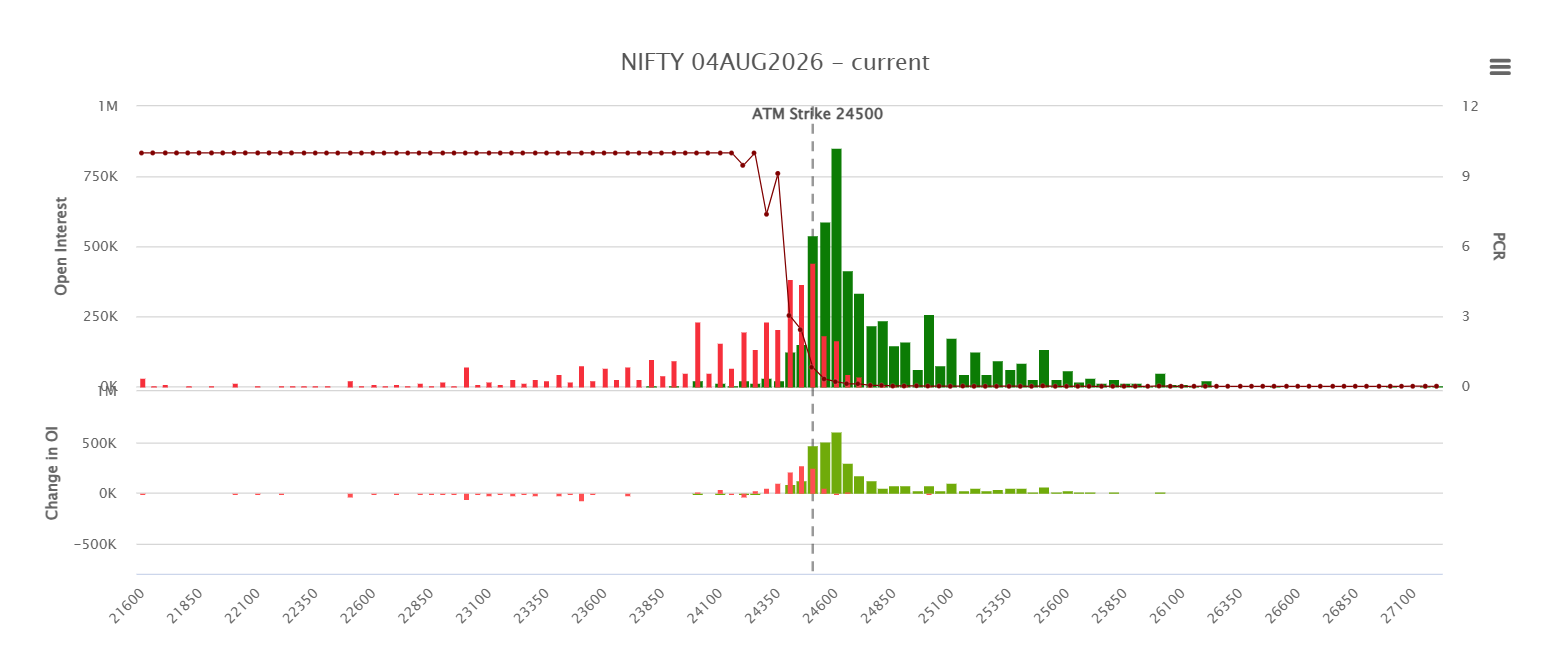
Nifty remained under pressure during the afternoon session of the weekly expiry, trading below the 24,500 mark. The PCR remained at 0.71, while max pain continued at 24,500. Strong call writing at 24,550–24,600 continued to cap the upside, while put writers defended the 24,500 level. A sustained break on either side could determine the next move into the closing hours of trade.
The Nifty 50 extended its intraday decline and slipped below the 24,500 mark during the afternoon session.
In the morning, the index was trading below 24,600. Derivatives positioning had indicated immediate resistance at 24,600, while 24,500 was emerging as the principal support.
The latest price action shows that call writers have maintained their hold, and the index is trading marginally below the 24,500 level.
The put-call ratio (PCR) remained unchanged at 0.71. The stable PCR indicates that call open interest remains higher than put open interest.
This reflects a cautious market setup, with the overall derivatives positioning remaining largely unchanged from the morning session. As the Nifty trades below the 24,500 mark, expectations of a strong expiry recovery remain limited.
The maximum pain level remained unchanged at 24,500.
The unchanged max pain suggests that there has been no major shift in options positioning during the afternoon session. The 24,500 level remains the central expiry pivot and is likely to attract close attention in the remaining hours of trade.
On the call side, the 24,600 strike has witnessed the highest open interest addition and currently holds the highest concentration of call open interest.
The 24,550 strike has also seen significant call writing during the session. This confirms that the 24,550–24,600 zone remains the immediate resistance for the weekly expiry.
A sustained move above this zone would be required to weaken the current resistance and improve the chances of a late recovery.
On the put side, the 24,500 strike continues to hold the highest concentration of put open interest, making it the principal support for the weekly expiry.
The 24,450 strike has seen the highest open interest addition during the session, while the 24,400 strike has the next-highest concentration of put open interest.
This keeps 24,500 as the immediate support for the weekly expiry. Put writers continue to defend 24,500, while call writers continue to restrict the index near 24,550–24,600.
The derivatives setup remains weak compared with the morning session. The PCR remained at 0.71, while max pain continued at 24,500. Call writers continued to cap the upside near 24,550–24,600, while put writers defended 24,500.
A sustained break below 24,500 could trigger put unwinding and expose the index to the 24,450–24,400 zone. Conversely, a sustained move above 24,600 could trigger call unwinding and improve the chances of a late recovery into the weekly expiry close.
The Nifty 50 began the weekly expiry session on Tuesday, August 4, 2026, on a weaker footing after posting a strong rally in the previous session. On Monday, the index surged 390.70 points, or 1.60%, to close at 24,774.30 after touching an intraday high of 24,774.30 and a low of 24,515.15. However, sentiment reversed on Tuesday as the index slipped to an intraday low of 24,569.00 after opening at 24,703.90. At the time of writing, it was trading 184.20 points lower at 24,590.10, down 0.74% from the previous close.
The decline has pulled the index below the psychologically important 24,600 level. Monday's rally was followed by a weaker session ahead of the weekly expiry, while derivatives positioning suggests the market is approaching an important equilibrium zone.
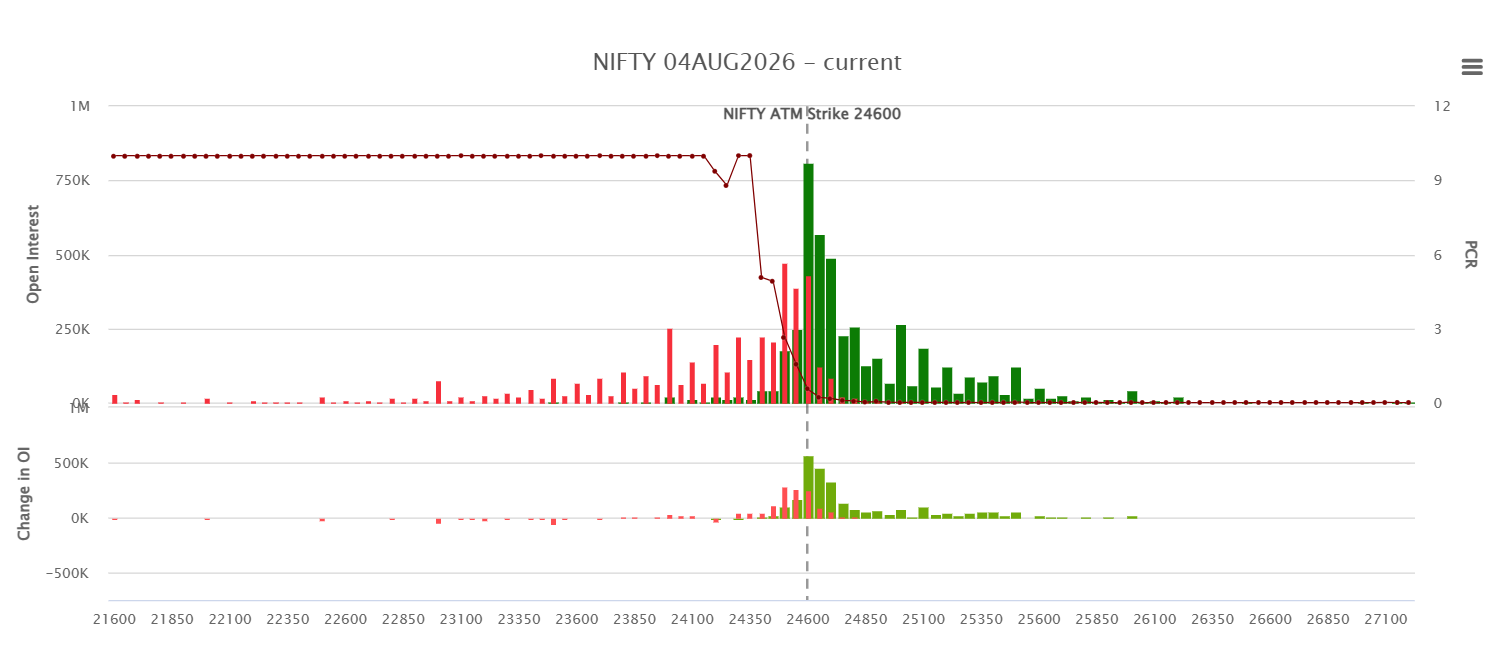
The put-call ratio (PCR) stands at 0.91, indicating relatively heavier positioning on the call side. The maximum pain level is placed at 24,600, which is also emerging as the central pivot for the expiry session.
Fresh call open interest has been added at the 24,600, 24,650 and 24,700 strikes. The highest call open interest is concentrated at 24,600, followed by 24,650 and 24,700, making the 24,600-24,700 zone the immediate resistance area.
The index is currently trading below this resistance band as defined by open interest concentration which stands at 24,600-24,700 and below the maximum pain level. As long as Nifty remains below 24,600-24,700, call writers are expected to retain the upper hand and restrict meaningful upside. Repeated failures near this zone would strengthen the resistance and could invite further selling pressure.
The mildly bearish derivatives positioning could change quickly if Nifty reclaims 24,600 and sustains beyond 24,650.
Such a breakout would place call writers at 24,600 and 24,650 under pressure. A round of short-covering could then accelerate the move towards 24,700 and higher levels.
For the breakout to remain credible, the index must sustain above 24,600 rather than merely registering an intraday spike. A sustained move above the resistance band would indicate that buyers have regained control despite the weaker start to the session.
On the put side, fresh open interest has added at the 24,500, 24,550 and 24,600 strikes. The highest put open interest is concentrated at 24,500, followed by 24,600 and 24,550.
This makes 24,500 the immediate derivatives-based support for the expiry session. As long as the Nifty remains above this level, the concentration of open interest is expected to cushion the downside.
A break below 24,500 would weaken the near-term structure and could lead to put unwinding, exposing the index to lower levels for the remainder of the expiry session.
The Nifty is currently positioned between strong call writing at 24,600-24,700 and put writing at around 24,500-24,600. This creates a well-defined expiry range.
Below 24,600, the bias remains mildly negative, with 24,500 acting as the key downside level. Above 24,650, the balance could shift in favour of buyers, opening the way to 24,700.
Until either boundary is crossed decisively, the index may remain volatile but largely range-bound around the 24,600 maximum pain level through the weekly expiry.
Source: Dalal Street Investment Journal (DSIJ), NSE
SEBI Registered Research Analyst (INH000006396).
Founded in 1986, Dalal Street Investment Journal (DSIJ) brings decades of experience in India’s equity markets. DSIJ's research combines fundamental analysis with price action, guided by disciplined risk management and capital preservation. They follow a structured, data-driven approach designed to help investors and traders make informed decisions beyond short-term market noise.

Disclaimer :
Investments in securities market are subject to market risk, read all related documents carefully before investing. This content is for educational purposes only. Securities quoted are exemplary and not recommendatory.
The information on this website is provided on "AS IS" basis. Bajaj Broking (BFSL) does not warrant the accuracy of the information given herein, either expressly or impliedly, for any particular purpose and expressly disclaims any warranties of merchantability or suitability for any particular purpose. While BFSL strives to ensure accuracy, it does not guarantee the completeness, reliability, or timeliness of the information. Users are advised to independently verify details and stay updated with any changes.
The information provided on this website is for general informational purposes only and is subject to change without prior notice. BFSL shall not be responsible for any consequences arising from reliance on the information provided herein and shall not be held responsible for all or any actions that may subsequently result in any loss, damage and/or liability. Interest rates, fees, and charges etc., are revised from time to time, for the latest details please refer to our Pricing page.
Neither the information, nor any opinion contained in this website constitutes a solicitation or offer by BFSL or its affiliates to buy or sell any securities, futures, options or other financial instruments or provide any investment advice or service.
BFSL is acting as distributor for non-broking products/ services such as IPO, Mutual Fund, Insurance, PMS, and NPS. These are not Exchange Traded Products. For more details on risk factors, terms and conditions please read the sales brochure carefully before investing.
Content Partner - Dalal Street Investment Journal Wealth Advisory Private Limited
This article is for educational purposes only and should not be considered investment advice. Market investments are subject to risks. DSIJ Wealth Advisory Private Limited is a SEBI-registered Research Analyst (Reg. No: INH000006396) and Investment Adviser (Reg. No: INA000001142). Please consult your financial adviser before investing.
For more disclaimer, check here : https://www.bajajbroking.in/disclaimer
Level up your stock market experience: Scan the QR to download the Bajaj Broking App for effortless investing and trading

Enjoy low brokerage on delivery trades
|
Open Your Free Demat Account
Enjoy low brokerage on delivery trades
|


