








Open Your Free Demat Account
Enjoy low brokerage on delivery trades
By Dalal Street Investment Journal (DSIJ)
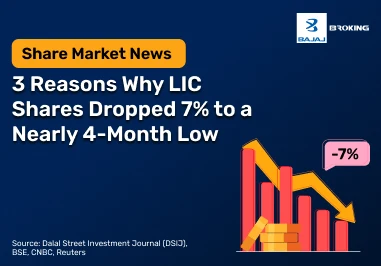
LIC share price fell 7% to ₹397.85 on August 4, 2026, hitting a nearly four-month low. The decline followed the government's discounted ₹382 offer for sale (OFS), concerns over the insurer's declining market share despite strong FY26 earnings, and investor caution ahead of its Q1 FY27 results, which are scheduled to be announced on August 6.
Life Insurance Corporation of India (LIC) share price was trading at ₹397.85 on August 4, 2026, down 7% for the day and hitting its weakest level in nearly four months. Trading volume surged to 157 lakh shares, well above the 30-day average of 32 lakh shares. The sharp selloff followed the government's announcement, late on Monday, of a large stake sale in the country's largest insurer at a significant discount to the prevailing market price.
The Department of Investment and Public Asset Management (DIPAM) announced on Monday evening that the government will offload up to a 6.5% stake in LIC through a two-day offer for sale (OFS). The floor price has been fixed at ₹382 per share, approximately 10% below LIC's closing price of ₹424.35 on the BSE on Monday. DIPAM Secretary Arunish Chawla confirmed the terms publicly, noting that the stake sale would help the government achieve its minimum public shareholding (MPS) milestones ahead of schedule.
According to the announcement, the offer comprises a base divestment of 2.5% of LIC's equity, with an additional 4% available through a green shoe option in case of oversubscription. A green shoe provision gives the seller the flexibility to sell shares beyond the base offer size if investor demand is strong. Combined, the two tranches allow a maximum divestment of 6.5%, involving over 82.22 crore shares. If fully subscribed at the floor price, the government stands to collect about ₹31,000 crore.
The OFS opened for institutional and other non-retail investors on August 4, with the retail window scheduled for August 5. This staggered structure, non-retail first, followed by retail, is standard for most government OFS transactions, as it allows the institutional book to be assessed before retail demand is measured.
The timing of the OFS is driven primarily by SEBI's listing requirements. The government currently holds 96.5% of LIC, having sold a 3.5% stake via the insurer's initial public offering in May 2022 at a price band of ₹902–₹949 per share, one of the largest share issues in Indian capital markets at the time, raising about ₹21,000 crore.
Under SEBI rules, LIC must bring its public shareholding to at least 10% by May 2027. Public float currently stands at 3.5%. If this OFS is fully subscribed, it will raise public ownership to exactly 10%, thereby meeting the near-term regulatory requirement. The government also carries a longer obligation to reduce its stake in LIC to 75% by 2032, in line with broader MPS norms applicable to listed companies.
So far in the current fiscal year, the government has raised ₹21,082 crore through stake sales in seven public sector undertakings and remittances from the Specified Undertaking of the Unit Trust of India (SUUTI), according to DIPAM data.
LIC's FY26 full-year results, announced in May 2026, showed a strong headline. Net profit rose 19.25% YoY to ₹57,419 crore, while total premium income grew 9.80% YoY to ₹5,35,984 crore. Individual new business premium climbed 8.29% YoY to ₹67,676 crore, and assets under management expanded 5.08% YoY to ₹57,29,396 crore. The solvency ratio improved to 2.35 from 2.11, and the gross NPA ratio tightened to 1.21% from 1.46%, both positive signals on financial stability.
However, a closer look at the annual numbers flags a few concerns. LIC's share of the life insurance market by premium income slipped from 57.05% to 56.66%, and its share by number of policies fell from 65.83% to 65.16%, a pattern that suggests private insurers continue to narrow the gap. The insurer's Indian Embedded Value (IEV) grew only 1.58% YoY, adding ₹12,309 crore from March 2025 to March 2026, a modest rate of embedded value accretion that may have tempered market enthusiasm even as the profit line held up.
LIC's board is scheduled to meet on August 6, 2026, to consider Q1 FY27 results. Adding to the uncertainty, 10-year government bond yields have moved higher since the close of FY26 typically acts as a headwind for the value of new business (VNB) margins, which are a key measure of profitability in the life insurance industry.
Life Insurance Corporation of India is the country's largest life insurer, holding over 56% of the market by premium income. Founded in 1956 following the nationalisation of private insurance companies, LIC offers a range of individual and group life insurance products, as well as savings and pension plans.
Source: Dalal Street Investment Journal (DSIJ), BSE, CNBC, Reuters
SEBI Registered Research Analyst (INH000006396).
Founded in 1986, Dalal Street Investment Journal (DSIJ) brings decades of experience in India’s equity markets. DSIJ's research combines fundamental analysis with price action, guided by disciplined risk management and capital preservation. They follow a structured, data-driven approach designed to help investors and traders make informed decisions beyond short-term market noise.
Disclaimer :
Investments in securities market are subject to market risk, read all related documents carefully before investing. This content is for educational purposes only. Securities quoted are exemplary and not recommendatory.
The information on this website is provided on "AS IS" basis. Bajaj Broking (BFSL) does not warrant the accuracy of the information given herein, either expressly or impliedly, for any particular purpose and expressly disclaims any warranties of merchantability or suitability for any particular purpose. While BFSL strives to ensure accuracy, it does not guarantee the completeness, reliability, or timeliness of the information. Users are advised to independently verify details and stay updated with any changes.
The information provided on this website is for general informational purposes only and is subject to change without prior notice. BFSL shall not be responsible for any consequences arising from reliance on the information provided herein and shall not be held responsible for all or any actions that may subsequently result in any loss, damage and/or liability. Interest rates, fees, and charges etc., are revised from time to time, for the latest details please refer to our Pricing page.
Neither the information, nor any opinion contained in this website constitutes a solicitation or offer by BFSL or its affiliates to buy or sell any securities, futures, options or other financial instruments or provide any investment advice or service.
BFSL is acting as distributor for non-broking products/ services such as IPO, Mutual Fund, Insurance, PMS, and NPS. These are not Exchange Traded Products. For more details on risk factors, terms and conditions please read the sales brochure carefully before investing.
Content Partner - Dalal Street Investment Journal Wealth Advisory Private Limited
This article is for educational purposes only and should not be considered investment advice. Market investments are subject to risks. DSIJ Wealth Advisory Private Limited is a SEBI-registered Research Analyst (Reg. No: INH000006396) and Investment Adviser (Reg. No: INA000001142). Please consult your financial adviser before investing.
For more disclaimer, check here : https://www.bajajbroking.in/disclaimer
Level up your stock market experience: Scan the QR to download the Bajaj Broking App for effortless investing and trading

Enjoy low brokerage on delivery trades
|
Open Your Free Demat Account
Enjoy low brokerage on delivery trades
|


