
Get Free Demat Account*










Open Your Free Demat Account
Enjoy low brokerage on delivery trades
By Dalal Street Investment Journal (DSIJ)
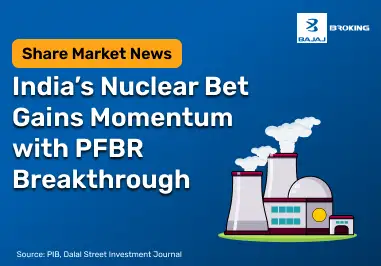
India has entered a new phase in its nuclear journey with the successful criticality of the Prototype Fast Breeder Reactor at Kalpakkam in Tamil Nadu. This milestone advances the second stage of its three-stage programme, aimed at long-term energy security. Once fully operational, India will become only the second country in the world after Russia to operate a commercial fast breeder reactor.
India has taken strong steps in its nuclear journey. As per PIB, the nuclear generation capacity of India is currently estimated at 8.78 gigawatts. For the fiscal year 2024-25, nuclear power plants have produced 56,681 million units of electricity.
In this broader energy mix, nuclear power plays a crucial role in ensuring a steady and uninterrupted electricity supply. Unlike solar or wind energy, which depend heavily on weather conditions, nuclear power plants operate continuously and provide reliable base load power. This reliability makes nuclear energy an important pillar as India works to meet rising demand without compromising on climate commitments.
But meeting the needs of a population of over 1.47 billion, while staying aligned with global climate goals, will require sustained investment and careful planning. Being the third-largest consumer of energy globally, following the US and China, India must not confine itself to one option for its energy transition. Instead, India’s future hinges on developing a diversified energy portfolio capable of achieving economies of scale, resilience, and sustainability.
In this regard, the government has set forth an ambitious plan for the Nuclear Energy Mission, highlighted in the Union Budget 2025-26. Under this plan, India’s nuclear capacity would be increased to 22.38 GW by 2031-32. Such growth would take place through the construction of indigenous 700 MW plants as well as large nuclear units with the help of foreign collaborators. The country already has a total of 18 nations who have entered into civil nuclear cooperation with India.
In the context of the sustained development and planned long-term policy, there was one important achievement made by the country on April 6, 2026. India's indigenously developed Prototype Fast Breeder Reactor (PFBR) located at Kalpakkam in Tamil Nadu reached its criticality. Criticality is basically the state when the nuclear reactor starts operating on its own.
This is important for a number of reasons. It marks India’s official arrival at the second stage of its three-stage programme for harnessing nuclear power.
This is significant because it is not just about adding another reactor to the grid. It signals India’s formal entry into the second stage of its three-stage nuclear power programme. This ambitious long-term vision had been outlined by Homi Jehangir Bhabha, who saw that India’s small supply of uranium and large deposits of thorium needed a different plan. With this milestone, that vision has moved closer to reality.
The PFBR is a 500 MWe reactor built by Bharatiya Nabhikiya Vidyut Nigam Ltd (BHAVINI) at the Kalpakkam Nuclear Complex. What makes this reactor special is the fact that it produces more fuel than it uses. This single feature makes it an important part of India's long-term energy security strategy. Once fully operational, India will be the second nation to use a commercial fast breeder reactor, apart from Russia.
In order to appreciate the significance of this accomplishment, it is necessary to take into consideration the nature of India’s nuclear programme. India lacks significant resources of uranium, which is required for a typical nuclear reactor. But what India possesses is that it owns one of the biggest reserves of thorium in the world. This difference helps India to shape a unique three-stage strategy.
In the first stage, Pressurised Heavy Water Reactors use natural uranium as fuel. These reactors generate electricity. But more importantly, these reactors produce plutonium in the process. Instead of considering it as a waste, India goes ahead and reprocesses it to use it as fuel for its second stage reactors. This brings us to PFBR.
The second stage revolves around Fast Breeder Reactors. These reactors use plutonium-based fuel and are designed to “breed” more fissile material. As far as the PFBR is concerned, fast neutrons convert Uranium-238 into Plutonium-239. So while producing energy, these reactors help create fuel stock for future reactors. It serves as a link between the first and third stages.
Thirdly, we have reactors based on thorium and using them to produce Uranium-233 which will serve as the fuel source. Thorium is available in abundance in India. This offers great potential in achieving energy self-sufficiency. The PFBR works as a bridge between the first and third stages.
However, the aspirations of India go beyond this. As per the mission on Nuclear Energy proposed in the Union Budget 2025-26, the Indian government is planning to achieve the production of 100 GW of nuclear power by 2047, which is part of their plan to become net-zero by 2070. What started out as an ambitious plan for India some years back is finally beginning to materialise. The PFBR stands right at the heart of this progress from past to future. If planned properly, it may change the way India looks at fulfilling its energy requirements.
SEBI Registered Research Analyst (INH000006396).
Founded in 1986, Dalal Street Investment Journal (DSIJ) brings decades of experience in India’s equity markets. DSIJ's research combines fundamental analysis with price action, guided by disciplined risk management and capital preservation. They follow a structured, data-driven approach designed to help investors and traders make informed decisions beyond short-term market noise.

Disclaimer :
Investments in securities market are subject to market risk, read all related documents carefully before investing. This content is for educational purposes only. Securities quoted are exemplary and not recommendatory.
The information on this website is provided on "AS IS" basis. Bajaj Broking (BFSL) does not warrant the accuracy of the information given herein, either expressly or impliedly, for any particular purpose and expressly disclaims any warranties of merchantability or suitability for any particular purpose. While BFSL strives to ensure accuracy, it does not guarantee the completeness, reliability, or timeliness of the information. Users are advised to independently verify details and stay updated with any changes.
The information provided on this website is for general informational purposes only and is subject to change without prior notice. BFSL shall not be responsible for any consequences arising from reliance on the information provided herein and shall not be held responsible for all or any actions that may subsequently result in any loss, damage and/or liability. Interest rates, fees, and charges etc., are revised from time to time, for the latest details please refer to our Pricing page.
Neither the information, nor any opinion contained in this website constitutes a solicitation or offer by BFSL or its affiliates to buy or sell any securities, futures, options or other financial instruments or provide any investment advice or service.
BFSL is acting as distributor for non-broking products/ services such as IPO, Mutual Fund, Insurance, PMS, and NPS. These are not Exchange Traded Products. For more details on risk factors, terms and conditions please read the sales brochure carefully before investing.
Content Partner - Dalal Street Investment Journal Wealth Advisory Private Limited
This article is for educational purposes only and should not be considered investment advice. Market investments are subject to risks. DSIJ Wealth Advisory Private Limited is a SEBI-registered Research Analyst (Reg. No: INH000006396) and Investment Adviser (Reg. No: INA000001142). Please consult your financial adviser before investing.
For more disclaimer, check here : https://www.bajajbroking.in/disclaimer
Level up your stock market experience: Scan the QR to download the Bajaj Broking App for effortless investing and trading

Enjoy low brokerage on delivery trades
|
Open Your Free Demat Account
Enjoy low brokerage on delivery trades
|


