
Get Free Demat Account*










Open Your Free Demat Account
Enjoy low brokerage on delivery trades
By Dalal Street Investment Journal (DSIJ)
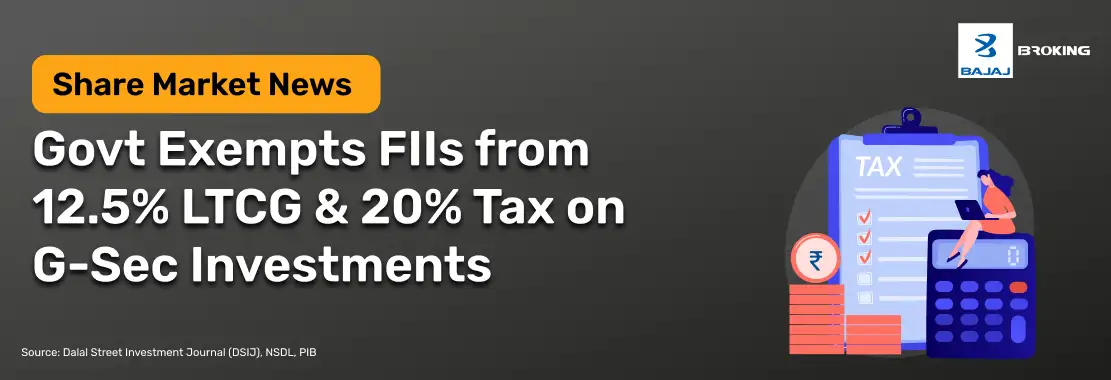
The Union Cabinet has approved an ordinance amending the Income Tax Act to exempt foreign portfolio investors from 12.5% long-term capital gains tax and 20% withholding tax on interest income from government securities. The move, effective April 1, 2026, comes amid sustained foreign capital outflows from equities and aims to attract long-term overseas investment into India’s government debt market.
The Union Cabinet, chaired by Prime Minister Narendra Modi, approved an ordinance this week that removes the long-term capital gains tax applicable to foreign portfolio investors on their holdings in government securities. Along with this, the 20% withholding tax on interest income that these investors earn from such securities has also been done away with.
The ordinance works through an amendment to the Income Tax Act and came into force immediately, without requiring Parliament to be in session. The benefit applies from April 1, 2026, and covers all interest income and capital gains arising on or after that date from investments in government securities. The Bank for International Settlements has been included in this exemption as well.
Until this ordinance came through, foreign portfolio investors were required to pay a 12.5% long-term capital gains tax on listed bonds they held for more than 12 months. On top of this, a 20% withholding tax applied to the interest income they earned from government bonds.
It is worth noting that the government had already removed a concessional 5% withholding tax rate that was available to these investors back in 2023. The net effect of both taxes together was that the post-tax return on Indian government securities was noticeably lower than what comparable instruments in other markets offered, which made it harder to attract the kind of patient, long-tenure capital that India's debt market needs.
The timing of this decision is closely tied to what has been happening with foreign capital flows over the past several months. Foreign investors have pulled out ₹2.6 lakh crore from Indian equities so far in 2026, a figure that already exceeds the total outflow of ₹1.66 lakh crore seen through all of 2025. In just the first five days of June, the outflow from equities stood at ₹38,852 crore, adding pressure on the rupee. On the debt side, foreign investors have put in over ₹17,000 crore through the Fully Accessible Route, suggesting there is some appetite for Indian fixed-income instruments when the conditions are right.
The broader global backdrop has not been easy either, with crude oil prices staying elevated, geopolitical tensions persisting, and markets in many parts of the world remaining unsettled. The government's decision to use the ordinance route is consistent with what it did in 2019, when corporate tax rates were cut through the same mechanism to push private investment at a time when the economy needed a boost.
The tax change was not the only move announced on this front. The government also simplified how foreign portfolio investors can access government securities under the General Route. Three restrictions that were previously in place, covering short-term investment limits, concentration limits, and security-wise limits, have been removed. The overall cap of 6% of outstanding central government securities and 2% of state government securities remains in place.
Additionally, the earlier distinction between 'general' and 'long-term' sub-categories of investment limits has been collapsed into a single unified limit. For fund managers dealing with large allocations across multiple markets, these kinds of operational constraints matter; removing them reduces the friction involved in building meaningful positions in Indian sovereign debt.
The government's ordinance landed on the same day as the Reserve Bank of India's Monetary Policy Committee decision. The MPC voted unanimously to hold the benchmark repo rate under the Liquidity Adjustment Facility at 5.25%, with the Standing Deposit Facility rate kept at 5%. The RBI also announced that investment limits for Non-Resident Indians and Overseas Citizens of India in Indian equity markets would be raised, and that this facility would no longer require SEBI registration.
The plan is to extend the same arrangement to all individual Persons Resident Outside India, putting them on the same footing as NRIs and OCIs. Separately, the RBI has permitted certain long-tenor sovereign bonds to be designated as fully accessible, with no cap on overseas purchases. The last time such a change was made to this list was in 2024, when 14-year and 30-year bonds were removed from it.
Taken together, these steps are aimed at making the Indian government securities market a more viable destination for long-term foreign capital, including from pension funds, insurance companies, and sovereign wealth funds. The tax alignment with what several other major markets already offer has been a long-standing ask from the industry, and getting it done through the ordinance route means it does not have to wait for the Union Budget. A smoother yield curve and steadier inflows over time are the expected outcomes if the measures succeed in drawing in the kind of patient institutional money they are designed to attract. Whether that happens will depend partly on how global conditions evolve and how quickly overseas fund managers are able to act on the new framework.
Source: Dalal Street Investment Journal (DSIJ), NSDL, PIB
Disclaimer :
Investments in securities market are subject to market risk, read all related documents carefully before investing. This content is for educational purposes only. Securities quoted are exemplary and not recommendatory.
The information on this website is provided on "AS IS" basis. Bajaj Broking (BFSL) does not warrant the accuracy of the information given herein, either expressly or impliedly, for any particular purpose and expressly disclaims any warranties of merchantability or suitability for any particular purpose. While BFSL strives to ensure accuracy, it does not guarantee the completeness, reliability, or timeliness of the information. Users are advised to independently verify details and stay updated with any changes.
The information provided on this website is for general informational purposes only and is subject to change without prior notice. BFSL shall not be responsible for any consequences arising from reliance on the information provided herein and shall not be held responsible for all or any actions that may subsequently result in any loss, damage and/or liability. Interest rates, fees, and charges etc., are revised from time to time, for the latest details please refer to our Pricing page.
Neither the information, nor any opinion contained in this website constitutes a solicitation or offer by BFSL or its affiliates to buy or sell any securities, futures, options or other financial instruments or provide any investment advice or service.
BFSL is acting as distributor for non-broking products/ services such as IPO, Mutual Fund, Insurance, PMS, and NPS. These are not Exchange Traded Products. For more details on risk factors, terms and conditions please read the sales brochure carefully before investing.
Content Partner - Dalal Street Investment Journal Wealth Advisory Private Limited
This article is for educational purposes only and should not be considered investment advice. Market investments are subject to risks. DSIJ Wealth Advisory Private Limited is a SEBI-registered Research Analyst (Reg. No: INH000006396) and Investment Adviser (Reg. No: INA000001142). Please consult your financial adviser before investing.
For more disclaimer, check here : https://www.bajajbroking.in/disclaimer
Level up your stock market experience: Scan the QR to download the Bajaj Broking App for effortless investing and trading

Enjoy low brokerage on delivery trades
|
Open Your Free Demat Account
Enjoy low brokerage on delivery trades
|


