
Get Free Demat Account*












Open Your Free Demat Account
Enjoy low brokerage on delivery trades
By Dalal Street Investment Journal (DSIJ)
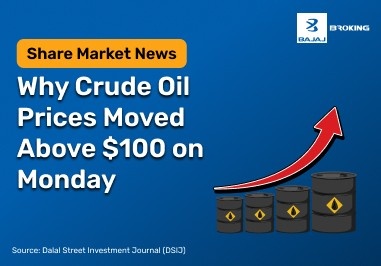
Indian stock markets crashed on Monday after US-Iran talks collapsed and Trump threatened a Strait of Hormuz blockade, reviving fears of supply disruption. Crude oil prices climbed above $100, hurting sentiment in oil-import dependent India. CENTCOM later clarified that its forces would not impede vessels transiting the Strait of Hormuz to and from non-Iranian ports.
The weekend peace talks in Pakistan ended without a deal between the US and Iran. By Monday morning, crude oil prices climbed sharply when Asian markets opened, and financial markets turned cautious.
Brent crude rose 7.3% to $102.30 a barrel. West Texas Intermediate was up 8.7%, trading at $104.94. Oil was sitting at around $72 a barrel before the conflict began on February 28.
The talks in Islamabad drew attention from governments, businesses, and markets worldwide. The hope was that a permanent arrangement could follow the conditional two-week ceasefire agreed on last Wednesday-one that included the reopening of the Strait of Hormuz, the narrow waterway through which roughly one-fifth of the world's energy shipments pass every day.
When that ceasefire was announced, Brent crude fell to around $90 a barrel on April 8, and domestic stock markets bounced back, as the Nifty 50 & Sensex recovered by nearly 4%.
The weekend talks stretched to 21 hours without reaching an agreement. The American side said Iran refused to give up its nuclear weapons programme, while Iranian sources described Washington's demands as excessive. With neither party offering a clear path to resuming negotiations, the fragile optimism that had built up during the week evaporated.
After the negotiations failed to reach a conclusion, in the opening session of the week, both the Nifty and the Sensex fell by nearly 2%.
US President Donald Trump posted on Sunday that the United States would begin blockading all ships trying to enter or leave the Strait of Hormuz. US Central Command (CENTCOM) confirmed the blockade of traffic entering and exiting Iranian ports would begin at 10:00 ET on Monday, enforced against vessels of all nationalities. CENTCOM later clarified that its forces would not impede vessels transiting the Strait of Hormuz to and from non-Iranian ports, appearing to narrow Trump’s earlier warning that “any and all ships” would be blocked. This distinction is important for countries like India, which rely heavily on shipping routes through the region.
“The blockade will be enforced impartially against vessels of all nations entering or departing Iranian ports and coastal areas, including all Iranian ports on the Arabian Gulf and Gulf of Oman,” US Central Command (CENTCOM) said in a post on X on Sunday (April 12, 2026).
“CENTCOM forces will not impede freedom of navigation for vessels transiting the Strait of Hormuz to and from non-Iranian ports,” it added, appearing to walk back President Donald Trump’s earlier post in which he said “any and all Ships” would be blocked.
Iran's response was firm. Its parliamentary speaker said the country would not submit to threats. The Islamic Revolutionary Guard Corps warned that any military vessels approaching the strait would be considered to have violated the ceasefire. An Iranian deputy parliament speaker added that the Strait of Hormuz is completely under Iranian control and that tolls must be paid in rials (Iranian Currency) — a demand that creates its own complications for international shippers.
The Strait of Hormuz is the route through which a large share of the world's oil and gas physically travels from producer to consumer. Since the conflict started in late February, shipments have largely been at a standstill. Three supertankers managed to pass through during the ceasefire on Saturday, the first vessels to exit the Gulf since the truce — but that window now looks uncertain again.
Countries in Asia have been particularly affected. Japan, South Korea, India, and China depend heavily on Middle Eastern oil. On Monday morning, Japan's Nikkei 225 fell 1% and South Korea's Kospi dropped 0.8%. US stock futures also pointed to a weaker Wall Street opening.
The impact of reduced oil supplies from the Middle East is now becoming clearly visible. Ship traffic through the Strait of Hormuz continues to remain well below normal levels, reflecting ongoing disruptions. As highlighted by Sultan Al Jaber, CEO of the Abu Dhabi National Oil Company, shipments that had departed before the conflict are only now reaching their destinations. This indicates that the global market is finally experiencing the real effects of the roughly 40-day disruption in energy flows.
To manage the supply problem, major Asian economies which are heavily dependent on Middle Eastern energy are turning to alternative sources. India has significantly increased its crude imports from Venezuela, with around 6 million barrels shipped in just the first week of April which is almost twice the volume seen during the same period in March. Japan, on the other hand, is sourcing oil from the United States and using smaller vessels via the Panama Canal to speed up deliveries. Meanwhile, China has ramped up its purchases from Canada to record levels. For refiners across these countries, the focus has now shifted away from cost considerations toward ensuring reliable energy supply and
SEBI Registered Research Analyst (INH000006396).
Founded in 1986, Dalal Street Investment Journal (DSIJ) brings decades of experience in India’s equity markets. DSIJ's research combines fundamental analysis with price action, guided by disciplined risk management and capital preservation. They follow a structured, data-driven approach designed to help investors and traders make informed decisions beyond short-term market noise.

Disclaimer :
Investments in securities market are subject to market risk, read all related documents carefully before investing. This content is for educational purposes only. Securities quoted are exemplary and not recommendatory.
The information on this website is provided on "AS IS" basis. Bajaj Broking (BFSL) does not warrant the accuracy of the information given herein, either expressly or impliedly, for any particular purpose and expressly disclaims any warranties of merchantability or suitability for any particular purpose. While BFSL strives to ensure accuracy, it does not guarantee the completeness, reliability, or timeliness of the information. Users are advised to independently verify details and stay updated with any changes.
The information provided on this website is for general informational purposes only and is subject to change without prior notice. BFSL shall not be responsible for any consequences arising from reliance on the information provided herein and shall not be held responsible for all or any actions that may subsequently result in any loss, damage and/or liability. Interest rates, fees, and charges etc., are revised from time to time, for the latest details please refer to our Pricing page.
Neither the information, nor any opinion contained in this website constitutes a solicitation or offer by BFSL or its affiliates to buy or sell any securities, futures, options or other financial instruments or provide any investment advice or service.
BFSL is acting as distributor for non-broking products/ services such as IPO, Mutual Fund, Insurance, PMS, and NPS. These are not Exchange Traded Products. For more details on risk factors, terms and conditions please read the sales brochure carefully before investing.
Content Partner - Dalal Street Investment Journal Wealth Advisory Private Limited
This article is for educational purposes only and should not be considered investment advice. Market investments are subject to risks. DSIJ Wealth Advisory Private Limited is a SEBI-registered Research Analyst (Reg. No: INH000006396) and Investment Adviser (Reg. No: INA000001142). Please consult your financial adviser before investing.
For more disclaimer, check here : https://www.bajajbroking.in/disclaimer
Level up your stock market experience: Scan the QR to download the Bajaj Broking App for effortless investing and trading

Enjoy low brokerage on delivery trades
|
Open Your Free Demat Account
Enjoy low brokerage on delivery trades
|


