

Get Free Demat Account*












Open Your Free Demat Account
Enjoy low brokerage on delivery trades
By Dalal Street Investment Journal (DSIJ)
For BSE Sensex expiry on May 27, the index is likely to remain range-bound between 75,800 and 76,130, with 76,000 acting as the key level. Sustaining above 76,130 may push the index towards 76,500, while a break below 75,800 can invite selling pressure. Falling PCR signals heavier resistance at higher levels.
In the afternoon session on Wednesday, May 27, the BSE Sensex expiry setup has turned more balanced, with the index giving up nearly 200 points from the day’s high and trading almost flat around the 76,000 mark at 12:50 pm.
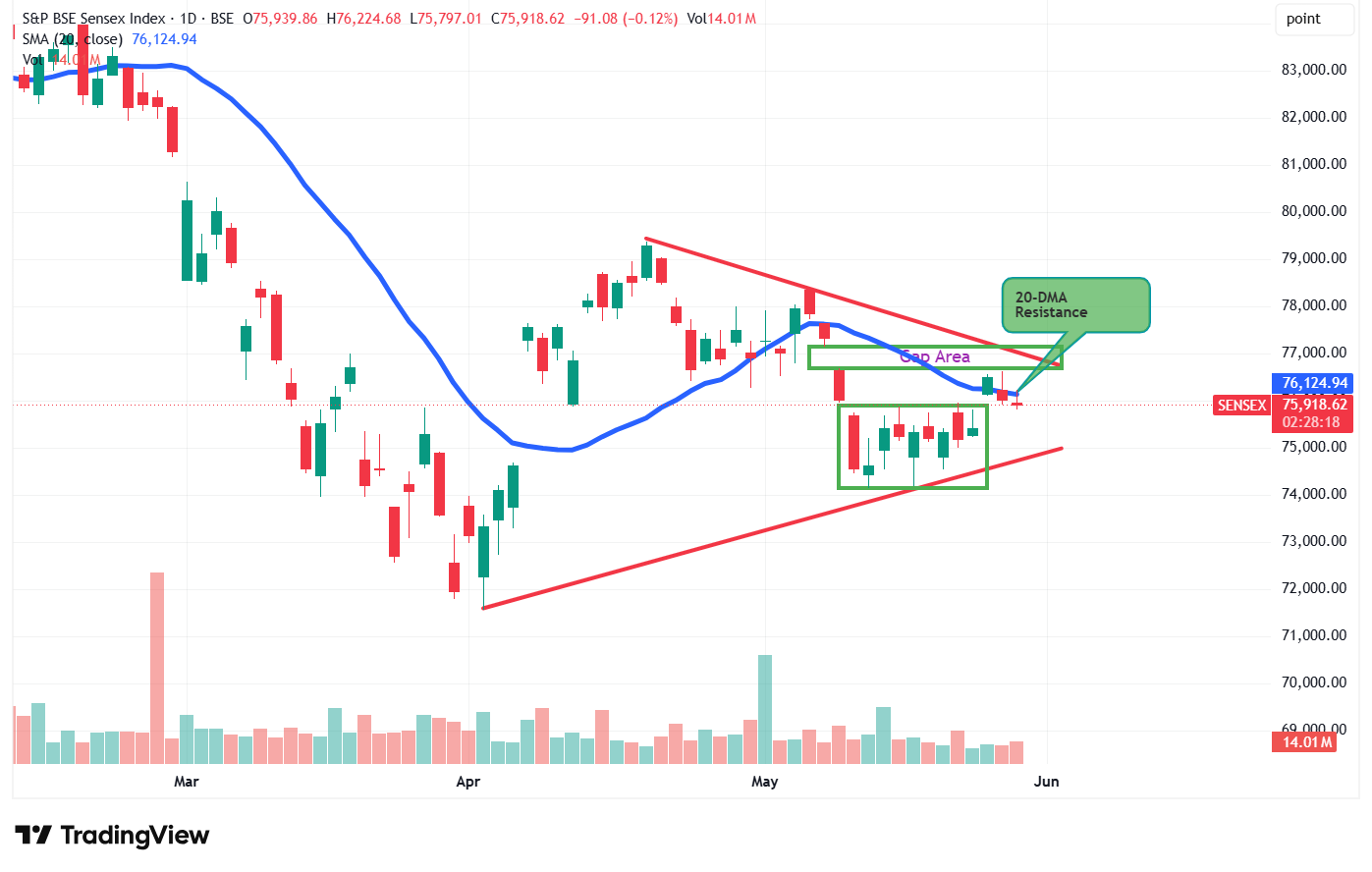
This is a notable shift from the morning setup. Earlier, the Sensex had recovered smartly from the day’s low of 75,797.01 and moved above 76,100, supported by strength in select heavyweights. The index had also moved close to its 20-DMA, which stands at 76,129.59. However, as the session progressed, the Sensex managed to cross the 20-DMA but failed to sustain at higher levels. Selling pressure emerged near the previous trading session’s opening level, pulling the index back towards 76,000.
In the morning update, the PCR across expiries stood at 1.07, indicating that Put open interest was slightly higher than Call open interest. This suggested a mildly supportive setup, especially as Put writers were active around the 76,000–75,800 zone.
By afternoon, the PCR slipped to 0.75, meaning Call open interest has moved ahead of Put open interest. This indicates that the earlier positive undertone has weakened, with Call-side writing picking up at higher levels. The sharp Call OI addition at the 76,100 strike, combined with the Sensex failing to sustain above its 20-DMA of 76,129.59, makes the 76,100–76,130 zone an immediate hurdle for traders.
At the same time, the max pain remains at 76,000, while Put OI remains strong at 76,000 and 75,800. Hence, the expiry setup is not outright bearish, but it has shifted from mildly positive in the morning to more range-bound and resistance-heavy in the afternoon.
A sustained move above 76,130 may improve the tone again, while a break below 75,800 can tilt the setup in favour of sellers.
On the Put side, strong open interest addition continues around the 75,800 PE strike. Open interest at this strike has increased from 55.26 lakh in the morning to nearly 71 lakh by afternoon. This shows that traders are still trying to defend the 75,800 zone.
Fresh open interest addition is also visible at the 76,000 and 75,900 PE strikes, while the highest Put open interest remains concentrated at the 76,000 strike, followed by 75,800.
For traders, this means the 75,800–76,000 zone remains the key support band. A sustained move below 75,800 can weaken the expiry structure and may trigger fresh intraday pressure.
On the Call side, the biggest open interest addition is now seen at the 76,100 CE strike, with nearly 67 lakh open interest added. This is important because the Sensex has struggled near the 20-DMA and has slipped back towards 76,000.
The highest Call open interest concentration, however, remains at the 76,500 strike, making it the larger resistance zone for the day.
For now, the immediate resistance has shifted lower to 76,100–76,130, while 76,500 remains the upper hurdle if the index manages to regain strength.
Compared with the morning setup, the expiry tone has become less bullish and more range-bound. The fall in PCR from 1.07 to 0.75 shows that Call writers have gained control at higher levels, especially around 76,100.
For the rest of the session, 76,000 is the key level to watch. A sustained move above 76,100–76,130 can bring some strength back, while a fall below 75,800 may tilt the setup in favour of sellers.
As of now, the BSE Sensex expiry setup points to a narrow battle between 76,100 resistance and 75,800 support, with 76,000 acting as the most important level for the day.
The BSE Sensex expiry session on May 27 began on a weak note as the index opened lower at 75,939.86 and soon slipped below the previous day’s low to hit an intraday low of 75,797.01. However, the selling pressure did not sustain for long. Buying interest emerged from lower levels, led by heavyweights such as ICICI Bank and Tata Steel, helping the index recover above the 76,100 mark by 10:30 am.
The recovery is important because the Sensex is now trading close to its 20-DMA, a short-term trend reference point closely watched by traders. A sustained move above this zone can improve intraday sentiment, while failure to hold above it may again invite selling pressure.
The options data for the BSE Sensex May 27 expiry suggests that 76,000 has become the key battleground for traders.
On the Put (PE) side, heavy open interest addition was seen between the 75,500 and 76,000 strike prices. The sharpest addition was recorded at the 75,800 strike, where open interest rose by 55.26 lakh. However, the highest Put open interest stands at the 76,000 strike, with open interest of 65.84 lakh.
This indicates that traders are building support around the 76,000 to 75,800 zone. If the Sensex manages to stay above 76,000, it may keep the expiry bias mildly positive. However, a slip below 75,800 can weaken the structure and may trigger fresh intraday pressure.
On the Call (CE) side, sizeable open interest addition is visible at the 76,000 strike and above, suggesting resistance at higher levels. The 76,500 strike holds the highest Call open interest of 45.66 lakh, making it an important upside hurdle for the day.
For expiry traders, 76,000 is the immediate make-or-break level. The max pain is also placed at 76,000, which reinforces the importance of this level for the session.
The Put-Call Ratio across expiries stands at 1.07, indicating a slightly positive undertone, but not a one-sided bullish setup. This means traders should avoid chasing sharp moves and instead watch how the index behaves around the 76,000 mark.
A sustained move above 76,100–76,200 can open room for a move towards 76,500, where Call writers may try to defend the upside. On the downside, 75,800 remains the first important support, followed by 75,500.
Overall, the BSE Sensex expiry setup points to a tightly contested session, with 76,000 acting as the pivot, 75,800 as the key support, and 76,500 as the major resistance zone.
Source: Dalal Street Investment Journal (DSIJ), Opstra
SEBI Registered Research Analyst (INH000006396).
Founded in 1986, Dalal Street Investment Journal (DSIJ) brings decades of experience in India’s equity markets. DSIJ's research combines fundamental analysis with price action, guided by disciplined risk management and capital preservation. They follow a structured, data-driven approach designed to help investors and traders make informed decisions beyond short-term market noise.

Disclaimer :
Investments in securities market are subject to market risk, read all related documents carefully before investing. This content is for educational purposes only. Securities quoted are exemplary and not recommendatory.
The information on this website is provided on "AS IS" basis. Bajaj Broking (BFSL) does not warrant the accuracy of the information given herein, either expressly or impliedly, for any particular purpose and expressly disclaims any warranties of merchantability or suitability for any particular purpose. While BFSL strives to ensure accuracy, it does not guarantee the completeness, reliability, or timeliness of the information. Users are advised to independently verify details and stay updated with any changes.
The information provided on this website is for general informational purposes only and is subject to change without prior notice. BFSL shall not be responsible for any consequences arising from reliance on the information provided herein and shall not be held responsible for all or any actions that may subsequently result in any loss, damage and/or liability. Interest rates, fees, and charges etc., are revised from time to time, for the latest details please refer to our Pricing page.
Neither the information, nor any opinion contained in this website constitutes a solicitation or offer by BFSL or its affiliates to buy or sell any securities, futures, options or other financial instruments or provide any investment advice or service.
BFSL is acting as distributor for non-broking products/ services such as IPO, Mutual Fund, Insurance, PMS, and NPS. These are not Exchange Traded Products. For more details on risk factors, terms and conditions please read the sales brochure carefully before investing.
Content Partner - Dalal Street Investment Journal Wealth Advisory Private Limited
This article is for educational purposes only and should not be considered investment advice. Market investments are subject to risks. DSIJ Wealth Advisory Private Limited is a SEBI-registered Research Analyst (Reg. No: INH000006396) and Investment Adviser (Reg. No: INA000001142). Please consult your financial adviser before investing.
For more disclaimer, check here : https://www.bajajbroking.in/disclaimer
Level up your stock market experience: Scan the QR to download the Bajaj Broking App for effortless investing and trading

Enjoy low brokerage on delivery trades
|
Open Your Free Demat Account
Enjoy low brokerage on delivery trades
|


