
Get Free Demat Account*











Open Your Free Demat Account
Enjoy low brokerage on delivery trades
By Dalal Street Investment Journal (DSIJ)
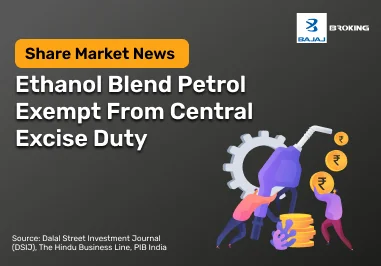
The central government has exempted petrol blended with 22%, 25%, 27%, and 30% ethanol from excise duty and key cesses. This move updates earlier rules and aims to improve the viability of high ethanol-blended fuels for oil marketing companies.
Petrol mixed with a higher share of ethanol will no longer attract central excise duty. On June 11, 2026, the Department of Revenue under the Ministry of Finance issued a gazette notification removing all central levies on petrol blended with 22%, 25%, 27%, and 30% ethanol. Earlier excise duty rules dating back to 2002 and 2017 have been revised to accommodate these higher blend categories. The move is aimed at making such fuels commercially workable for oil marketing companies (OMCs) and at pushing India closer to its 30% ethanol blending goal.
The exemption wipes out four levies in one go: Central Excise Duty, Special Additional Excise Duty, Road and Infrastructure Cess, and Agriculture Infrastructure and Development Cess. All four now stand at nil for petrol blended at 22%, 25%, 27%, and 30% ethanol, respectively.
Until now, this zero-duty benefit was limited to petrol carrying a lower ethanol content. Higher-blend fuels sat in a grey area where the tax treatment made them less attractive to produce and sell at the retail level.
There is a qualification condition attached. Each blend must meet a defined volume composition and must conform to the Bureau of Indian Standards specification IS 19850. The 22% blend, for instance, must consist of exactly 78% motor spirit and 22% ethanol by volume. The same logic runs through the 25%, 27%, and 30% categories, each with its corresponding petrol share and mandatory BIS compliance. Blends that do not meet these standards will not qualify for the nil rate.
India's crude oil import dependence sits at roughly 85–88%. Every litre of ethanol blended into petrol is one less fraction of crude that needs to come in from abroad. Ethanol here is produced from domestic sources, primarily sugarcane, along with damaged wheat and broken rice, so the foreign exchange stays within the country.
The earlier tax structure, however, created an awkward situation. Petrol blended with 22% or more ethanol carried a relatively heavier tax load than conventional petrol, which meant oil marketing companies had little financial reason to push higher-blend fuels through their networks. The notification corrects that. By bringing the duty on high-blend fuel to nil, the government has levelled the playing field between conventional petrol and the higher-blend alternatives.
The numbers behind India's blending programme tell a fairly sharp story. As per PIB, in 2014, ethanol content in petrol was around 1.5%. By June 2025, that figure had climbed to 20%, a target that was originally set for 2030 and was pulled forward multiple times as production scaled up. Ethanol output itself went from 38 crore litres in 2013–14 to 661.1 crore litres by June 2025.
With the 20% milestone now behind it, the focus has shifted to the next leg, getting blending up to 30%. The June 2026 notification is a fiscal signal that the government intends to make that transition happen rather than wait for market forces to drive it organically.
For Indian Oil Corporation, Bharat Petroleum, and Hindustan Petroleum, the change is operationally relevant. The previous duty structure meant that selling higher-blend fuel came with thinner or uncertain margins compared to standard petrol. That disincentive is now removed. With nil duty across the board on qualifying blends, the margin arithmetic on higher-blend petrol becomes more predictable, and the case for wider distribution gets stronger.
Further up the supply chain, sugar mills and grain-based distilleries that produce and supply ethanol to OMCs should see a pickup in procurement volumes as blending demand rises. The notification does not directly address procurement prices, but a broader market for higher-blend fuel logically supports higher ethanol offtake.
This is not a standalone decision. Over the past few years, the government has steadily built out the policy architecture around ethanol blending, advancing targets ahead of schedule, widening the list of permitted feedstocks, and adding a ₹2 per litre disincentive on unblended petrol and diesel. The June 2026 excise exemption fits within that continuing pattern.
The IS 19850 BIS compliance requirement attached to the exemption serves a practical purpose as well. It ensures that as higher-blend fuels enter the retail network more widely, quality and safety standards remain consistent across the supply chain.
Reducing crude import dependency has a knock-on effect across the economy — lower forex outflow, a smaller current account deficit, reduced carbon output, and additional income for farmers through ethanol procurement. The June notification nudges all of those outcomes in the same direction.
SEBI Registered Research Analyst (INH000006396).
Founded in 1986, Dalal Street Investment Journal (DSIJ) brings decades of experience in India’s equity markets. DSIJ's research combines fundamental analysis with price action, guided by disciplined risk management and capital preservation. They follow a structured, data-driven approach designed to help investors and traders make informed decisions beyond short-term market noise.
Disclaimer :
Investments in securities market are subject to market risk, read all related documents carefully before investing. This content is for educational purposes only. Securities quoted are exemplary and not recommendatory.
The information on this website is provided on "AS IS" basis. Bajaj Broking (BFSL) does not warrant the accuracy of the information given herein, either expressly or impliedly, for any particular purpose and expressly disclaims any warranties of merchantability or suitability for any particular purpose. While BFSL strives to ensure accuracy, it does not guarantee the completeness, reliability, or timeliness of the information. Users are advised to independently verify details and stay updated with any changes.
The information provided on this website is for general informational purposes only and is subject to change without prior notice. BFSL shall not be responsible for any consequences arising from reliance on the information provided herein and shall not be held responsible for all or any actions that may subsequently result in any loss, damage and/or liability. Interest rates, fees, and charges etc., are revised from time to time, for the latest details please refer to our Pricing page.
Neither the information, nor any opinion contained in this website constitutes a solicitation or offer by BFSL or its affiliates to buy or sell any securities, futures, options or other financial instruments or provide any investment advice or service.
BFSL is acting as distributor for non-broking products/ services such as IPO, Mutual Fund, Insurance, PMS, and NPS. These are not Exchange Traded Products. For more details on risk factors, terms and conditions please read the sales brochure carefully before investing.
Content Partner - Dalal Street Investment Journal Wealth Advisory Private Limited
This article is for educational purposes only and should not be considered investment advice. Market investments are subject to risks. DSIJ Wealth Advisory Private Limited is a SEBI-registered Research Analyst (Reg. No: INH000006396) and Investment Adviser (Reg. No: INA000001142). Please consult your financial adviser before investing.
For more disclaimer, check here : https://www.bajajbroking.in/disclaimer
Level up your stock market experience: Scan the QR to download the Bajaj Broking App for effortless investing and trading

Enjoy low brokerage on delivery trades
|
Open Your Free Demat Account
Enjoy low brokerage on delivery trades
|


