


Get Free Demat Account*








Open Your Free Demat Account
Enjoy low brokerage on delivery trades
By Dalal Street Investment Journal (DSIJ)
India's EMS sector remains on a strong growth path, but Q1 FY27 is expected to present varied outcomes. The market expects Dixon Technologies to report slower growth amid weak mobile demand, while Amber Enterprises and Kaynes Technology are likely to post stronger revenue growth, supported by expansion plans, order wins and favourable government policies.
The electronics manufacturing industry (EMS) in India has witnessed rapid evolution in recent times. Businesses which were previously concentrating on assembly activities alone have now ventured into the ecosystem of manufacturing. They are providing to global brands, venturing into newer product segments, and establishing themselves in value-added operations.
The EMS industry has been one of the major beneficiaries of this evolution. Government incentives, rising domestic demand and the China plus one strategy have all helped Indian manufacturers grow at a strong pace.
As the June quarter (Q1FY27) earnings season begins, investors will closely watch three major companies from the EMS sector. These are Dixon Technologies Ltd, Amber Enterprises Ltd and Kaynes Technology Ltd. While all three operate in the same broad industry, their businesses are very different. Their growth drivers, customer mix and end markets are not the same.
The first quarter of FY27 reflects this difference. Market expects growth across all three companies, although the pace is no longer as strong as it was over the last few years. Dixon is likely to face slower growth because of weakness in the mobile phone business and high memory prices. On the other hand, Amber and Kaynes are expected to report healthier revenue growth.
Company | Net Sales YoY (%) | Net Sales QoQ (%) | EBITDA YoY (%) | EBITDA QoQ (%) | APAT YoY (%) | APAT QoQ (%) |
Dixon Technologies Ltd | 13 | 38 | (0.8) | 17.2 | (2.7) | 14.7 |
Amber Enterprises Ltd | 23.8 | 2.9 | 33 | (4.7) | (34) | (1.8) |
Kaynes Technology Ltd | 27.0 | (31.2) | 15 | (32.9) | (27.6) | (40.8) |
Note: APAT stands for Adjusted Profit After Tax
Dixon Technologies is India's largest EMS company. It manufactures products across several categories, including mobile phones, consumer electronics, lighting, home appliances and CCTV cameras. The company has built its business around large-scale manufacturing, allowing it to keep production costs low.
The Mobile & Other EMS business is the largest part of the company’s business. In March 2026, more than 90% of the total revenue of the company came from this business line.
However, there has been a softening of the demand in the market for mobile handsets lately. The cost of memory chips has also become high. These conditions are likely to affect the June quarter results of Dixon Technologies.
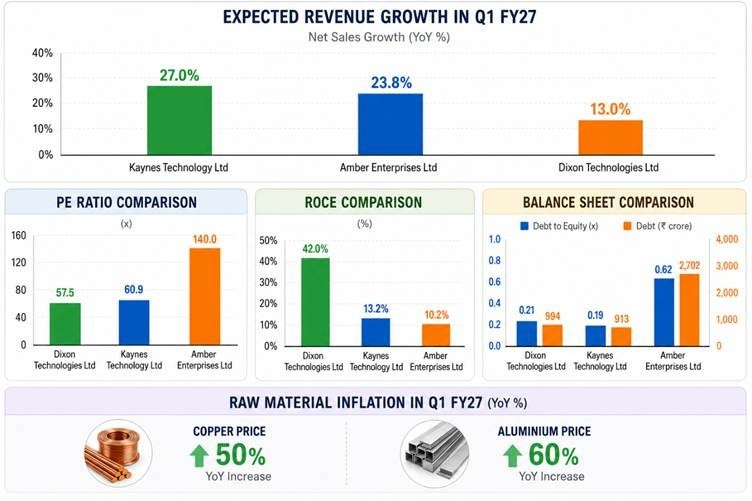
Market expects Dixon's net sales to increase by 13% YoY during Q1 FY27. Although this remains healthy, it is lower than the growth rates investors have become used to over recent years. Profitability could also come under pressure. Adjusted profit after tax (APAT) is expected to decline by 2.7% YoY.
Even so, the company's long-term outlook remains encouraging.
Management has guided for FY27 revenue of nearly ₹56,000 crore without including the expected contribution from Vivo. It also expects mobile phone volumes to remain broadly flat during the year. If Vivo manufacturing is added, it could become another major growth trigger. Even without that business, management believes revenue can continue growing by around 15% to 17%.
Particulars | Value |
PE Ratio | 57.5 |
ROCE | 42% |
Debt to Equity | 0.21 |
EPS | ₹237 |
Debt | ₹994 crore |
Promoter Holding | 28.7% |
Source: Screener
Kaynes Technology Ltd follows a very different business model. Instead of focusing on mass-market consumer products, it manufactures complex electronic systems for sectors such as aerospace, defence, industrial automation, railways and medical devices.
The company also spends heavily on design and engineering. This allows it to participate in products with higher value addition and stronger margins.
Market expects Kaynes to report net sales growth of 27% YoY during the June quarter. However, quarter-on-quarter comparisons are likely to remain weak because execution in this business tends to be uneven. Revenue is expected to decline by 31.2% compared to the March quarter. This is largely because the company's business is execution-led, with revenue depending on the timing of large project deliveries.
EBITDA is expected to grow by 15% YoY, while APAT may decline by 27.6% YoY.
One of the biggest positives for the company remains its order book. Management has indicated that it continues to exceed ₹9,000 crore as of March 2026.
The company is also shortening product development timelines. Earlier, new products generally took between 12 and 18 months to launch. Today, thanks to new technology acquisitions and stronger engineering teams, products can be introduced in nearly nine months.
Another important area is electric vehicles. Management expects more products to be launched across the EV ecosystem over the coming years. These new offerings should improve margins and diversify the revenue mix. The company also expects almost 30% of future revenue to come from newly developed products.
Particulars | Value |
PE Ratio | 60.9 |
ROCE | 13.2% |
Debt to Equity | 0.19 |
EPS | ₹54.3 |
Debt | ₹913 crore |
Promoter Holding | 53.5% |
Source: Screener
Amber initially built its business around room air conditioners. Now, it has turned into a diversified electronics and components manufacturer with a presence across several product categories.
The Electronics Division has become one of the major growth engines. Its FY26 revenues grew by 49% year-over-year (YoY), whereas its operating EBITDA climbed by an impressive 89% YoY. The acquisition of Power-One, Unitronics, and Shogini has helped build its position in all the sectors of the electronics value chain and created a balanced mix of value-added and high volume manufacturing operations.
Besides, Amber has inked a strategic agreement with Sumitronics of Japan and ILJIN for expanding its EMS business in Japan and globally in India.
As a result, management expects the Electronics Division to maintain its strong momentum, with revenue projected to grow by around 40% during FY27.
This is further expected to support another strong quarter for the company.
Market expects the company's revenue to increase by 23.8% YoY during Q1 FY27. Operating performance also looks healthy. EBITDA is expected to rise by 33% over the same period.
However, bottom-line growth could remain under pressure. APAT is expected to decline by 34% YoY, showing that higher operating profit may not fully offset other costs during the quarter.
Particulars | Value |
PE Ratio | 140 |
ROCE | 10.2% |
Debt to Equity | 0.62 |
EPS | ₹50.5 |
Debt | ₹2,702 crore |
Promoter Holding | 38.2% |
The broader outlook for India's EMS sector continues to remain positive. Recently, the government exempted customs duty on several specialised machinery and components that are not widely manufactured within the country. The decision is expected to reduce the cost of importing advanced equipment. The move should encourage investments in lithium-ion battery manufacturing, automotive electronics and advanced electronics assembly.
Production Linked Incentive (PLI) schemes also continue to support capacity expansion across the sector. These schemes have encouraged companies to invest in larger facilities while helping India strengthen its position in global electronics manufacturing.
Despite the favourable policy environment, companies are also dealing with fresh cost pressures. Copper prices during the June quarter were around 50% higher than the same period last year. Aluminium prices rose by nearly 60% YoY. Both metals are widely used across electronic components and manufacturing.
Most EMS companies eventually pass these higher costs on to customers. However, there is usually a gap before revised prices take effect. This delay can temporarily reduce margins and affect quarterly profitability. As a result, investors are likely to pay close attention to management commentary during the upcoming earnings season.
Source: Dalal Street Investment Journal (DSIJ), BSE, NSE
SEBI Registered Research Analyst (INH000006396).
Founded in 1986, Dalal Street Investment Journal (DSIJ) brings decades of experience in India’s equity markets. DSIJ's research combines fundamental analysis with price action, guided by disciplined risk management and capital preservation. They follow a structured, data-driven approach designed to help investors and traders make informed decisions beyond short-term market noise.

Disclaimer :
Investments in the securities market are subject to market risk, read all related documents carefully before investing. This content is for educational purposes only. Securities quoted are exemplary and not recommendatory.
The information on this website is provided on "AS IS" basis. Bajaj Broking (BFSL) does not warrant the accuracy of the information given herein, either expressly or impliedly, for any particular purpose and expressly disclaims any warranties of merchantability or suitability for any particular purpose. While BFSL strives to ensure accuracy, it does not guarantee the completeness, reliability, or timeliness of the information. Users are advised to independently verify details and stay updated with any changes.
The information provided on this website is for general informational purposes only and is subject to change without prior notice. BFSL shall not be responsible for any consequences arising from reliance on the information provided herein and shall not be held responsible for all or any actions that may subsequently result in any loss, damage and or liability. Interest rates, fees, and charges etc., are revised from time to time, for the latest details please refer to our Pricing page.
Neither the information, nor any opinion contained in this website constitutes a solicitation or offer by BFSL or its affiliates to buy or sell any securities, futures, options or other financial instruments or provide any investment advice or service.
BFSL is acting as distributor for non-broking products/ services such as IPO, Mutual Fund, Insurance, PMS, and NPS. These are not Exchange Traded Products. For more details on risk factors, terms and conditions please read the sales brochure carefully before investing.
Content Partner - Dalal Street Investment Journal Wealth Advisory Private Limited
This article is for educational purposes only and should not be considered investment advice. Market investments are subject to risks. DSIJ Wealth Advisory Private Limited is a SEBI-registered Research Analyst (Reg. No: INH000006396) and Investment Adviser (Reg. No: INA000001142). Please consult your financial adviser before investing.
For more disclaimer, check here : https://www.bajajbroking.in/disclaimer
Level up your stock market experience: Download the Bajaj Broking App for effortless investing and trading

Enjoy low brokerage on delivery trades
|
Open Your Free Demat Account
Enjoy low brokerage on delivery trades
|


