
Get Free Demat Account*









Open Your Free Demat Account
Enjoy low brokerage on delivery trades
By Dalal Street Investment Journal (DSIJ)
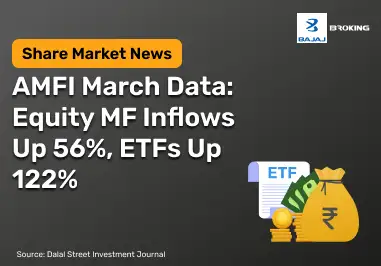
AMFI data for March 2026 showed active equity fund inflows surged 56% MoM above ₹40,000 crore , with traction in Flexi Cap, Mid Cap and Small Cap funds. Value and Contra Fund inflows jumped 196.47%. In contrast, sectoral and thematic fund inflows slowed, while Gold ETF inflows also moderated sharply during the month despite overall strong participation in ETFs.
According to the monthly data released by the Association of Mutual Funds in India (AMFI), net inflows into equity mutual fund schemes rose sharply in March 2026. Inflows stood at ₹40,450.26 crore, up from ₹25,977.91 crore in February 2026, marking a 55.71% month-on-month rise. The sharp increase points to stronger investor participation across most equity fund categories.
Category | February 2026 (₹ Cr) | March 2026 (₹ Cr) | Change (₹ Cr) | % Change |
Multi Cap Fund | 1,933.53 | 2,981.55 | 1,048.02 | 54.20% |
Large Cap Fund | 2,111.68 | 2,997.84 | 886.16 | 41.97% |
Large & Mid Cap Fund | 3,137.73 | 5,307.25 | 2,169.52 | 69.14% |
Mid Cap Fund | 4,002.99 | 6,063.53 | 2,060.54 | 51.48% |
Small Cap Fund | 3,881.06 | 6,263.56 | 2,382.50 | 61.39% |
Dividend Yield Fund | 21.22 | -59.21 | ||
Value Fund/Contra Fund | 727.07 | 2,155.55 | 1,428.48 | 196.47% |
Focused Fund | 900.72 | 2,424.59 | 1,523.87 | 169.18% |
Sectoral/Thematic Funds | 2,987.29 | 2,698.82 | -288.47 | -9.66% |
ELSS | -650.02 | -437.34 | ||
Flexi Cap Fund | 6,924.65 | 10,054.12 | 3,129.47 | 45.19% |
A broad-based improvement was visible in March. Except for Dividend Yield Funds and ELSS, all major equity mutual fund categories reported net inflows. The data suggests that investors were more willing to deploy money across diversified, market-cap-based and strategy-led categories.
Flexi Cap Funds continued to remain the most preferred category in March. Inflows into the segment increased from ₹6,924.65 crore in February to ₹10,054.12 crore in March, reflecting a rise of 45.19%. This was also the highest absolute increase among all equity fund categories, with inflows rising by ₹3,129.47 crore.
March also saw strong inflows into Small Cap, Mid Cap and Large & Mid Cap Funds. Small Cap Funds attracted ₹6,263.56 crore in March, compared with ₹3,881.06 crore in February, registering a rise of 61.39%. Mid Cap Funds also posted healthy growth, with inflows climbing 51.48% to ₹6,063.53 crore from ₹4,002.99 crore.
Large & Mid Cap Funds recorded an even sharper jump. Net inflows in this category rose from ₹3,137.73 crore in February to ₹5,307.25 crore in March, an increase of 69.14%. This suggests that investors were not only willing to participate in relatively stable large-cap names, but were also seeking growth opportunities from mid-cap exposure.
Other diversified categories also witnessed healthy traction in March. Multi Cap Funds saw inflows rise 54.20% to ₹2,981.55 crore, while Large Cap Funds recorded inflows of ₹2,997.84 crore, up 41.97% from February.
Value Fund/Contra Funds rose sharply from ₹727.07 crore to ₹2,155.55 crore, reflecting a jump of 196.47%. Focused Funds also posted a strong rise, with inflows increasing from ₹900.72 crore to ₹2,424.59 crore, up 169.18%.
Sectoral/Thematic Funds were among the few segments to witness moderation. Net inflows in this category declined by 9.66%, falling from ₹2,987.29 crore in February to ₹2,698.82 crore in March.
Dividend Yield Funds also slipped into outflow territory. The category moved from a marginal inflow of ₹21.22 crore in February to an outflow of ₹59.21 crore in March, indicating weaker sentiment in that segment.
ELSS remained under pressure as well, though the situation improved slightly. Outflows narrowed from ₹650.02 crore in February to ₹437.34 crore in March. While redemptions continued, the lower outflow suggests the pressure eased somewhat during the month.
Category | February 2026 (₹ Cr) | March 2026 (₹ Cr) | Change (₹ Cr) | % Change |
Index Funds | 3,233.44 | 8,168.76 | 4,935.32 | 152.65% |
GOLD ETF | 5,254.95 | 2,265.68 | -2,989.27 | -56.89% |
Other ETFs | 4,487.15 | 19,802.41 | 15,315.26 | 341.31% |
Fund of funds investing overseas | 903.77 | 530.75 | -373.02 | -41.27% |
Sub Total | 13,879.31 | 30,767.60 | 16,888.29 | 121.68% |
The momentum was even stronger in the passive and ETF space. The subtotal for this basket rose from ₹13,879.31 crore in February to ₹30,767.60 crore in March, marking a sharp increase of 121.68%.
This jump was driven largely by strong inflows into Other ETFs and Index Funds, which together accounted for a major share of the increase. The data shows that investor interest in passive products rose significantly during the month.
Among all categories in this basket, Other ETFs saw the strongest rise. Inflows surged from ₹4,487.15 crore in February to ₹19,802.41 crore in March, an increase of 341.31%. This was the largest increase both in absolute and percentage terms.
Index Funds also posted a strong performance. Inflows rose from ₹3,233.44 crore to ₹8,168.76 crore, reflecting a jump of 152.65%. This indicates that passive participation strengthened considerably in March, likely supported by continued investor interest in low-cost market-linked products.
While passive domestic products gained traction, some other categories saw softer flows. Gold ETFs recorded inflows of ₹2,265.68 crore in March, down from ₹5,254.95 crore in February. This was a decline of 56.89%, suggesting that demand for gold as a safe-haven allocation cooled during the month.
Fund of funds investing overseas also witnessed a decline. Inflows dropped from ₹903.77 crore in February to ₹530.75 crore in March, a fall of 41.27%. This may indicate reduced investor enthusiasm for overseas-oriented schemes compared with domestic passive products.
The February-to-March trend clearly shows that investor interest in the other schemes basket turned much stronger in March 2026. The rise was led overwhelmingly by ETFs and index-linked products, while allocations towards Gold ETFs and overseas fund of funds moderated.
Taken together, the AMFI data for March points to a decisive improvement in investor participation across both equity mutual funds and passive products. The strongest flows were seen in flexible and broader-market equity categories, while passive investing also gained substantial momentum through index funds and ETFs.
SEBI Registered Research Analyst (INH000006396).
Founded in 1986, Dalal Street Investment Journal (DSIJ) brings decades of experience in India’s equity markets. DSIJ's research combines fundamental analysis with price action, guided by disciplined risk management and capital preservation. They follow a structured, data-driven approach designed to help investors and traders make informed decisions beyond short-term market noise.

Disclaimer :
Investments in securities market are subject to market risk, read all related documents carefully before investing. This content is for educational purposes only. Securities quoted are exemplary and not recommendatory.
The information on this website is provided on "AS IS" basis. Bajaj Broking (BFSL) does not warrant the accuracy of the information given herein, either expressly or impliedly, for any particular purpose and expressly disclaims any warranties of merchantability or suitability for any particular purpose. While BFSL strives to ensure accuracy, it does not guarantee the completeness, reliability, or timeliness of the information. Users are advised to independently verify details and stay updated with any changes.
The information provided on this website is for general informational purposes only and is subject to change without prior notice. BFSL shall not be responsible for any consequences arising from reliance on the information provided herein and shall not be held responsible for all or any actions that may subsequently result in any loss, damage and/or liability. Interest rates, fees, and charges etc., are revised from time to time, for the latest details please refer to our Pricing page.
Neither the information, nor any opinion contained in this website constitutes a solicitation or offer by BFSL or its affiliates to buy or sell any securities, futures, options or other financial instruments or provide any investment advice or service.
BFSL is acting as distributor for non-broking products/ services such as IPO, Mutual Fund, Insurance, PMS, and NPS. These are not Exchange Traded Products. For more details on risk factors, terms and conditions please read the sales brochure carefully before investing.
Content Partner - Dalal Street Investment Journal Wealth Advisory Private Limited
This article is for educational purposes only and should not be considered investment advice. Market investments are subject to risks. DSIJ Wealth Advisory Private Limited is a SEBI-registered Research Analyst (Reg. No: INH000006396) and Investment Adviser (Reg. No: INA000001142). Please consult your financial adviser before investing.
For more disclaimer, check here : https://www.bajajbroking.in/disclaimer
Level up your stock market experience: Scan the QR to download the Bajaj Broking App for effortless investing and trading

Enjoy low brokerage on delivery trades
|
Open Your Free Demat Account
Enjoy low brokerage on delivery trades
|


