What is Nifty 50 and How to Invest in Nifty 50?
If you track financial news on a daily basis, you would have heard this term called “Nifty 50” several times by now. But, what is Nifty 50? It is an index comprising the 50 biggest large-cap companies in India. These companies are the leaders in their respective industries.
You can invest in Nifty 50 in two ways. First, you can check the weightage of various stocks comprising Nifty 50 and then you can invest in them exactly in the same weightage. Second, you can invest in an index fund that invests in Nifty 50. Such funds invest in stocks in the same percentage as they have in Nifty 50.
What is Nifty 50 in the Context of the Share Market?
Overview of Nifty 50 Index
Nifty 50 is one of the most important stock market indices in India. By observing the movements in Nifty 50, investors can gauge the mood in the stock market and also the direction in which the Indian economy is likely to be headed. Nifty 50 is made up of the 50 biggest large-cap stocks in India. These stocks belong to some of the biggest companies in the country, which have become the leaders of their sectors over the years. Hence, investors show much more confidence in such stocks than they show in other stocks
- History and Evolution of Nifty 50
Nifty 50 came into being on November 3, 1995. At that time, the constituents of Nifty 50 accounted for around 33.7% of the full market capitalisation of actively traded stocks on the National Stock Exchange (NSE). By 2021, the constituents of Nifty 50 accounted for 53.2% of the full market capitalisation of actively traded stocks. Over the years, the sectoral composition of the index has changed. For example, when the index was formed in 1995, it had no representation of the information-technology sector (IT). However, today, there are many IT stocks in Nifty 50.
Now that we know what Nifty 50 is, let us delve on other related aspects, like what its constituents are and how Nifty 50 works.
Additional Read: Trent and BEL to Join Nifty 50 Index, Divi's Lab and LTIMindtree Out
Key Features of Nifty 50
Composition and Weightage of Nifty 50 Stocks
The 50 stocks that constitute Nifty 50 are: Adani Enterprises, Adani Ports and Special Economic Zone, Apollo Hospitals Enterprise, Asian Paints, Larsen & Toubro, Tata Consultancy Services, Axis Bank, Power Grid Corporation of India, Bajaj Auto, Bajaj Finance, Bajaj Finserv, Bharat Electronics, Bharat Petroleum Corporation, Bharti Airtel, Britannia Industries, Cipla, Coal India, Dr. Reddy's Laboratories, Eicher Motors, Grasim Industries, HCL Technologies, HDFC Bank, Titan Company, HDFC Life Insurance Company, Hero MotoCorp, Hindalco Industries, Hindustan Unilever, ICICI Bank, ITC, IndusInd Bank, Infosys, JSW Steel, Kotak Mahindra Bank, Maruti Suzuki India, NTPC, Nestle India, Oil & Natural Gas Corporation, Reliance Industries, SBI Life Insurance Company, Shriram Finance, State Bank of India, Sun Pharmaceutical Industries, Tata Consumer Products, Tata Motors, Tata Steel, Tech Mahindra, Trent, UltraTech Cement, Mahindra & Mahindra, and Wipro. The weightage of the top constituents of Nifty 50 is provided in the table below. Please keep in mind that the constituents of Nifty 50 and their weightage can change based on how these stocks perform.
Source: https://www.niftyindices.com/Factsheet/ind_nifty50.pdf
Criteria for Inclusion in Nifty 50
Stocks have to fulfil certain criteria to be included in Nifty 50, which are explained below:
Ø The stock must belong to an Indian company registered on the NSE.
Ø The stock must have high liquidity.
Ø The trading frequency of the company must be 100% in the last six months.
Ø The average free-float market cap of the company should be at least 1.5 times higher than that of the smallest company on Nifty 50.
Sector
| Weightage %
|
Financial Services
| 32.92
|
Information Technology (IT)
| 12.75
|
Oil, Gas & Consumable Fuels
| 11.25
|
Fast Moving Consumer Goods (FMCG)
| 8.58
|
Automobile and Auto Components
| 8.08
|
Telecommunication
| 3.95
|
Healthcare
| 3.92
|
Construction
| 3.73
|
Metals & Mining
| 3.64
|
Power
| 3.19
|
Consumer Durables
| 2.66
|
Construction Materials
| 2.06
|
Consumer Services
| 1.45
|
Services
| 0.92
|
Capital Goods
| 0.88
|
Source: https://www.niftyindices.com/Factsheet/ind_nifty50.pdf
How to Invest in Nifty 50?
Investing via Nifty 50 Index Funds
Those mutual funds that invest in the stocks that constitute Nifty 50 and in the same weightage as they have in Nifty 50 are called Nifty 50 Index Funds. Such funds are passively managed because the fund manager has to mirror the composition of Nifty 50. Hence, they have a lower expense ratio than actively managed funds.
How to Invest in Nifty 50 through Exchange Traded Funds (ETFs)
You can also invest in a Nifty 50 ETF. Such funds are passively managed and they mirror Nifty 50 in terms of composition. Being an ETF, you can buy and sell units of Nifty 50 ETF throughout a trading day. However, the units of a mutual fund can be bought or sold only at the end of a trading day.
Direct Investment in Nifty 50 Stocks
You can also directly invest in Nifty 50 stocks. By going to the NSE’s website, you can check the constituents of Nifty 50. After that, you can invest in these stocks on your own in the same percentage in which they constitute the Nifty 50 index. In this case, you will not have to pay anything to a manager of a mutual fund or an ETF. That said, you can also invest in Nifty 50 stocks in any percentage you desire.
Additional Read: What is Trading Account: Definition, Types & Benefits
NIFTY 50 Performance: How Much Return has it generated?
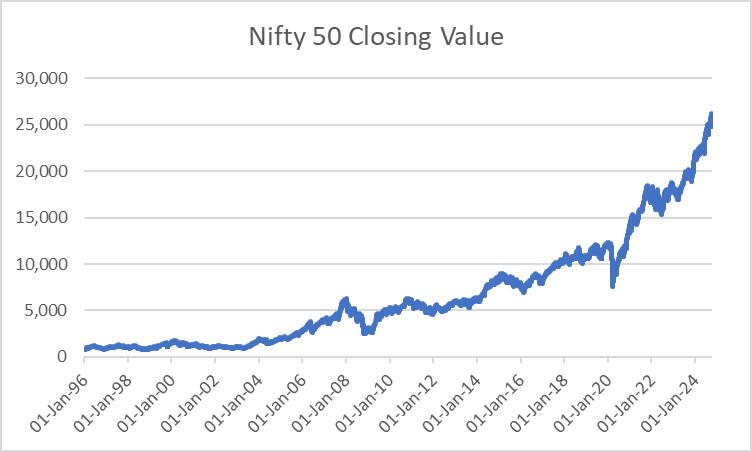
The graph below shows how Nifty 50 has performed since January 1, 1996. With the exception of a few dips, the index has mostly moved up in this time duration. If you had invested ₹1 in Nifty 50 on January 1, 1996, it would have become ₹27.5 by October 8, 2024. In other words, between January 1, 1996, and October 8, 2024, Nifty 50 has provided a compounded average annual return (CAGR) of 12.2%.