








Open Your Free Demat Account
Enjoy low brokerage on delivery trades
 August 06, 2026
 4 mins read
This overview of the LEAP India IPO has been prepared by Bajaj Broking based entirely on the disclosures made in the DRHP. LEAP India Limited is an asset pooling company with a history dating back to 2013. The company provides pallets, containers, and material handling equipment serving FMCG, food and beverage, third-party logistics, e-commerce, automotive, and industrial sectors. The company has reported growth in revenue, an expanding asset base, and improving financial metrics over recent years. Its pan-India network and diversified asset portfolio represent important business strengths.
At the same time, the company faces risks related to revenue concentration in pallet pooling, supplier concentration, employee and operator attrition, asset loss, and regulatory compliance.
Most pallets in India get used once and thrown away. LEAP India runs the opposite model. Palletisation and pallet pooling in India remain well below levels seen in developed markets. Warehousing expansion and rising automation in supply chains are pushing that gap to narrow, according to the industry report cited in the Red Herring Prospectus (RHP).
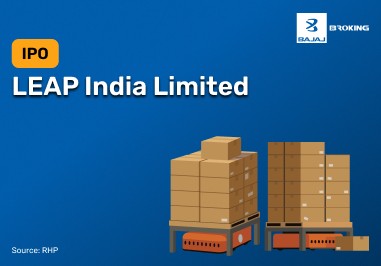
LEAP India Limited has filed its Red Herring Prospectus (RHP) with the Securities and Exchange Board of India (SEBI) to raise funds through an initial public offering (IPO). The company operates in the asset pooling segment. Customers rent pallets, containers, and material handling equipment (MHE) from a pool the company owns and maintains, rather than buying these assets themselves.
This article walks through what the RHP discloses: how the company earns money, and where the LEAP India Limited IPO proceeds are headed. This article simplifies the key information available in the RHP in an easy-to-understand format.
The table below highlights the key details of the public issue available in the RHP.
| Particulars | Details |
|---|---|
| IPO Type | Book Built Issue |
| IPO Open Date | Friday, August 7, 2026 |
| IPO Close Date | Tuesday, August 11, 2026 |
| Face Value | ₹1 per equity share |
| Price Band | ₹151 to ₹159 per share |
| Lot Size | 94 shares |
| Fresh Issue | 3,01,88,679 shares (agg. up to ₹480 Cr) |
| Offer for Sale | 12,57,86,163 shares of ₹1 (agg. up to ₹2,000 Cr) |
| Total Issue Size | 15,59,74,842 shares (agg. up to ₹2,480 Cr) |
| Listing Exchange | NSE and BSE |
The IPO consists of both a Fresh Issue and an Offer for Sale (OFS).
Under the Fresh Issue portion, the company will receive funds from the IPO. The OFS portion is different. Those shares are being sold by Vertical Holdings II Pte. Ltd. and KIA EBT Scheme 3, both promoter or promoter group entities, and the proceeds go to the selling shareholders rather than the company.
LEAP India Limited traces its origins back to 2013 when it was incorporated as LEAP India Private Limited. Twelve years on, in 2025, it converted into a public limited company and was renamed LEAP India Limited soon after.
The company's promoters are Sunu Mathew and Vertical Holdings II Pte. Ltd. Its registered and corporate office sits in Goregaon (East), Mumbai, Maharashtra.
The company operates a share and reuse asset pooling model, referred to as pooling, across its product range. Rather than selling pallets, containers, and equipment outright, it keeps ownership and lets customers pay for use.
The business runs on three categories of pooled assets:
Pallets, used to support and move goods in supply chains
Containers, used to store and transport goods
Material handling equipment (MHE), including forklifts, reach trucks, and pallet trucks
As of March 31, 2026, the company's network comprised 14.70 million assets, more than 10,100 customer touchpoints, and 29 fulfilment centres.
These assets are used across a range of sectors, including fast-moving consumer goods (FMCG), food and beverage, third-party logistics, e-commerce and quick commerce, automotive, and industrials.
The company acquired CHEP India in January 2025. This acquisition widened LEAP India's pooling network and strengthened its container business.
Customers pay to use LEAP India's pallets, containers, and MHE rather than buy them outright, and that usage fee is where most of the company's revenue originates, following a pooling-based model. The company supplies these assets to:
FMCG and food and beverage customers
Third-party logistics providers
E-commerce and quick commerce operators
Automotive and industrial customers
Customer count crossed 1,000 by March 31, 2026. Pallets still carry the business, contributing 62.17% of revenue from operations in Fiscal 2026 — though that share has been shrinking, down from 67.90% in Fiscal 2025 and 72.23% in Fiscal 2024. MHE pooling and other operations fill in the rest.
The company operates in the asset pooling industry. According to the RHP, citing the Frost & Sullivan Report commissioned for the Offer, it holds the position of largest on-demand asset pooling provider in India by number of pooled assets. Set against that is a smaller number worth noting: India's own pallet pooling penetration stood at just 9.4% of the country's total pallet base as of the report date, notably lower than penetration levels reported in North America, the European Union, and Australia and New Zealand.
Its subsidiary, TARON, operates in the MHE pooling segment, including lithium-ion forklifts.
Once the issue opens and closes, investors will be able to check the LEAP India allotment status through the registrar's website to confirm share allocation.
India's asset pooling industry benefits from multiple long-term growth drivers, tied closely to the broader expansion of the country's e-commerce and logistics sectors. India's e-commerce market was valued at USD 168 billion in Fiscal 2025 and is projected to grow at approximately 17% CAGR between Fiscal 2026 and Fiscal 2031. This growth is expected to increase daily parcel volumes and push demand for warehouse automation, material handling equipment, and pallet usage.
Government initiatives are also shaping the industry's outlook. Programmes such as PM Gati Shakti and the National Logistics Policy aim to reduce logistics costs and improve multimodal connectivity across the country, while schemes including Make in India and Production Linked Incentives are encouraging domestic manufacturing and technology adoption. Taken together, these initiatives are expected to support demand for organised warehousing and asset pooling solutions.
Key factors supporting this outlook include:
Expansion of Grade A warehousing
Rising automation in supply chains
Growth in FMCG, food and beverage, e-commerce, and automotive end-use sectors
Increasing ESG-linked adoption of reusable packaging
Fiscal 2031 targets stand out in the RHP's projections. Pallet use in food and beverage is projected to grow at a CAGR of approximately 7.88% from a Fiscal 2026 base. Industrials and other sectors are projected to grow slightly faster over the same stretch, at approximately 7.99% CAGR.
The table below sets out LEAP India Limited's consolidated financial performance, based on figures disclosed in the DRHP.
| Financials (₹ crore) | FY2026 | FY2025 | FY2024 |
|---|---|---|---|
| Revenue from Operations | 747.36 | 485.03 | 371.94 |
| EBITDA | 378.83 | 273.80 | 209.92 |
| PAT | 62.34 | 37.56 | 37.17 |
| Total Assets | 2,401.05 | 2042.46 | 1,400.28 |
| Net Worth | 1,006.33 | 917.35 | 714.18 |
LEAP India Limited has built its business around a pooled asset-sharing model supported by a wide operational network and technology-driven processes. Its experience, asset base, and customer-centric approach have contributed to its market presence. The following strengths highlight the key aspects of the company's business model and operational capabilities.
The company traces its roots to 2013 and has more than a decade of operating history in the asset pooling segment. A longer runway like this tends to steady customer relationships and day-to-day operations alike.
Three asset categories, several end-use sectors. Pallets, containers, and MHE together reduce how much any single revenue line carries the business.
The company reported 14.70 million assets and more than 10,100 customer touchpoints as of March 31, 2026. Establishing a network of this scale requires considerable time and capital, which the RHP identifies as a barrier to entry for newer participants in the industry.
Customer churn among the company's top 100 customers stood at 0.00% in Fiscal 2026, compared with 0.19% in Fiscal 2025 and 0.75% in Fiscal 2024. A majority of the top 10 customers by revenue contribution have maintained relationships with the company for more than five years.
The company uses an in-house platform, MyLEAP, for order tracking and management, along with SAP S/4HANA and Salesforce integration for electronic data interchange with customers. Passive RFID and IoT-based tracking are used across containers and forklifts, and operations are ISO 27001 certified.
The company's Corporate Promoter is affiliated with funds, vehicles, and entities managed or advised by Kohlberg Kravis Roberts & Co. L.P. (KKR). Mr. Sunu Mathew serves as Chairman, Managing Director, and Chief Executive Officer, bringing more than 26 years in the industry, including time at CHEP India Private Limited and L'Oréal India Private Limited.
Revenue from operations grew 56.39% year-on-year in Fiscal 2026, well above the 27.81% pace in Fiscal 2025. The RHP is candid about this: growth at this rate may not continue in future periods.
More than three-fifths of Fiscal 2026 revenue from operations — 62.17% — traces back to pallets alone. A slowdown in this one segment would be felt well beyond it.
63%. That's the share of Fiscal 2026 purchases coming from the top ten suppliers, versus 60.00% in Fiscal 2025 and 77.00% in Fiscal 2024. A disruption at any one of these suppliers carries real operational weight.
MHE operator attrition hit 56.00% in Fiscal 2026, one of several attrition figures the RHP discloses across key managerial personnel, senior management, and permanent employees. Costs tend to climb with turnover like this: more hiring, more training, on repeat.
₹28.30 million in assets went unrecovered from customers in Fiscal 2026, booked as an impairment loss. Cross a commercially acceptable threshold on this front, and the hit to financial performance gets harder to absorb.
Long-term, recurring agreements define most customer relationships here. Lose scope with a top account, or lose the renewal outright, and revenue answers directly.
Polymer prices climbed in Fiscal 2026, pushing up costs for certain plastic-based offerings. The RHP ties this to regional supply disruptions — pressure that starts well outside the company's control.
Before evaluating the IPO, investors may consider the following factors:
The company's asset pooling business model and revenue mix across pallets, containers, and MHE
Revenue concentration in the pallet pooling segment
Growth in revenue, EBITDA, and net worth over recent years
Industry penetration levels for palletisation and pallet pooling in India
Dependence on top suppliers and customer contract renewals
Attrition levels among employees and MHE operators
Use of Net Proceeds towards debt repayment and general corporate purposes
Risks associated with asset loss, supplier concentration, and regulatory compliance
Disclaimer :
Investments in securities market are subject to market risk, read all related documents carefully before investing. This content is for educational purposes only. Securities quoted are exemplary and not recommendatory.
The information on this website is provided on "AS IS" basis. Bajaj Broking (BFSL) does not warrant the accuracy of the information given herein, either expressly or impliedly, for any particular purpose and expressly disclaims any warranties of merchantability or suitability for any particular purpose. While BFSL strives to ensure accuracy, it does not guarantee the completeness, reliability, or timeliness of the information. Users are advised to independently verify details and stay updated with any changes. The securities are quoted as an example and not as a recommendation. Past performance is not necessarily a guide to future performance.
The information provided on this website is for general informational purposes only and is subject to change without prior notice. BFSL shall not be responsible for any consequences arising from reliance on the information provided herein and shall not be held responsible for all or any actions that may subsequently result in any loss, damage and/or liability. Interest rates, fees, and charges etc., are revised from time to time, for the latest details please refer to our Pricing page.
Neither the information, nor any opinion contained in this website constitutes a solicitation or offer by BFSL or its affiliates to buy or sell any securities, futures, options or other financial instruments or provide any investment advice or service.
BFSL is acting as distributor for non-broking products/ services such as IPO, Mutual Fund, Insurance, PMS, and NPS. These are not Exchange Traded Products. For more details on risk factors, terms and conditions please read the sales brochure carefully before investing.
Content Partner - Dalal Street Investment Journal Wealth Advisory Private Limited
This article is for educational purposes only and should not be considered investment advice. Market investments are subject to risks. DSIJ Wealth Advisory Private Limited is a SEBI-registered Research Analyst (Reg. No: INH000006396) and Investment Adviser (Reg. No: INA000001142). Please consult your financial adviser before investing.
For more disclaimer, check here : https://www.bajajbroking.in/disclaimer
Level up your stock market experience: Scan the QR to download the Bajaj Broking App for effortless investing and trading

Enjoy low brokerage on delivery trades
|
Open Your Free Demat Account
Enjoy low brokerage on delivery trades
|


