


Get Free Demat Account*





Open Your Free Demat Account
Enjoy low brokerage on delivery trades
By Dalal Street Investment Journal (DSIJ)
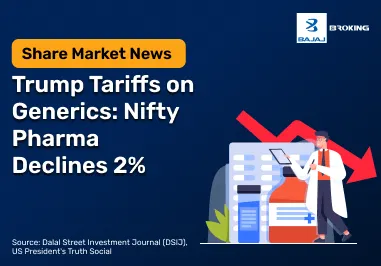
Nifty Pharma fell nearly 2% after US President Donald Trump announced a phased tariff plan on imported generic medicines. The proposal keeps generics duty-free for two years before imposing 100% and later 200% tariffs, raising concerns for Indian pharmaceutical companies with significant exposure to the US market.
US President Donald Trump announced on Tuesday a phased tariff structure on imported generic medicines, giving pharmaceutical companies a two-year window before steep duties come into force. Under the plan, which takes effect from August 1, 2026, generic drugs imported into the United States will remain duty-free for two years. After that, a 100% tariff will apply for one year, followed by a permanent rate of 200%, a structure explicitly designed to pressure companies into building manufacturing capacity on American soil.
Trump announced the move on Truth Social, stating that the policy's purpose is to reshore generic pharmaceutical production to America and that companies choosing not to invest in domestic plant and equipment during the grace period will face the full weight of rising duties. The policy applies specifically to generic medicines; tariffs on patented, branded, and innovative drugs remain unchanged, which Trump said had already been successful in driving domestic pharmaceutical investment.
The announcement triggered an immediate sell-off in Indian pharmaceutical stocks, reflecting investor concerns over the sector's exposure to the US generic medicines market. The Nifty Pharma index opened lower and fell nearly 2% in early trade.
Among the top losers, Lupin, Gland Pharma, Aurobindo Pharma, Ajanta Pharma, Sai Life Sciences, and Zydus Lifesciences each fell more than 2%. Piramal Pharma, Alkem Laboratories, Cipla, and Glenmark Pharmaceuticals were also among the sharpest decliners on the index. The broad-based nature of the sell-off shows how much Indian generic drug makers depend on the US market.
Generic medicines are copies of branded drugs that have lost patent protection and account for more than 90% of all prescriptions dispensed in the United States, according to the US Food and Drug Administration. Whereas branded products are frequently produced by international corporations in the US and Europe, generics are largely manufactured in nations with cheaper manufacturing costs, including India.
The difference is relevant since the new tariff policy, which does not affect branded products at all, hits where Indian companies have their greatest presence in America.
India supplies nearly 40% of all generic medicines consumed in the United States by volume, earning it the informal title of the pharmacy of the world. In FY25, India exported $9.7 billion worth of pharmaceuticals to the US, equivalent to 38% of its total global pharmaceutical exports of $25.8 billion, according to the Global Trade Research Initiative.
Indian-manufactured generic drugs are commonly prescribed under various therapeutic areas such as hypertension, depression, diabetes, cancer, infectious diseases, and mental illnesses. It is clear that the size of these exports reflects how deeply India is involved in the supply chain of US healthcare.
The India-US bilateral agreement was entered into in February 2026, and the agreement indicates that India would negotiate its results concerning generic medicines and their components. It remains to be seen whether such terms provide any protection against the imposed tariff system. The implications for Indian medicine companies will depend greatly on how those terms are interpreted.
The two years of duty-free treatment is just a reprieve for India's drug industry, while the impending imposition of 100% and even 200% duties constitutes an element of uncertainty that would persist if production were not moved to the U.S., which would be an expensive and lengthy process.
The outcome of applying the February trade agreement for drugs will be the ultimate determinant of India's exposure to tariffs. Until there is more clarity on this policy, it will continue to represent a major source of risk for the Indian drug industry.
Source: Dalal Street Investment Journal (DSIJ), US President's Truth Social
SEBI Registered Research Analyst (INH000006396).
Founded in 1986, Dalal Street Investment Journal (DSIJ) brings decades of experience in India’s equity markets. DSIJ's research combines fundamental analysis with price action, guided by disciplined risk management and capital preservation. They follow a structured, data-driven approach designed to help investors and traders make informed decisions beyond short-term market noise.
Disclaimer :
Investments in the securities market are subject to market risk, read all related documents carefully before investing. This content is for educational purposes only. Securities quoted are exemplary and not recommendatory.
The information on this website is provided on "AS IS" basis. Bajaj Broking (BFSL) does not warrant the accuracy of the information given herein, either expressly or impliedly, for any particular purpose and expressly disclaims any warranties of merchantability or suitability for any particular purpose. While BFSL strives to ensure accuracy, it does not guarantee the completeness, reliability, or timeliness of the information. Users are advised to independently verify details and stay updated with any changes.
The information provided on this website is for general informational purposes only and is subject to change without prior notice. BFSL shall not be responsible for any consequences arising from reliance on the information provided herein and shall not be held responsible for all or any actions that may subsequently result in any loss, damage and or liability. Interest rates, fees, and charges etc., are revised from time to time, for the latest details please refer to our Pricing page.
Neither the information, nor any opinion contained in this website constitutes a solicitation or offer by BFSL or its affiliates to buy or sell any securities, futures, options or other financial instruments or provide any investment advice or service.
BFSL is acting as distributor for non-broking products/ services such as IPO, Mutual Fund, Insurance, PMS, and NPS. These are not Exchange Traded Products. For more details on risk factors, terms and conditions please read the sales brochure carefully before investing.
Content Partner - Dalal Street Investment Journal Wealth Advisory Private Limited
This article is for educational purposes only and should not be considered investment advice. Market investments are subject to risks. DSIJ Wealth Advisory Private Limited is a SEBI-registered Research Analyst (Reg. No: INH000006396) and Investment Adviser (Reg. No: INA000001142). Please consult your financial adviser before investing.
For more disclaimer, check here : https://www.bajajbroking.in/disclaimer
Level up your stock market experience: Scan the QR to download the Bajaj Broking App for effortless investing and trading

Enjoy low brokerage on delivery trades
|
Open Your Free Demat Account
Enjoy low brokerage on delivery trades
|


