










Open Your Free Demat Account
Enjoy low brokerage on delivery trades
By Dalal Street Investment Journal (DSIJ)
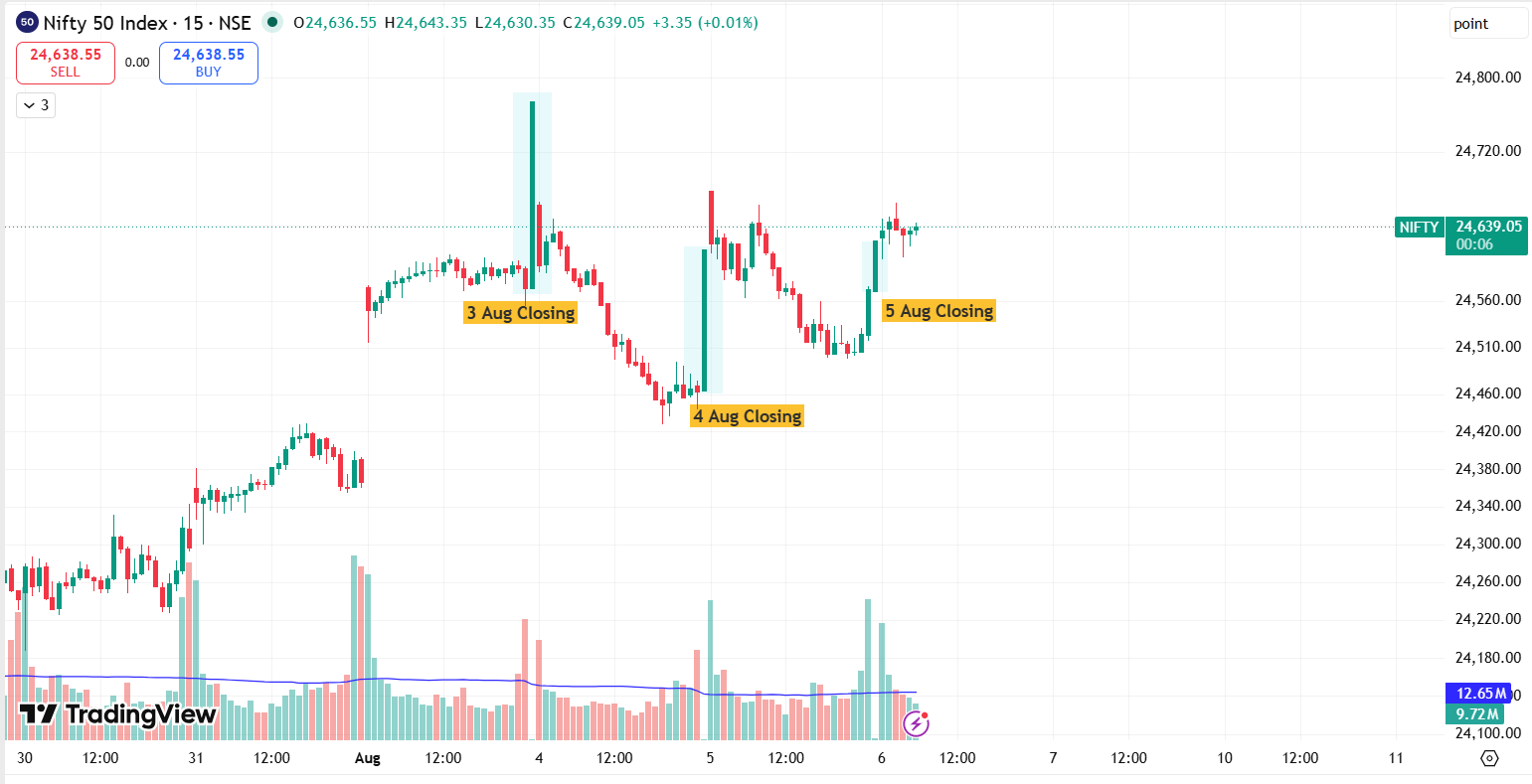
The Nifty 50 has witnessed sharp upward movements during the final minutes of trading since the Closing Auction Session (CAS) went live on August 3, on the debut day, the index surged by 200 points. With the new mechanism changing how closing prices are determined for F&O stocks, the recent market moves raise questions about its impact on index price discovery.
Since the Closing Auction Session (CAS) went live on August 3, an unusual pattern has emerged in the benchmark indices. The Nifty 50 has seen sharp upward movements at the end of the trading session.
While the initial observation covers only a few trading sessions and is therefore too early to establish a trend, the timing has drawn attention. The new auction-based mechanism has changed how closing prices are discovered for eligible F&O stocks, raising an important question: is CAS influencing end-of-day price action, or are broader market factors behind the recent moves?
The Nifty 50’s price action during the final minutes provides the clearest indication of the recent shift. Between August 3 and August 5, the index recorded sharp upward movements during the final minutes of each session, gaining 0.82% on August 3, 0.62% on August 4 and 0.22% on August 5. The index gained an average of 0.55% during the final minutes across these three sessions, highlighting the extent of the late-session movement.
The Nifty 50 witnessed sharp upward movements during the final fifteen minutes of trading between August 3 and August 5.
| Date | Nifty 50 Final 15-Minute Move (Points) |
|---|---|
| 3 August 2026 | 200.75 |
| 4 August 2026 | 151.95 |
| 5 August 2026 | 52.4 |
| Average | 135.03 |
The Closing Auction Session was introduced for F&O-eligible stocks to determine their official closing prices through an auction-based mechanism. Under the earlier system, the closing price was determined using the volume-weighted average price (VWAP) of trades executed between 3:00 PM and 3:30 PM.
Under CAS, the process is structured differently. From 3:00 PM to 3:15 PM, continuous trading continues in F&O stocks, with the VWAP of this period becoming the CAS reference price.
From 3:15 PM to 3:20 PM, a ±3% price range is established around this reference price. For example, if the reference price is ₹100, CAS orders can be placed between ₹97 and ₹103.
The next stage, from 3:20 PM to 3:25 PM, allows market and limit orders. From 3:25 PM to 3:30 PM, only limit orders are permitted, with the session closing randomly between 3:28 PM and 3:30 PM. From 3:30 PM to 3:35 PM, eligible buy and sell orders are matched at a common equilibrium price. The price at which the maximum quantity can be matched becomes the official closing price.
Importantly, the CAS change applies to F&O stocks, while non-F&O stocks continue with regular trading until 3:30 PM.
This change matters because several F&O stocks are also constituents of the Nifty 50. Therefore, changes in their official closing prices can collectively influence the index level.
When substantial buy or sell orders are concentrated around the closing process, the equilibrium prices determined through the auction can differ from the prices seen immediately before the auction. When these adjustments occur across multiple index constituents, their combined effect can become visible in the Nifty.
This provides one possible explanation for the sharp late-session moves observed since August 3. However, the movement should not automatically be interpreted as fresh buying interest or a sudden improvement in market sentiment.
The average Nifty 50 return during the final 15 minutes of trading increased from 0.10% in the pre-CAS period to 0.55% between August 3 and August 5, representing an increase of 0.45 percentage points.
The initial data therefore point to a noticeable change in late-session price behaviour. However, three trading sessions are not sufficient to establish a structural trend.
The timing of the movement following the introduction of CAS is certainly noteworthy. The new mechanism changes how closing prices are discovered for F&O stocks, and because many of these stocks form part of the Nifty 50, their combined price adjustments can influence the index.
However, broader market factors, institutional orders, liquidity and derivatives positioning can also contribute to the observed moves.
The coming sessions will therefore be important. If similar late-session movements continue over a larger sample, it could indicate that CAS is having a meaningful impact on closing-price dynamics. For now, the key question is whether the sharp Nifty moves represent a temporary adjustment to the new auction mechanism or the beginning of a new pattern in end-of-day price discovery.
Source: Dalal Street Investment Journal (DSIJ), BSE, CNBC, Reuters
SEBI Registered Research Analyst (INH000006396).
Founded in 1986, Dalal Street Investment Journal (DSIJ) brings decades of experience in India’s equity markets. DSIJ's research combines fundamental analysis with price action, guided by disciplined risk management and capital preservation. They follow a structured, data-driven approach designed to help investors and traders make informed decisions beyond short-term market noise.

Disclaimer :
Investments in securities market are subject to market risk, read all related documents carefully before investing. This content is for educational purposes only. Securities quoted are exemplary and not recommendatory.
The information on this website is provided on "AS IS" basis. Bajaj Broking (BFSL) does not warrant the accuracy of the information given herein, either expressly or impliedly, for any particular purpose and expressly disclaims any warranties of merchantability or suitability for any particular purpose. While BFSL strives to ensure accuracy, it does not guarantee the completeness, reliability, or timeliness of the information. Users are advised to independently verify details and stay updated with any changes.
The information provided on this website is for general informational purposes only and is subject to change without prior notice. BFSL shall not be responsible for any consequences arising from reliance on the information provided herein and shall not be held responsible for all or any actions that may subsequently result in any loss, damage and/or liability. Interest rates, fees, and charges etc., are revised from time to time, for the latest details please refer to our Pricing page.
Neither the information, nor any opinion contained in this website constitutes a solicitation or offer by BFSL or its affiliates to buy or sell any securities, futures, options or other financial instruments or provide any investment advice or service.
BFSL is acting as distributor for non-broking products/ services such as IPO, Mutual Fund, Insurance, PMS, and NPS. These are not Exchange Traded Products. For more details on risk factors, terms and conditions please read the sales brochure carefully before investing.
Content Partner - Dalal Street Investment Journal Wealth Advisory Private Limited
This article is for educational purposes only and should not be considered investment advice. Market investments are subject to risks. DSIJ Wealth Advisory Private Limited is a SEBI-registered Research Analyst (Reg. No: INH000006396) and Investment Adviser (Reg. No: INA000001142). Please consult your financial adviser before investing.
For more disclaimer, check here : https://www.bajajbroking.in/disclaimer
Level up your stock market experience: Scan the QR to download the Bajaj Broking App for effortless investing and trading

Enjoy low brokerage on delivery trades
|
Open Your Free Demat Account
Enjoy low brokerage on delivery trades
|


