
Get Free Demat Account*









Open Your Free Demat Account
Enjoy low brokerage on delivery trades
By Dalal Street Investment Journal (DSIJ)
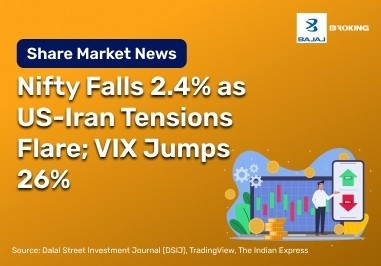
Nifty 50 dropped 2.4% on July 8, 2026, its largest single-day fall since March, as US strikes on Iranian military targets and Trump declaring the interim Iran deal triggered a sharp risk-off move across global markets.
Indian equity markets witnessed their sharpest single-session decline since March 19, 2026, on July 8, as rising geopolitical tensions rattled investor sentiment. The Nifty 50 was trading at 23,838, down around 2.4% for the day, while the BSE Sensex also slipped about 2.4%. The Nifty had touched an intraday high of 24,300 before heavy selling gathered pace through the afternoon. At the same time, India VIX, the exchange's volatility gauge, jumped 28%, its biggest single-day rise in recent weeks, signalling that traders were preparing for more market swings.
The sell-off came after a sharp escalation in the conflict between the United States and Iran. On July 8, 2026, the US Central Command said it had carried out strikes on more than 80 Iranian military targets following attacks on merchant vessels in the Strait of Hormuz, one of the world's busiest oil shipping routes. In its statement, the US military said the strikes were aimed at imposing high costs for attacks on commercial shipping in international waters.
Market sentiment deteriorated further after US President Donald Trump, speaking on the sidelines of the NATO summit in Ankara, said the interim agreement with Iran was effectively over. "For me, I think it's over. It's just a waste of time dealing with them," he told reporters. At the same time, he left the door open for talks on a broader peace arrangement. Even so, the combination of military action and uncertainty over diplomacy unsettled investors across global markets.
Brent crude prices have climbed roughly 9% over the past two sessions as fears of supply disruptions increased. The Strait of Hormuz connects the Persian Gulf with the Arabian Sea and carries a significant share of the world's seaborne crude oil. Any disruption in this route tends to push oil prices higher.
For India, that matters because the country imports most of its crude oil. Higher oil prices can widen the trade deficit, weaken the rupee, add to inflationary pressure and increase costs for industries such as aviation, logistics, paints and chemicals.
The Indian rupee weakened against the US dollar, with the USD/INR rate trading at 95.54, up 0.62% for the session. A weaker currency makes imports more expensive and often weighs on market sentiment.
The cautious mood was also visible overseas. The yield on the US 10-year Treasury rose to 4.6%, suggesting investors were moving towards the dollar. Gold slipped 1.06% to around $4,056 per ounce despite the geopolitical tensions. Dow Jones Futures were down 574.9 points, or 1.08%, at 52,605.4, pointing to a weak start for US markets. Nasdaq futures were also trading near their lowest level in four weeks, showing that investors remained cautious.
Markets are likely to remain sensitive as long as tensions in the Middle East persist. If crude oil prices continue to rise, India could face higher inflation, pressure on the rupee and rising input costs for several sectors. The sharp jump in India VIX also suggests traders expect volatility to remain elevated in the coming days.
However, the steep drop of 2.4% in the Nifty 50 index witnessed on July 8 was the worst daily performance since March 19, which indicated that investor sentiments were becoming increasingly worried about the mounting tension between the US and Iran. The hike in the price of crude oil, the depreciated value of the rupee, and market volatility are all signs of an uncertain market for investors.
Source: Dalal Street Investment Journal (DSIJ), BSE, NSE
SEBI Registered Research Analyst (INH000006396).
Founded in 1986, Dalal Street Investment Journal (DSIJ) brings decades of experience in India’s equity markets. DSIJ's research combines fundamental analysis with price action, guided by disciplined risk management and capital preservation. They follow a structured, data-driven approach designed to help investors and traders make informed decisions beyond short-term market noise.

Disclaimer :
Investments in the securities market are subject to market risk, read all related documents carefully before investing. This content is for educational purposes only. Securities quoted are exemplary and not recommendatory.
The information on this website is provided on "AS IS" basis. Bajaj Broking (BFSL) does not warrant the accuracy of the information given herein, either expressly or impliedly, for any particular purpose and expressly disclaims any warranties of merchantability or suitability for any particular purpose. While BFSL strives to ensure accuracy, it does not guarantee the completeness, reliability, or timeliness of the information. Users are advised to independently verify details and stay updated with any changes.
The information provided on this website is for general informational purposes only and is subject to change without prior notice. BFSL shall not be responsible for any consequences arising from reliance on the information provided herein and shall not be held responsible for all or any actions that may subsequently result in any loss, damage and or liability. Interest rates, fees, and charges etc., are revised from time to time, for the latest details please refer to our Pricing page.
Neither the information, nor any opinion contained in this website constitutes a solicitation or offer by BFSL or its affiliates to buy or sell any securities, futures, options or other financial instruments or provide any investment advice or service.
BFSL is acting as distributor for non-broking products/ services such as IPO, Mutual Fund, Insurance, PMS, and NPS. These are not Exchange Traded Products. For more details on risk factors, terms and conditions please read the sales brochure carefully before investing.
Content Partner - Dalal Street Investment Journal Wealth Advisory Private Limited
This article is for educational purposes only and should not be considered investment advice. Market investments are subject to risks. DSIJ Wealth Advisory Private Limited is a SEBI-registered Research Analyst (Reg. No: INH000006396) and Investment Adviser (Reg. No: INA000001142). Please consult your financial adviser before investing.
For more disclaimer, check here : https://www.bajajbroking.in/disclaimer
Level up your stock market experience: Download the Bajaj Broking App for effortless investing and trading

Enjoy low brokerage on delivery trades
|
Open Your Free Demat Account
Enjoy low brokerage on delivery trades
|


