
Get Free Demat Account*





Open Your Free Demat Account
Enjoy low brokerage on delivery trades
By Dalal Street Investment Journal (DSIJ)
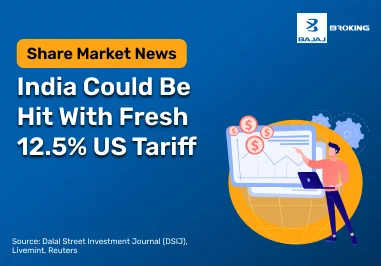
India could be subjected to an additional 12.5% US tariff after the USTR found it failed to adequately prohibit and enforce restrictions on goods produced using forced labour. The proposal, part of a Section 301 investigation covering 60 economies, is open for public consultation. India has opposed the findings and urged the US to terminate the probe.
India could face an additional 12.5% tariff on exports to the United States after the Office of the United States Trade Representative (USTR) concluded that India and several other economies have failed to adequately prohibit and enforce restrictions on imports of goods produced using forced labour.
The proposed action comes under Section 301 of the US Trade Act of 1974, which allows the US government to impose trade measures against countries whose policies are deemed to burden or restrict US commerce.
The USTR announced on June 3 that investigations launched in March had found that the acts, policies and practices of 60 economies regarding forced labour imports were “unreasonable” and negatively affected American trade interests.
According to the USTR findings, India is among 54 economies that have neither imposed nor effectively enforced a prohibition on the importation of goods produced through forced labour.
Countries placed in this category include China, Australia, Brazil, Japan, South Korea, the United Kingdom, Saudi Arabia, Singapore, Switzerland, Thailand, Vietnam and the United Arab Emirates.
Products imported into the US from these economies could face an additional tariff of 12.5% if the proposal is implemented.
The USTR stated that countries which have adopted a forced labour import prohibition, committed to doing so under trade agreements, or have partially implemented such measures would face a lower additional tariff of 10%.
The USTR identified six economies that have existing prohibitions but have failed to effectively enforce them. These economies are Canada, Ecuador, the European Union, Indonesia, Mexico and Pakistan.
Imports from these economies would be subject to an additional 10% tariff under the proposal.
The agency said the distinction was based on whether countries had established and effectively enforced laws preventing the import of goods linked to forced labour.
US Trade Representative Jamieson Greer defended the proposed tariffs, stating that the failure of major trading partners to address forced labour imports creates unfair competition for American workers.
According to Greer, American workers are being forced to compete on an uneven playing field when imported products benefit from lower costs associated with forced labour practices.
The USTR said the additional duties are intended to discourage such practices globally and ensure fairer trade conditions for US businesses and workers.
The proposed tariffs represent the latest effort by President Donald Trump’s administration to pursue alternative trade measures after a recent US Supreme Court ruling limited the president’s authority to impose broad tariffs without congressional approval.
Following the court decision, US officials initiated a series of trade investigations aimed at establishing a stronger legal basis for imposing long-term tariffs on trading partners.
The forced labour investigations are part of that broader strategy and could become a significant new trade tool if approved.
India has strongly challenged the USTR investigation and argued that the probe did not satisfy the legal requirements necessary for initiating a Section 301 action.
In its submission to the USTR, India requested the termination of the investigation and urged US authorities to issue a negative determination.
India stated that it remains willing to engage constructively with the United States while seeking the closure of the probe.
The proposed tariffs include several exemptions.
Products such as beef, coffee and certain fruits and nuts would be exempt from the additional duties.
Goods imported from Canada and Mexico that comply with the North American free trade agreement would also be excluded from the tariffs. Certain textile and apparel products are expected to receive exemptions as well.
The USTR has invited interested parties to participate in the consultation process before a final decision is made.
Requests to appear at the hearings, along with summaries of testimony, must be submitted by June 22. Written comments can be filed until July 6.
Public hearings on the proposed tariff measures are scheduled to begin on July 7 before a Section 301 panel.
The outcome of these hearings will play a key role in determining whether the proposed additional tariffs of 10% and 12.5% are ultimately imposed on imports from the affected economies, including India.
Source: Dalal Street Investment Journal, BSE
Disclaimer :
Investments in securities market are subject to market risk, read all related documents carefully before investing. This content is for educational purposes only. Securities quoted are exemplary and not recommendatory.
The information on this website is provided on "AS IS" basis. Bajaj Broking (BFSL) does not warrant the accuracy of the information given herein, either expressly or impliedly, for any particular purpose and expressly disclaims any warranties of merchantability or suitability for any particular purpose. While BFSL strives to ensure accuracy, it does not guarantee the completeness, reliability, or timeliness of the information. Users are advised to independently verify details and stay updated with any changes.
The information provided on this website is for general informational purposes only and is subject to change without prior notice. BFSL shall not be responsible for any consequences arising from reliance on the information provided herein and shall not be held responsible for all or any actions that may subsequently result in any loss, damage and/or liability. Interest rates, fees, and charges etc., are revised from time to time, for the latest details please refer to our Pricing page.
Neither the information, nor any opinion contained in this website constitutes a solicitation or offer by BFSL or its affiliates to buy or sell any securities, futures, options or other financial instruments or provide any investment advice or service.
BFSL is acting as distributor for non-broking products/ services such as IPO, Mutual Fund, Insurance, PMS, and NPS. These are not Exchange Traded Products. For more details on risk factors, terms and conditions please read the sales brochure carefully before investing.
Content Partner - Dalal Street Investment Journal Wealth Advisory Private Limited
This article is for educational purposes only and should not be considered investment advice. Market investments are subject to risks. DSIJ Wealth Advisory Private Limited is a SEBI-registered Research Analyst (Reg. No: INH000006396) and Investment Adviser (Reg. No: INA000001142). Please consult your financial adviser before investing.
For more disclaimer, check here : https://www.bajajbroking.in/disclaimer
Level up your stock market experience: Scan the QR to download the Bajaj Broking App for effortless investing and trading

Enjoy low brokerage on delivery trades
|
Open Your Free Demat Account
Enjoy low brokerage on delivery trades
|


