
Get Free Demat Account*










Open Your Free Demat Account
Enjoy low brokerage on delivery trades
By Dalal Street Investment Journal (DSIJ)
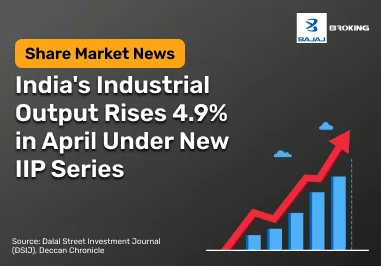
India's Index of Industrial Production (IIP) grew 4.9% in April 2026 under the revamped FY23-based series. Manufacturing output rose 6.2%, while mining contracted 5.1% amid disruptions linked to the West Asia crisis. The revised index now covers 1,042 products across 463 item groups, including 120 new additions. Capital goods output surged 16%, indicating sustained investment activity and economic momentum.
According to the data provided by the Ministry of Statistics & Programme Implementation (MoSPI) on June 1, 2026, India’s industrial production grew 4.9% in April 2026, based on the Index of Industrial Production (IIP). It must be noted that the new IIP series was also launched on the same day, which now uses 2022-23 as its base year instead of 2011-12.
For context, factory output had grown 5.7% in April 2025, meaning the April 2026 reading reflects a modest deceleration on a YoY basis. However, the change in base year makes direct comparison with the old series difficult.
The revised basket under the new series consists of 1,042 products mapped to 463 item groups, including 120 new item groups. The revised base year was undertaken by the Technical Advisory Committee for Base Year Revision of the All India Index of Industrial Production (TAC-IIP). This committee published its report on May 25, 2026.
The revised series, on the other hand, gives more detail, including individual indices for production of electricity from renewables and non-renewables, gas, fuel minerals, metallic
minerals, non-metallic minerals, water supply, sewerage, and waste management. These additions bring the index closer to the current structure of the Indian economy.
Among the 120 new item groups added are cards with a magnetic stripe (debit and credit cards), CCTV cameras, articles of non-woven textiles, parts of aircraft and spacecraft, stents, and vaccines. At the same time, 64 item groups have been removed, including kerosene, fluorescent tubes and CFLs, and tubes for bicycle, tricycle, rickshaw, and LMV tires. This reflects how industrial priorities in the country have evolved over the past decade.
This marks the 10th revision of the IIP base year, with the first series having been prepared with a base year of 1937.
The rate of growth in the following four industries: mining and quarrying; manufacturing; generation of electricity and supply of gas; and water supply, sewerage, and waste management was -5.1%, 6.2%, 4.9%, and 6.6%, respectively. The estimated value of the IIP stood at 118.9, while in April 2025 it was 113.1
Manufacturing, which carries the largest weight in the index, was the primary driver of overall growth, posting 6.2% expansion. The water supply and waste management segment also recorded healthy growth at 6.6%, reflecting increasing coverage and activity in civic infrastructure. Electricity and gas supply grew at 4.9%, though its pace was constrained by the ongoing West Asia crisis, which has added pressure on energy supply chains and input costs globally.
Mining and quarrying was the only sector to contract, falling 5.1%. This is a notable reversal and suggests stress in extraction activity, though the precise contributors at a sub-sector level will become clearer in subsequent detailed releases.
Capital goods recorded growth of 16%, which industry body Assocham described as a strong indicator of enhanced investment and aggregate demand in the economy. Intermediate goods increased by 7.7%, infrastructure and construction goods saw an increase of 7.1%, and durable consumer goods posted a gain of 4.3%.
The growth in capital goods exceeding 15% can be considered an indicator of planned investments by businesses and the government, since the figure covers expenditure in machinery and other items utilised in manufacturing processes. Growth of infrastructure and construction goods at 7.1% also fits into the plans made by the central government.
Saurabh Garg, secretary, MoSPI, pointed out that the revised IIP index fills in the gaps in the old basket by including minor minerals and by giving more weightage to plastic, rubber, and automobiles. This has been done keeping in mind their increasing proportion in the industrial production of India.
The figures from the Industrial Production Index for April 2026, according to the revised series, show that industrial production is quite robust but not equally robust across all industries. Both the manufacturing sector and the infrastructure sector have performed very well, but this can be seen from the performance of the capital goods sector. The mining sector has performed poorly, while underperformance in the energy sector is of great concern considering the challenges associated with energy and raw materials.
Source: Dalal Street Investment Journal (DSIJ), Deccan Chronicle, MoSPI
Disclaimer :
Investments in securities market are subject to market risk, read all related documents carefully before investing. This content is for educational purposes only. Securities quoted are exemplary and not recommendatory.
The information on this website is provided on "AS IS" basis. Bajaj Broking (BFSL) does not warrant the accuracy of the information given herein, either expressly or impliedly, for any particular purpose and expressly disclaims any warranties of merchantability or suitability for any particular purpose. While BFSL strives to ensure accuracy, it does not guarantee the completeness, reliability, or timeliness of the information. Users are advised to independently verify details and stay updated with any changes.
The information provided on this website is for general informational purposes only and is subject to change without prior notice. BFSL shall not be responsible for any consequences arising from reliance on the information provided herein and shall not be held responsible for all or any actions that may subsequently result in any loss, damage and/or liability. Interest rates, fees, and charges etc., are revised from time to time, for the latest details please refer to our Pricing page.
Neither the information, nor any opinion contained in this website constitutes a solicitation or offer by BFSL or its affiliates to buy or sell any securities, futures, options or other financial instruments or provide any investment advice or service.
BFSL is acting as distributor for non-broking products/ services such as IPO, Mutual Fund, Insurance, PMS, and NPS. These are not Exchange Traded Products. For more details on risk factors, terms and conditions please read the sales brochure carefully before investing.
Content Partner - Dalal Street Investment Journal Wealth Advisory Private Limited
This article is for educational purposes only and should not be considered investment advice. Market investments are subject to risks. DSIJ Wealth Advisory Private Limited is a SEBI-registered Research Analyst (Reg. No: INH000006396) and Investment Adviser (Reg. No: INA000001142). Please consult your financial adviser before investing.
For more disclaimer, check here : https://www.bajajbroking.in/disclaimer
Level up your stock market experience: Scan the QR to download the Bajaj Broking App for effortless investing and trading

Enjoy low brokerage on delivery trades
|
Open Your Free Demat Account
Enjoy low brokerage on delivery trades
|


