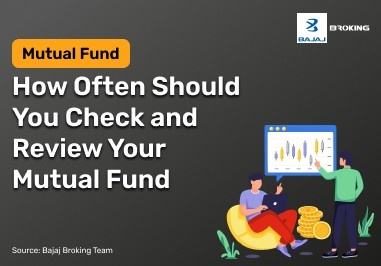
How Often Should You Review Your Mutual Fund Investments?

    Summary:


    Reviewing your mutual fund investments at the right frequency helps you keep your portfolio aligned with your goals without triggering unnecessary decisions. Checking too often leads to panic-driven switches, while never reviewing means underperformance goes unnoticed. This article goes in depth on how often to review, what to look for, when to act immediately, and which tools make the process simple and effective.

    Investing in mutual funds is not a one-time decision. But checking your portfolio every day is not the answer either.

    The right review frequency keeps your money working towards your goals without the stress of constant monitoring. Too many checks lead to emotional decisions. Too few mean a quietly underperforming fund goes unnoticed for years.

    Knowing how often you should check and review your mutual fund, what to look at during each review, and when to act immediately gives you the confidence to stay invested without second-guessing every market move. 

    A structured, periodic review is something almost all investors need to stay on track.

    Importance of Regular Mutual Fund Review

    A lot of investors either never look at their portfolio or check it every single day. Both extremes cause problems. Not reviewing at all means you may be holding a fund that has quietly stopped performing well. 

    Checking too often leads to panic selling and unnecessary switching that costs you money. Regular reviews help you stay on top of things without overreacting. Here is why it matters:

    • Your life changes over time, and your investments need to keep up with those changes

    • A fund that was right for you two years ago may not suit your current goal or risk level

    • Regular checks help you spot a genuinely underperforming fund before too much damage is done

    • You can make sure your money is still split between equity and debt the way you originally planned

    • It helps you stay disciplined and not make rushed decisions based on news or short term market noise

    • Reviewing lets you track whether you are on course to reach your financial goal on time

    • It gives you a clear picture of your overall portfolio without having to scramble for information at the last minute

    Recommended Frequency to Review Mutual Funds

    There is no single rule that fits everyone, but there are some sensible guidelines that work for most investors. Here is a practical way to think about it:

    • For long term equity funds, once a year is enough for a proper review. These funds need time to grow and too many checks lead to unnecessary changes

    • For debt funds or short term investments, checking once every three to six months makes more sense since these are more sensitive to interest rate changes

    • If you have a Systematic Investment Plan (SIP) running, a quick look every six months is fine to make sure the fund is still on track

    • When markets go through a big swing, either up or down, a review makes sense just to confirm your portfolio is still balanced the way you want

    • If your personal situation changes, such as a new job, marriage, a child, or retirement planning, that is always a good trigger for a review

    • Avoid checking daily or weekly. It creates anxiety and pushes you towards decisions based on emotion rather than logic

    • The goal of a review is not to find a reason to switch funds. It is to confirm that everything is still going in the right direction

    Key Factors to Consider During Mutual Fund Review

    When you sit down to review your portfolio, knowing what to look at saves time and helps you make better decisions. Here is what actually matters:

    • Compare the fund's returns with its benchmark index over one year, three years, and five years. A good fund should not be lagging its benchmark consistently

    • Check how the fund has done compared to other funds in the same category. One bad year is fine but consistent underperformance is a warning sign

    • Look at the expense ratio. If a fund is charging more than similar funds without giving better returns, it is worth questioning

    • See if the fund manager has changed recently. A new manager may have a different style that changes how the fund behaves

    • Check whether your overall portfolio is still balanced the way you planned. Markets move and the split between equity and debt can drift over time

    • Think about whether your own goal or timeline has changed and whether the fund still fits

    • Look at the exit load period before making any switch, so you do not end up paying an unnecessary penalty

    How to Effectively Review Your Mutual Fund Portfolio

    Reviewing your portfolio does not need to be complicated. Here is a simple and clear way to do it:

    • Start by writing down what each fund in your portfolio is supposed to do for you. Is it for retirement, a house, your child's education? Knowing the purpose helps you judge it correctly

    • Pull up the fund's fact sheet from the fund house website. It gives you everything from returns to portfolio composition to the expense ratio

    • Check the one-year, three-year, and five-year returns and compare them with the fund's category average

    • Look at whether the equity-to-debt split in your overall portfolio has shifted. If equity has grown a lot your portfolio may now carry more risk than you intended

    • If rebalancing is needed, move money from the asset that has grown too much into the one that has fallen behind

    • Do not switch a fund just because it had one bad quarter. Look at performance over a longer period before making that call

    • Keep a simple record of your review with the date, what you checked, and what you decided. This helps you track your thinking over time

    Signs You Should Review Your Mutual Fund Immediately

    Sometimes you do not need to wait for your yearly review. Certain things are a clear signal to take a closer look right away:

    • Your fund has been underperforming its benchmark and similar funds for two to three years in a row without any recovery

    • The fund manager has changed and the new person has a very different investment approach from the previous one

    • The fund house itself has gone through major changes like a merger or a change in ownership

    • Your own financial situation has changed significantly, a job loss, a medical emergency, or a big new goal that needs planning

    • You are getting much closer to the date when you actually need the money and the fund you hold carries too much risk for that timeline

    • The overall mix of your portfolio has shifted too far from what you originally set up due to market movements

    • You notice the fund's expense ratio has gone up without any explanation or improvement in returns

    These are genuine reasons to sit down and take stock. A dip in returns for a month or two is not.

    Tools and Resources for Mutual Fund Monitoring

    You do not need to be an expert to keep track of your investments. There are some simple tools and resources that make it easy:

    • The fund house website publishes a monthly fact sheet for every scheme. It covers returns, portfolio holdings, expense ratio, and the fund manager's commentary

    • Your investment platform or broker app usually has a portfolio tracker built in that shows you how each fund is doing and your overall gain or loss

    • The Association of Mutual Funds in India (AMFI) website has data on all registered mutual funds, including their Net Asset Value (NAV) history

    • Credit rating agencies and independent research platforms publish fund ratings and analysis that can give you a second opinion on your fund

    • If you are investing through a registered advisor they can help you review your portfolio and flag anything that needs attention

    • Setting a reminder on your phone once or twice a year for a portfolio check takes two minutes and makes sure you never let too much time pass without a look

    • Keeping a simple spreadsheet with your fund name, the amount invested, the date of investment, and the current value gives you a clear picture at a glance without needing any fancy tool

    Frequently Asked Questions

    Published Date : 04 Jul 2026

    Disclaimer :

    Investments in the securities market are subject to market risk, read all related documents carefully before investing. This content is for educational purposes only. Securities quoted are exemplary and not recommendatory.


    The information on this website is provided on "AS IS" basis. Bajaj Broking (BFSL) does not warrant the accuracy of the information given herein, either expressly or impliedly, for any particular purpose and expressly disclaims any warranties of merchantability or suitability for any particular purpose. While BFSL strives to ensure accuracy, it does not guarantee the completeness, reliability, or timeliness of the information. Users are advised to independently verify details and stay updated with any changes. The securities are quoted as an example and not as a recommendation. Past performance is not necessarily a guide to future performance.

    The information provided on this website is for general informational purposes only and is subject to change without prior notice. BFSL shall not be responsible for any consequences arising from reliance on the information provided herein and shall not be held responsible for all or any actions that may subsequently result in any loss, damage and or liability. Interest rates, fees, and charges etc., are revised from time to time, for the latest details please refer to our Pricing page.

    Neither the information, nor any opinion contained in this website constitutes a solicitation or offer by BFSL or its affiliates to buy or sell any securities, futures, options or other financial instruments or provide any investment advice or service.

    BFSL is acting as distributor for non-broking products/ services such as IPO, Mutual Fund, Insurance, PMS, and NPS. These are not Exchange Traded Products. For more details on risk factors, terms and conditions please read the sales brochure carefully before investing.


    Content Partner - Dalal Street Investment Journal Wealth Advisory Private Limited


    This article is for educational purposes only and should not be considered investment advice. Market investments are subject to risks. DSIJ Wealth Advisory Private Limited is a SEBI-registered Research Analyst (Reg. No: INH000006396) and Investment Adviser (Reg. No: INA000001142). Please consult your financial adviser before investing. 

    For more disclaimer, check here : https://www.bajajbroking.in/disclaimer

    Read More Blogs

    Our Secure Trading Platforms

    Level up your stock market experience: Download the Bajaj Broking App for effortless investing and trading

    QR code to download Bajaj Broking App

    9 lakh+ Users

    icon-with-text

    4.9 App Rating

    icon-with-text

    4 Languages

    icon-with-text

    ₹7,300 Cr+ MTF Book

    icon-with-text
    banner-icon

    Open Your Free Demat Account

    Enjoy low brokerage on delivery trades

    +91

    |

    Open Your Free Demat Account

    Enjoy low brokerage on delivery trades

    +91

    |