









Open Your Free Demat Account
Enjoy low brokerage on delivery trades
 April 10, 2026
 2 mins read
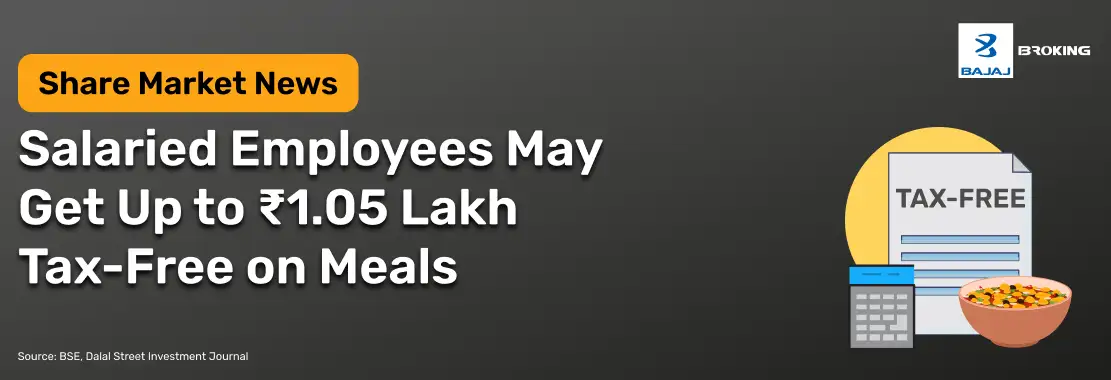
Meal vouchers are back in focus after the Income Tax Rules, 2026 increased the tax free limit to up to ₹200 per meal with effect from April 1, 2026. For salaried employees, this may translate into a meaningful annual tax free benefit, subject to employer policy and compliance with the specified conditions.
Imagine saving yourself thousands on taxes with what you eat every day. Yet, quite a lot of salaried employees rely only on their payslips and fail to avail these seemingly simple tax-saving options.
This is where employee benefits come into action. It is important to note that they are not just small perks but smart tools that can reduce your taxable income when structured correctly.
And now, there’s even better news. The Indian Government has updated the Income-tax rules 2026 with changes to make meal vouchers more tax-friendly. By this update, the tax-free limit for employer-provided food has been enhanced, effective from April 01, 2026 (FY 2026-27), thereby reducing the money out of your pocket every month.
In the old system, meals supplied by an employer free of cost were subject to a partial income tax exemption:
Where the meal cost exceeds ₹50, the amount in excess of ₹50 would be taxable in the hands of the employee.
Only select provisions, such as meals in remote areas or during working hours, or snacks and beverages, were tax-free.
Under the new regime, the exemption has been raised to ₹200 per meal. Employees can now claim up to ₹1.05 lakh annually tax-free. Previously, employees would be able to claim only ₹26,400 per year. This is a jump of 300%.
In case of a hypothetical 2 meals/day with 22 working days/month, the tax-free benefit would be:
2 meals per day multiplied by ₹200 per meal multiplied by 22 days/month multiplied by 12 months
This equates to ₹1,05,600.
This benefit enables the employees to use the tax-free meal benefit for eating out in office cafeterias or at restaurants using non-transferable meal vouchers. It increases the disposable income and reduces the tax on day-to-day expenditure.
If you are in a 30% tax bracket, then new rules for meal vouchers could result in savings as much as ₹25,000 on your taxes every year. That amounts to almost ₹2,000 on a monthly basis and can quite easily account for your daily needs like groceries, subscriptions, etc. With the course of time, the same may go on to make a visible impact on your disposable income and that too without affecting your monthly salary.
The exemption is applied to:
1. Meals provided by employers while working at remote locations or on offshore installations at that point in time.
2. Tea, coffee or non-alcoholic drinks, and snacks while at work.
3. Food at the workplace or through non-transferable paid vouchers restricted to eateries approved by employers, up to a cost of ₹200 per meal.
Perquisites are benefits (non-monetary in nature) given by an employer to an employee, other than basic salary. Some examples of perquisites are meal vouchers, laptops, or gift cards. They are valued before income is computed, so if a benefit is excluded at this stage, it never becomes part of your taxable salary.
Don’t just accept the basic CTC structure. Discuss this with your HR/payroll department and get the eligible perquisites like meal vouchers and gift allowances included. You do not always need a higher salary; you need a smarter salary.
SEBI Registered Research Analyst (INH000006396).
Founded in 1986, Dalal Street Investment Journal (DSIJ) brings decades of experience in India’s equity markets. DSIJ's research combines fundamental analysis with price action, guided by disciplined risk management and capital preservation. They follow a structured, data-driven approach designed to help investors and traders make informed decisions beyond short-term market noise.

Disclaimer :
Investments in securities market are subject to market risk, read all related documents carefully before investing. This content is for educational purposes only. Securities quoted are exemplary and not recommendatory.
The information on this website is provided on "AS IS" basis. Bajaj Broking (BFSL) does not warrant the accuracy of the information given herein, either expressly or impliedly, for any particular purpose and expressly disclaims any warranties of merchantability or suitability for any particular purpose. While BFSL strives to ensure accuracy, it does not guarantee the completeness, reliability, or timeliness of the information. Users are advised to independently verify details and stay updated with any changes.
The information provided on this website is for general informational purposes only and is subject to change without prior notice. BFSL shall not be responsible for any consequences arising from reliance on the information provided herein and shall not be held responsible for all or any actions that may subsequently result in any loss, damage and/or liability. Interest rates, fees, and charges etc., are revised from time to time, for the latest details please refer to our Pricing page.
Neither the information, nor any opinion contained in this website constitutes a solicitation or offer by BFSL or its affiliates to buy or sell any securities, futures, options or other financial instruments or provide any investment advice or service.
BFSL is acting as distributor for non-broking products/ services such as IPO, Mutual Fund, Insurance, PMS, and NPS. These are not Exchange Traded Products. For more details on risk factors, terms and conditions please read the sales brochure carefully before investing.
Content Partner - Dalal Street Investment Journal Wealth Advisory Private Limited
This article is for educational purposes only and should not be considered investment advice. Market investments are subject to risks. DSIJ Wealth Advisory Private Limited is a SEBI-registered Research Analyst (Reg. No: INH000006396) and Investment Adviser (Reg. No: INA000001142). Please consult your financial adviser before investing.
For more disclaimer, check here : https://www.bajajbroking.in/disclaimer
Level up your stock market experience: Scan the QR to download the Bajaj Broking App for effortless investing and trading

Enjoy low brokerage on delivery trades
|
Open Your Free Demat Account
Enjoy low brokerage on delivery trades
|


