
Get Free Demat Account*









Open Your Free Demat Account
Enjoy low brokerage on delivery trades
By Dalal Street Investment Journal (DSIJ)
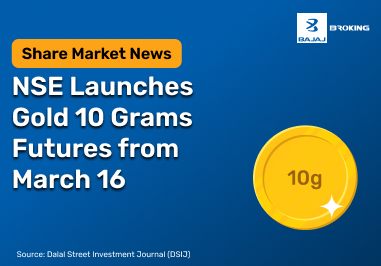
NSE will launch Gold 10-gram Futures (GOLD10G) in the commodity derivatives segment from March 16, 2026. The contract is traded in 10-gram units with a tick size of Re 1 and follows monthly expiry on the last calendar day of the contract month. Traders should note the daily price limit of 6%, extendable to 9%.
India’s commodity derivatives market is getting a more “retail-sized” gold futures contract. The National Stock Exchange of India (NSE) has announced the launch of Gold 10-gram Futures after receiving regulatory approval, and trading will begin on March 16, 2026.
NSE is introducing a Gold 10 grams Futures contract in its Commodity Derivatives segment.
Key identifiers you’ll see on the terminal
Product: Gold Futures
Symbol: GOLD10G
Contract description format: GOLD10GYYMMM
Instrument type: Futures contract (FUTBLN)
This contract is designed around a 10-gram trading unit. That’s the core sizing.
Contract basics
Trading unit: 10 grams
Quotation/base value: 10 grams
Tick size (minimum price movement): Re. 1 per 10 grams
What this means in practice
If the price moves from ₹62,000 to ₹62,050 (per 10 g), that’s a 50-tick move.
Your profit/loss is directly tied to movement per 10 grams, not per 1 gram or per 1 kg.
NSE specifies the price quote as Ex-Ahmedabad. Importantly, it’s inclusive of import duty and customs-related levies, but it excludes GST and any additional GST-related levies/surcharges.
Also Read: Gold Price Today in India
Trading period: Monday to Friday
Trading session: 9:00 AM to 11:30 PM / 11:55 PM (The latter close depends on the US daylight saving time period.)
This is a monthly contract.
Expiry / last trading day
Last trading day (contract expiry): the last calendar day of the expiry month.
If that day is a holiday, expiry shifts to the preceding working day.
Contract commencement day
New contract starts on the business day immediately after the last trading day (Expiry Day + 1).
Launch calendar (what months are listed first)
NSE has provided a contract launch calendar beginning March 16, 2026, and the initial expiries include April 2026 and May 2026, followed by a rolling monthly sequence extending up to March 2027.
Maximum order size: 10 kg
This is an order-entry control—useful for risk containment and market stability.
NSE has defined a structured circuit-style mechanism:
Base daily price limit: 6%
If the 6% limit is breached, after a 15-minute cooling-off, the limit can be relaxed up to 9%.
If international market movement is beyond the domestic limit range (after currency conversion and comparison with the previous close), NSE may relax further in steps of 3% beyond the maximum permitted limit, with due notice.
In exceptional circumstances, where there is extreme movement beyond the initial slab, the daily price limit may be relaxed directly to the required level with notice.
Circular lays out the framework for margins:
Initial margin: minimum margin based on volatility category or SPAN, whichever is higher.
Extreme loss margin (ELM): 1%
Additional/special margins can be imposed during higher volatility—either on both buy & sell positions or on one side, as deemed fit.
What is ELM (Extreme Loss Margin)?
ELM stands for Extreme Loss Margin.
It is an additional margin collected by the exchange/clearing corporation to protect against unexpected, extreme market movements beyond what is covered by normal initial (SPAN) margin.
The circular provides open position limits across all gold contracts combined:
For a member (all clients collectively)
50 MT or 20% of the market-wide open position, whichever is higher.
For an individual client
5 MT or 5% of the market-wide open position, whichever is higher.
These limits matter most when liquidity grows, and larger traders start building size.
For mark-to-market (MTM), the daily settlement price is based on the closing price of the contract.
And the closing price computation is method-driven:
Uses the last half-hour weighted average price, subject to a minimum of 10 trades in the last half-hour, or
Weighted average price of the last 10 trades of the day, or
Any other price method as decided by the relevant authority from time to time.
This is not a “cash-only” settlement contract. The delivery framework is clearly spelt out.
Delivery basics
Delivery unit: 10 grams
Delivery logic: Compulsory
On expiry, all open positions are marked for delivery.
Delivery pay-in: on an E + 1 basis by 11:00 AM, except Saturdays, Sundays and trading holidays.
Staggered delivery period
The last three working days, including the expiry day.
Delivery centre
Designated clearing house facilities at Ahmedabad.
Quality specifications (what can be delivered)
999 purity, serially numbered gold 10-gram bars supplied by LBMA-approved suppliers (or other suppliers approved by NSE), along with the supplier’s quality certificate.
Also Read: Silver Rate Today in India
During the delivery period, margins are set higher than:
3% + 5-day 99% VaR of spot price volatility, or
20%
This is the exchange telling you, plainly: delivery week is not the time to be undermargined.
NSE will announce the Final Settlement Price (FSP) based on the Ahmedabad spot price for Gold (10 gms) of 995 purity, converted to 999 purity using:
FSP reference conversion:
995 spot price × 999/995
This price is polled on the expiry day by around 5:00 PM.
If the polled spot price isn’t available due to emergency physical market closure at the basis centre, NSE will decide the course of action in consultation with SEBI.
SEBI Registered Research Analyst (INH000006396).
Founded in 1986, Dalal Street Investment Journal (DSIJ) brings decades of experience in India’s equity markets. DSIJ's research combines fundamental analysis with price action, guided by disciplined risk management and capital preservation. They follow a structured, data-driven approach designed to help investors and traders make informed decisions beyond short-term market noise.

Disclaimer :
Investments in the securities market are subject to market risk, read all related documents carefully before investing. This content is for educational purposes only. Securities quoted are exemplary and not recommendatory.
The information on this website is provided on "AS IS" basis. Bajaj Broking (BFSL) does not warrant the accuracy of the information given herein, either expressly or impliedly, for any particular purpose and expressly disclaims any warranties of merchantability or suitability for any particular purpose. While BFSL strives to ensure accuracy, it does not guarantee the completeness, reliability, or timeliness of the information. Users are advised to independently verify details and stay updated with any changes.
The information provided on this website is for general informational purposes only and is subject to change without prior notice. BFSL shall not be responsible for any consequences arising from reliance on the information provided herein and shall not be held responsible for all or any actions that may subsequently result in any loss, damage and or liability. Interest rates, fees, and charges etc., are revised from time to time, for the latest details please refer to our Pricing page.
Neither the information, nor any opinion contained in this website constitutes a solicitation or offer by BFSL or its affiliates to buy or sell any securities, futures, options or other financial instruments or provide any investment advice or service.
BFSL is acting as distributor for non-broking products/ services such as IPO, Mutual Fund, Insurance, PMS, and NPS. These are not Exchange Traded Products. For more details on risk factors, terms and conditions please read the sales brochure carefully before investing.
Content Partner - Dalal Street Investment Journal Wealth Advisory Private Limited
This article is for educational purposes only and should not be considered investment advice. Market investments are subject to risks. DSIJ Wealth Advisory Private Limited is a SEBI-registered Research Analyst (Reg. No: INH000006396) and Investment Adviser (Reg. No: INA000001142). Please consult your financial adviser before investing.
For more disclaimer, check here : https://www.bajajbroking.in/disclaimer
Level up your stock market experience: Download the Bajaj Broking App for effortless investing and trading

Enjoy low brokerage on delivery trades
|
Open Your Free Demat Account
Enjoy low brokerage on delivery trades
|


