

Get Free Demat Account*













Open Your Free Demat Account
Enjoy low brokerage on delivery trades
By Dalal Street Investment Journal (DSIJ)
Nifty weekly expiry outlook: On the July 7 weekly expiry, Nifty failed to sustain above the 24,525 resistance level and slipped from its intraday high. PCR eased to 1.39 from 1.66, indicating stronger call writing. The 24,500 CE now holds maximum open interest, making it key resistance, while 24,450, backed by put writing and max pain, remains crucial support for the expiry trade today.
The Nifty 50 index touched an intraday high of around 24,530, but the move once again failed to sustain above the earlier highlighted resistance band of 24,482 to 24,525. This zone acted as a strong supply area, as expected, and the index trimmed more than 60 points from the day’s high.
As of 12:54 PM, Nifty was trading at 24,458, up 0.12 per cent. The price action clearly shows that bulls attempted to cross the 24,500 mark, but call writers defended the zone aggressively.
The Put Call Ratio (PCR) has declined to 1.39 from the earlier reading of 1.66. This change is important from an expiry perspective.
A higher PCR earlier suggested stronger put writing and a relatively supportive setup for the index. However, the fall in PCR indicates that call writing has picked up meaningfully, especially around the 24,500 strike. This shows that the upside is now facing more resistance compared with the previous update.
The decline in PCR does not suggest sharp weakness yet, but it does indicate that the earlier bullish comfort has reduced.
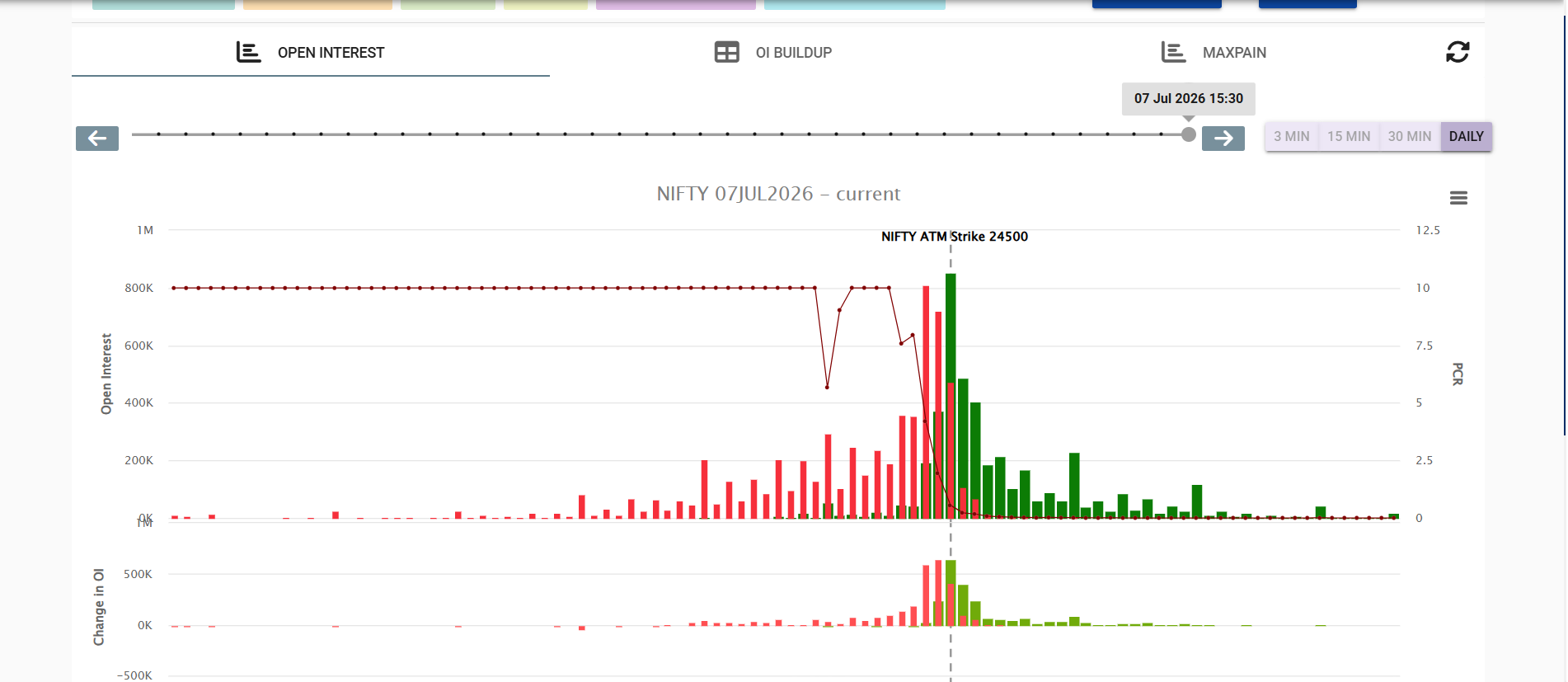
The most important change since the previous update is the sharp open interest addition at the 24,500 Call strike. Earlier, call writing was visible at 24,500 and 24,550, but now the 24,500 CE has become the strike with the highest open interest among all strikes for the July 7 expiry.
This clearly shows that option writers are expecting Nifty to remain below 24,500 into expiry. Since the index has already faced resistance near 24,530 and slipped back below 24,500, this level becomes the main battleground for the rest of the session.
If Nifty fails to sustain above 24,500, call writers will remain in control. However, a decisive move above 24,500 to 24,525 can force some call unwinding and may trigger a quick move towards 24,550.
On the Put side, significant open interest addition is visible at the 24,450 strike, followed by the 24,400 strike. The highest Put open interest concentration now stands at 24,450.
This suggests that put writers are trying to defend the 24,450 level. The max pain also stands at 24,450, making this level highly important for expiry-day movement.
As long as Nifty holds above 24,450, the index may remain range-bound with a slight positive bias. A break below 24,450 can weaken the setup and may drag the index towards 24,400.
The current data points to a narrow expiry for Nifty on July 7, in the range between 24,450 and 24,500. Put writers are active at 24,450, while call writers have built strong positions at 24,500.
Compared with the earlier update, the resistance at 24,500 has become stronger due to fresh call writing and the fall in PCR. At the same time, the 24,450 level remains the key support, supported by Put open interest and max pain.
For Nifty to regain strength, it needs to sustain above 24,500 to 24,525. Until then, the index may continue to face selling pressure on intraday bouncebacks.
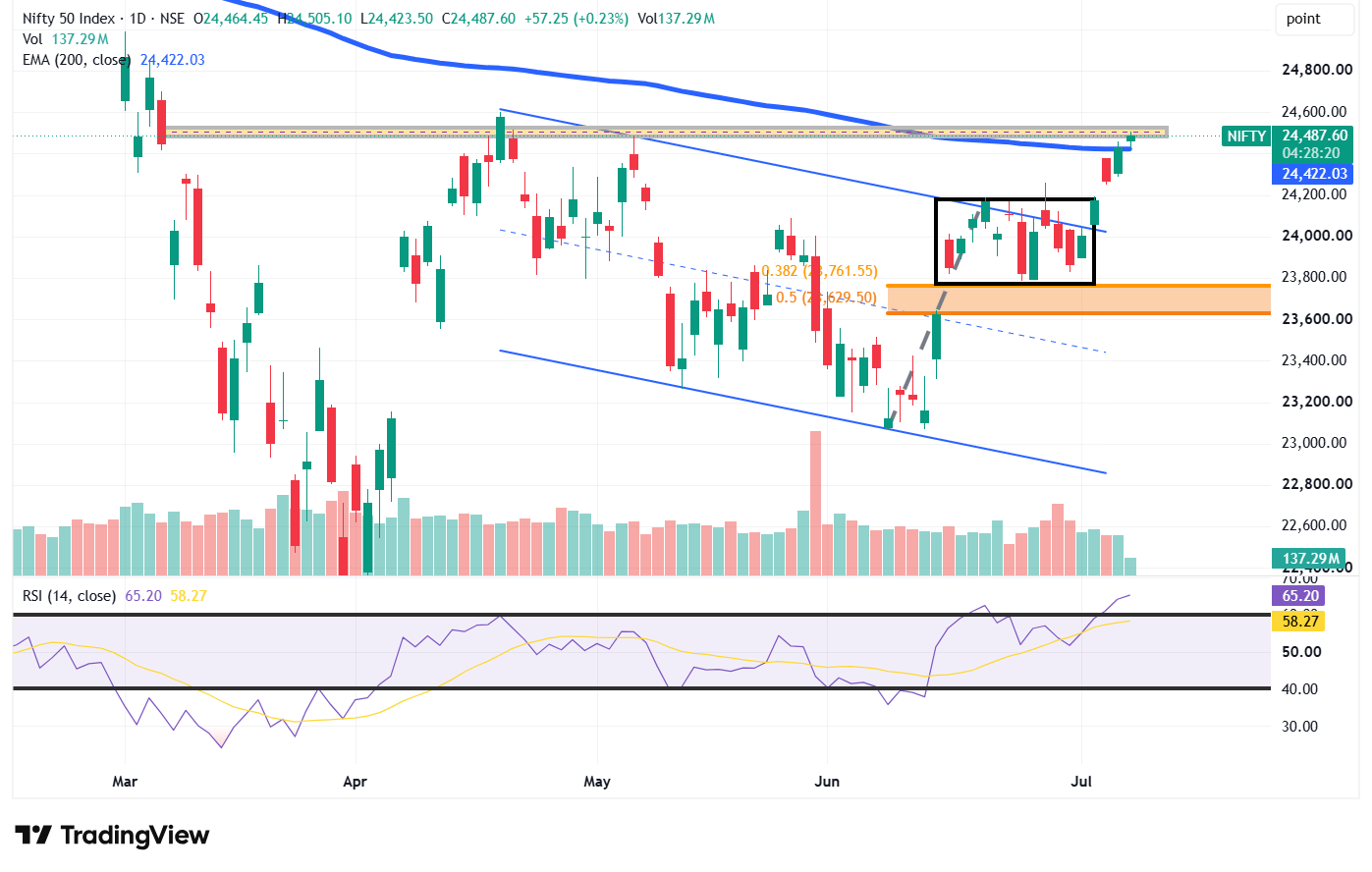
The Nifty 50 index opened the July 7 weekly expiry session on a positive note, but the early strength did not sustain for long. Soon after the opening, the index slipped and tested support around its 200-DEMA. This level once acted as an important intraday base, helping the index recover and move above the 24,500 mark during the session.
However, the recovery lacked follow-through at higher levels. After touching the day’s high, the index trimmed nearly 30 points and was trading at 24,473, up 42 points, as of 10:46 AM.
The zone of 24,482 to 24,525 continues to remain a crucial resistance area for the index. This band is important not only from a price-action perspective but also from an options data perspective.
The repeated inability to hold above this zone shows that sellers are active near higher levels. For bulls to gain better control, Nifty needs to sustain above this resistance band with strength. Until that happens, intraday rallies may continue to face supply near the 24,500 zone.
The Put-Call Ratio (PCR) stands at 1.66, indicating stronger put writing compared with call writing. The max pain for the July 7 Nifty expiry is placed at 24,450, suggesting that this level may remain an important reference point for expiry-day movement.
On the Put side, the 24,450 strike has seen significant open interest addition, followed by the 24,400 strike. This shows that put writers are building positions around these levels and are expecting the index to stay above this support zone.
On the Call side, open interest addition is visible at the 24,500 strike, followed by the 24,550 strike. The highest call open interest concentration is placed at 24,500, which aligns with the resistance band of 24,482 to 24,525.
The 24,500 level has become the key battleground for the current expiry. Call writers are active around this strike, which explains why Nifty is facing resistance near this zone. As long as the index remains below 24,500 to 24,525, call writers may continue to defend their positions.
However, if Nifty sustains above this resistance band, call writers may be forced to cover their positions. This can trigger short covering and push the index towards the 24,550 to 24,600 zone.
On the downside, 24,450 and 24,400 remain important support levels based on put writing. A fall below these levels may weaken the intraday structure and shift the expiry bias in favour of call writers.
For the rest of the session, 24,482 to 24,525 remains the immediate resistance zone. A sustained move above this range can support further upside towards 24,550 to 24,600.
On the lower side, 24,450 will be the first important support, followed by 24,400. The index staying above these levels would keep the expiry setup stable, while a break below them may increase selling pressure.
Source: Dalal Street Investment Journal (DSIJ), Opstra
SEBI Registered Research Analyst (INH000006396).
Founded in 1986, Dalal Street Investment Journal (DSIJ) brings decades of experience in India’s equity markets. DSIJ's research combines fundamental analysis with price action, guided by disciplined risk management and capital preservation. They follow a structured, data-driven approach designed to help investors and traders make informed decisions beyond short-term market noise.

Disclaimer :
Investments in the securities market are subject to market risk, read all related documents carefully before investing. This content is for educational purposes only. Securities quoted are exemplary and not recommendatory.
The information on this website is provided on "AS IS" basis. Bajaj Broking (BFSL) does not warrant the accuracy of the information given herein, either expressly or impliedly, for any particular purpose and expressly disclaims any warranties of merchantability or suitability for any particular purpose. While BFSL strives to ensure accuracy, it does not guarantee the completeness, reliability, or timeliness of the information. Users are advised to independently verify details and stay updated with any changes.
The information provided on this website is for general informational purposes only and is subject to change without prior notice. BFSL shall not be responsible for any consequences arising from reliance on the information provided herein and shall not be held responsible for all or any actions that may subsequently result in any loss, damage and or liability. Interest rates, fees, and charges etc., are revised from time to time, for the latest details please refer to our Pricing page.
Neither the information, nor any opinion contained in this website constitutes a solicitation or offer by BFSL or its affiliates to buy or sell any securities, futures, options or other financial instruments or provide any investment advice or service.
BFSL is acting as distributor for non-broking products/ services such as IPO, Mutual Fund, Insurance, PMS, and NPS. These are not Exchange Traded Products. For more details on risk factors, terms and conditions please read the sales brochure carefully before investing.
Content Partner - Dalal Street Investment Journal Wealth Advisory Private Limited
This article is for educational purposes only and should not be considered investment advice. Market investments are subject to risks. DSIJ Wealth Advisory Private Limited is a SEBI-registered Research Analyst (Reg. No: INH000006396) and Investment Adviser (Reg. No: INA000001142). Please consult your financial adviser before investing.
For more disclaimer, check here : https://www.bajajbroking.in/disclaimer
Level up your stock market experience: Download the Bajaj Broking App for effortless investing and trading

Enjoy low brokerage on delivery trades
|
Open Your Free Demat Account
Enjoy low brokerage on delivery trades
|


