

Get Free Demat Account*










Open Your Free Demat Account
Enjoy low brokerage on delivery trades
By Dalal Street Investment Journal (DSIJ)
India’s mutual fund industry reached ₹73.73 lakh crore in March 2026 despite market volatility. A shift in investor behaviour is visible, with Karnataka overtaking Gujarat in AAUM rankings. Strong SIP inflows and higher equity exposure have supported this rise.
The Indian mutual fund industry continues to grow, even as the market remained volatile in the month of March amid the Middle East crisis. After the pandemic, investors' preferences have slowly changed from traditional investments to mutual funds. The change has been slow but steady. Thanks to better awareness and easier access to investment platforms, which have resulted in the growth of the industry. As a result, overall participation has increased, with more investors entering the market each year.
This growing interest is also reflected in the industry’s size. As of March 31, 2026, total assets under management (AUM) stood at ₹73.73 lakh crore. This is a 12.2% increase over the same time last year. But the monthly trend tells a different story. From ₹82.03 lakh crore in February 2026, AUM fell by 10.1%. The main reason for this drop was mark-to-market losses in equity funds.
The bigger reason is that the world is uncertain. The ongoing conflict between the US, Israel, and Iran has made investors less confident in all markets. At the same time, debt funds had their biggest monthly net outflows, which made things even worse.
Even so, a lot of investors still took part. As per AMFI publication, in March 2026, the industry added a net of 33.63 lakh folios. There are now 27.39 crore folios in total. This shows that there is still interest from retailers in the markets.
Digital access has played a key role. Investors are now able to start with small amounts through mobile apps. This has brought in a younger audience. Financial awareness has also grown over the recent years. Campaigns and financial education have made mutual funds easier to understand. Many first-time investors are now comfortable with equity markets. Income levels have also seen a shift, especially in urban centres. The per-capita income of the country has increased in recent years.
As a result, instead of depending solely on conventional savings methods, these investors are more inclined to investigate market-linked investment solutions. This is because equity markets often deliver high returns as compared to other forms of investment.
Taken together, these factors show how savings habits are evolving across the country. The change is visible not just in overall industry growth, but also in how investments are distributed across regions. Certain states have emerged as clear leaders, driven by this new wave of investors.
This brings us to a closer look at where the money is actually flowing.
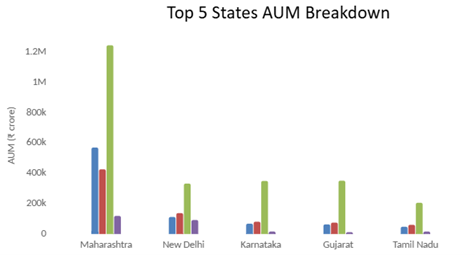
Top 5 States Leading the Average AUM Race
States | Liquid Schemes | Other Debt Schemes | Equity Schemes | Balanced/ETFs |
Maharashtra | 5,70,206 | 4,26,463.6 | 12,44,412 | 1,19,380.7 |
New Delhi | 1,12,440.1 | 1,37,798.8 | 3,32,525.1 | 92,323.37 |
Karnataka | 68,178.07 | 81,138.94 | 3,49,896.2 | 16,525.23 |
Gujarat | 63,361.66 | 75,067.36 | 3,51,582.8 | 12,250.54 |
Tamil Nadu | 47,901.36 | 60,486.45 | 2,,06,009.9 | 16,390.72 |
In the last few months, Karnataka has moved ahead of Gujarat. The change is clear in the data, even though it happened slowly. Gujarat was still a little ahead in October 2025. It had an AAUM of ₹5,47,721 crore, while Karnataka was close behind with ₹5,46,781 crore.
The roles have changed since then. Karnataka has not only passed Gujarat, but it has also been able to keep its lead. The gap is still small, but it's clear which way things are going.
The rise of Karnataka means that the mutual fund market is changing in a bigger way. Growth is no longer limited to traditional financial centres. Cities of the future are helping the industry grow. A younger group of investors is making the overall mix more equity-heavy.
Hence, over the coming years, more regions may follow a similar path. This can lead to a wider and more balanced participation across the country.
SEBI Registered Research Analyst (INH000006396).
Founded in 1986, Dalal Street Investment Journal (DSIJ) brings decades of experience in India’s equity markets. DSIJ's research combines fundamental analysis with price action, guided by disciplined risk management and capital preservation. They follow a structured, data-driven approach designed to help investors and traders make informed decisions beyond short-term market noise.
Disclaimer :
Investments in the securities market are subject to market risk, read all related documents carefully before investing. This content is for educational purposes only. Securities quoted are exemplary and not recommendatory.
The information on this website is provided on "AS IS" basis. Bajaj Broking (BFSL) does not warrant the accuracy of the information given herein, either expressly or impliedly, for any particular purpose and expressly disclaims any warranties of merchantability or suitability for any particular purpose. While BFSL strives to ensure accuracy, it does not guarantee the completeness, reliability, or timeliness of the information. Users are advised to independently verify details and stay updated with any changes.
The information provided on this website is for general informational purposes only and is subject to change without prior notice. BFSL shall not be responsible for any consequences arising from reliance on the information provided herein and shall not be held responsible for all or any actions that may subsequently result in any loss, damage and or liability. Interest rates, fees, and charges etc., are revised from time to time, for the latest details please refer to our Pricing page.
Neither the information, nor any opinion contained in this website constitutes a solicitation or offer by BFSL or its affiliates to buy or sell any securities, futures, options or other financial instruments or provide any investment advice or service.
BFSL is acting as distributor for non-broking products/ services such as IPO, Mutual Fund, Insurance, PMS, and NPS. These are not Exchange Traded Products. For more details on risk factors, terms and conditions please read the sales brochure carefully before investing.
Content Partner - Dalal Street Investment Journal Wealth Advisory Private Limited
This article is for educational purposes only and should not be considered investment advice. Market investments are subject to risks. DSIJ Wealth Advisory Private Limited is a SEBI-registered Research Analyst (Reg. No: INH000006396) and Investment Adviser (Reg. No: INA000001142). Please consult your financial adviser before investing.
For more disclaimer, check here : https://www.bajajbroking.in/disclaimer
Level up your stock market experience: Download the Bajaj Broking App for effortless investing and trading

Enjoy low brokerage on delivery trades
|
Open Your Free Demat Account
Enjoy low brokerage on delivery trades
|


