
Get Free Demat Account*















Open Your Free Demat Account
Enjoy low brokerage on delivery trades
By Dalal Street Investment Journal (DSIJ)
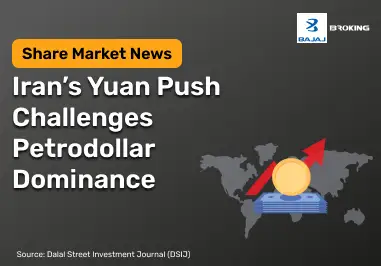
The global oil trade has long been dominated by the US dollar through the petrodollar system established in the 1970s. However, Iran’s proposal to allow oil shipments through the Strait of Hormuz only if traded in Chinese yuan is challenging this decades-old structure. If such a shift gains traction, it could weaken global demand for the dollar and reshape the balance of power in the international financial system.
The roots of modern global economic power can be traced back to the early 1970s, when the world changed the way it handled money and energy. Until 1971, the US dollar was linked to the gold standard, meaning every dollar was backed by a certain amount of physical gold. When the United States ended this system, it needed another way to maintain global trust in its currency. A major breakthrough came in 1974 when the US made a historic agreement with Saudi Arabia’s King Faisal. In return for American military protection and advanced technology, Saudi Arabia agreed to sell its oil only in US dollars and invest its extra oil revenues often called “petrodollars” into US Treasury bonds.
This deal had a huge impact on the global economy. Oil is essential for running industries, transportation, and power generation, so every country needs it. Because Saudi Arabia was a leading oil exporter and priced its oil in dollars, nations across the world had to hold large amounts of US dollars to buy energy. This created constant global demand for the currency, helping the United States maintain the dollar as the world’s main reserve currency even as it printed more money. At the same time, it gave Washington a powerful economic tool: control over the global financial system. By restricting access to the international SWIFT payment network, the US could impose sanctions that make it extremely difficult for targeted countries to trade globally or purchase vital resources like oil.
Also Read: GIFT Nifty Suggest Positive Start, Crude Oil Price Above $100 per barrel
As of March 2026, the long-standing dominance of the US dollar in global oil trade is facing one of its biggest challenges in decades. After a period of rising tensions in the Middle East and disruptions to shipping routes, Iran has proposed a “controlled reopening” of the Strait of Hormuz, one of the world’s most important oil routes. However, Iran has attached an unusual condition: oil shipments passing through the strait should be traded in Chinese yuan instead of US dollars. This proposal directly questions the decades-old petrodollar system that has shaped global oil trade since the 1970s.
The Strait of Hormuz is a narrow but extremely vital waterway through which nearly 20% of the world’s oil supply moves every day. Major economies such as China, India, and Japan rely heavily on this route to import oil from the Middle East. If Iran moves ahead with this idea, countries that depend on this oil may face a difficult choice. They could either continue following the US-led financial system that uses the dollar, or start using the Chinese yuan to secure their energy supplies. Such a move could slowly change how global oil trade works and may even affect the balance of economic power in the world.
This situation shifts the conflict from a traditional military confrontation to what can be seen as a financial battle. The idea behind the “Petrodollar War” is that the United States has historically acted against countries that attempted to sell oil in currencies other than the US dollar. In the past, countries such as Iraq and Libya had explored selling oil in alternative currencies, which many believed challenged the dollar’s dominance in global energy trade. If Iran now succeeds in shifting even a portion of the world’s oil trade to the Chinese yuan, it could encourage foreign governments and central banks to reduce their holdings of US Treasury bonds and slowly move away from the dollar-based system.
The timing of this challenge is especially sensitive for the United States. The US national debt has reached nearly $39 trillion, with around $9–10 trillion of Treasury securities expected to be refinanced in the coming year, according to data from the US Joint Economic Committee and Bloomberg estimates. This means the government will have to issue new bonds to replace the old ones that are maturing. If global demand for the dollar weakens, investors will likely demand higher interest rates to buy these bonds. Even a small rise in these rates could significantly increase the government’s borrowing costs, potentially pushing annual interest payments close to $1 trillion. By targeting the foundation of the dollar’s dominance in global oil trade, Iran’s move could create serious pressure on the U.S. financial system and may gradually push the world toward a more multi-currency global financial order.
SEBI Registered Research Analyst (INH000006396).
Founded in 1986, Dalal Street Investment Journal (DSIJ) brings decades of experience in India’s equity markets. DSIJ's research combines fundamental analysis with price action, guided by disciplined risk management and capital preservation. They follow a structured, data-driven approach designed to help investors and traders make informed decisions beyond short-term market noise.
Disclaimer :
Investments in the securities market are subject to market risk, read all related documents carefully before investing. This content is for educational purposes only. Securities quoted are exemplary and not recommendatory.
The information on this website is provided on "AS IS" basis. Bajaj Broking (BFSL) does not warrant the accuracy of the information given herein, either expressly or impliedly, for any particular purpose and expressly disclaims any warranties of merchantability or suitability for any particular purpose. While BFSL strives to ensure accuracy, it does not guarantee the completeness, reliability, or timeliness of the information. Users are advised to independently verify details and stay updated with any changes.
The information provided on this website is for general informational purposes only and is subject to change without prior notice. BFSL shall not be responsible for any consequences arising from reliance on the information provided herein and shall not be held responsible for all or any actions that may subsequently result in any loss, damage and or liability. Interest rates, fees, and charges etc., are revised from time to time, for the latest details please refer to our Pricing page.
Neither the information, nor any opinion contained in this website constitutes a solicitation or offer by BFSL or its affiliates to buy or sell any securities, futures, options or other financial instruments or provide any investment advice or service.
BFSL is acting as distributor for non-broking products/ services such as IPO, Mutual Fund, Insurance, PMS, and NPS. These are not Exchange Traded Products. For more details on risk factors, terms and conditions please read the sales brochure carefully before investing.
Content Partner - Dalal Street Investment Journal Wealth Advisory Private Limited
This article is for educational purposes only and should not be considered investment advice. Market investments are subject to risks. DSIJ Wealth Advisory Private Limited is a SEBI-registered Research Analyst (Reg. No: INH000006396) and Investment Adviser (Reg. No: INA000001142). Please consult your financial adviser before investing.
For more disclaimer, check here : https://www.bajajbroking.in/disclaimer
Level up your stock market experience: Download the Bajaj Broking App for effortless investing and trading

Enjoy low brokerage on delivery trades
|
Open Your Free Demat Account
Enjoy low brokerage on delivery trades
|


