
Get Free Demat Account*








Open Your Free Demat Account
Enjoy low brokerage on delivery trades
By Dalal Street Investment Journal (DSIJ)
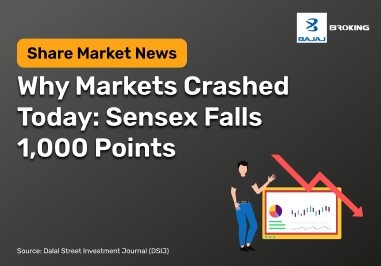
Indian equity markets witnessed a sharp sell-off on May 11, 2026, with the Sensex falling over 1,300 points and the Nifty slipping below 23,900. Rising crude oil prices above $105 per barrel, a 9% spike in India VIX, continued FII outflows, rupee weakness, and fears of inflationary pressure following PM Modi’s advisory on fuel consumption weighed heavily on investor sentiment.
Indian equity markets had a rough start to the week on Monday, May 11, 2026. The BSE Sensex was trading at 79,245, down 1,080 points or 1.39%, while the Nifty50 was at 23,860.90, down 315.50 points or 1.30% in early trade. As the session progressed, the selling pressure intensified, the Sensex hit an intraday low of 76,165.57, falling over 1,300 points, while the Nifty50 touched 23,845.30 at its lowest.
Multiple factors contributed to the hit sentiment at once, and here is what drove the market down today.
The most immediate domestic trigger today was a public advisory from Indian Prime Minister Narendra Modi over the weekend. Speaking at an event in Hyderabad, PM Modi repeatedly flagged the need to reduce petrol and diesel consumption and called on the public to consider fuel-saving measures, including COVID-era practices such as working from home. He also called on citizens to reduce edible oil consumption, asked farmers to lower dependence on imported fertilisers, and urged people to rethink large discretionary spending, including on gold and foreign travel, for at least a year.
The market read this as a signal that the government is preparing to hike domestic fuel prices, given the mounting pressure on oil marketing companies (OMCs) from elevated global crude prices. A fuel price hike would directly affect retail inflation, put pressure on consumer spending, and increase input costs across the economy, all of which are negative for the economy.
Crude oil prices jumped sharply today after US President Donald Trump largely rejected Iran's response to a peace proposal to end the ongoing Middle East war. In a post on Truth Social, Trump expressed dissatisfaction with Iran’s response delivered through diplomatic channels, calling it “TOTALLY UNACCEPTABLE.” Brent crude was trading at $105 per barrel, up over 4% on the day, while WTI crude also surged past $100. With the war in the region showing no clear signs of resolution, concerns over supply disruptions through the Strait of Hormuz remain alive.
India needs around 85% to 88% of its crude oil demand from imports, and a significant part of those imports comes via the Strait of Hormuz, which means any kind of rise in tensions will have a clear macro impact on India. An increase in crude prices translates into increased imports, an increase in current account deficits, and inflationary pressures, all of which the market has already priced in.
India’s rupee also experienced a depreciation against the US dollar, which stood at ₹95.18 per US dollar as of May 11, 2026. India’s rupee had been experiencing a continuous depreciation in CY2026 because of high oil prices, resulting in higher demand for dollars for purchasing oil and capital flight, hence causing a decrease in the supply of dollars.
A depreciation in the rupee increases the cost of imported products such as crude oil, thereby causing inflation directly. Moreover, a depreciation in the rupee makes the value of investments by FIIs fall, forcing them to sell off their assets.
4. FII Selling Continues Without A Break
FIIs have consistently remained net sellers of Indian equities up until 2026, and this trend persisted even during May as well. Around ₹1.2 lakh crore of Indian equity capital witnessed withdrawal by FIIs in March 2026 itself, and there has been no significant reversal of this outflow so far.
As per The Hindu Business Line, FPI ownership of Indian equities now stands at 14.7%; its lowest since June 2012, down from 19.9% a decade ago. The cumulative withdrawal of FIIs from Indian capital markets stood at over ₹2 lakh crore for the first four months of 2026, one of the sharpest and prolonged instances in recent years.
India VIX, popularly referred to as the “fear gauge” of the market, rose by 9% to about 18.2. Whenever there is a sharp rise in VIX, it indicates that there is expected volatility ahead, and investors tend to adopt a cautious approach by exiting their positions.
Given the current high VIX readings, volatility within the day is anticipated to stay high, and for any rally to be sustainable, a decline in VIX levels would be essential.
6. Broader Macro Headwinds: Current Account, Inflation, and Rate Outlook
Apart from these direct catalysts, the economy is also facing a broader macroeconomic environment that continues to worsen. High oil prices have increased India’s current account deficit as its import bills soar. Estimates from the Reserve Bank of India (RBI) indicate that a 10% increase in the price of oil would lead to an increase in India’s CPI inflation rate of about 30 basis points.
With inflation already elevated and the RBI navigating a difficult path between supporting growth and keeping prices in check, the room for any meaningful policy support to the markets remains limited. The prospect of a domestic fuel price hike, which Modi's advisory has now made more likely, adds another layer of inflationary pressure that the market has to price in today.
SEBI Registered Research Analyst (INH000006396).
Founded in 1986, Dalal Street Investment Journal (DSIJ) brings decades of experience in India’s equity markets. DSIJ's research combines fundamental analysis with price action, guided by disciplined risk management and capital preservation. They follow a structured, data-driven approach designed to help investors and traders make informed decisions beyond short-term market noise.

Disclaimer :
Investments in the securities market are subject to market risk, read all related documents carefully before investing. This content is for educational purposes only. Securities quoted are exemplary and not recommendatory.
The information on this website is provided on "AS IS" basis. Bajaj Broking (BFSL) does not warrant the accuracy of the information given herein, either expressly or impliedly, for any particular purpose and expressly disclaims any warranties of merchantability or suitability for any particular purpose. While BFSL strives to ensure accuracy, it does not guarantee the completeness, reliability, or timeliness of the information. Users are advised to independently verify details and stay updated with any changes.
The information provided on this website is for general informational purposes only and is subject to change without prior notice. BFSL shall not be responsible for any consequences arising from reliance on the information provided herein and shall not be held responsible for all or any actions that may subsequently result in any loss, damage and or liability. Interest rates, fees, and charges etc., are revised from time to time, for the latest details please refer to our Pricing page.
Neither the information, nor any opinion contained in this website constitutes a solicitation or offer by BFSL or its affiliates to buy or sell any securities, futures, options or other financial instruments or provide any investment advice or service.
BFSL is acting as distributor for non-broking products/ services such as IPO, Mutual Fund, Insurance, PMS, and NPS. These are not Exchange Traded Products. For more details on risk factors, terms and conditions please read the sales brochure carefully before investing.
Content Partner - Dalal Street Investment Journal Wealth Advisory Private Limited
This article is for educational purposes only and should not be considered investment advice. Market investments are subject to risks. DSIJ Wealth Advisory Private Limited is a SEBI-registered Research Analyst (Reg. No: INH000006396) and Investment Adviser (Reg. No: INA000001142). Please consult your financial adviser before investing.
For more disclaimer, check here : https://www.bajajbroking.in/disclaimer
Level up your stock market experience: Download the Bajaj Broking App for effortless investing and trading

Enjoy low brokerage on delivery trades
|
Open Your Free Demat Account
Enjoy low brokerage on delivery trades
|


