





















Open Your Free Demat Account
Enjoy low brokerage on delivery trades
 April 09, 2026
 2 mins read
India has emerged as the world’s third-largest country in renewable energy installed capacity, moving past Brazil and trailing only China and the United States. The milestone comes alongside another major achievement, with India reaching 50% of its cumulative installed power capacity from non-fossil fuel sources in June 2025, five years ahead of its 2030 Paris commitment.
India’s renewable energy journey has entered a new phase. It is no longer only about ambition, targets, or policy intent. The numbers now show visible progress on the ground.
According to the Renewable Energy Statistics 2026, India has moved up to become the world’s third-largest country in renewable energy installed capacity, overtaking Brazil and now standing behind only China and the United States. This is a notable shift in the global ranking and reflects the pace at which the country has been adding non-fossil fuel capacity.
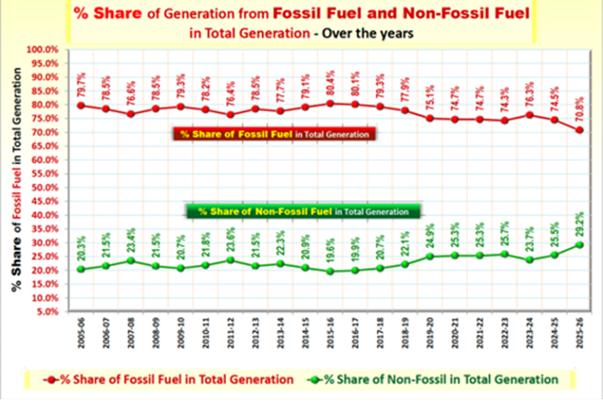
The momentum seen in FY 2025–26 adds further weight to this progress. India recorded a total non-fossil capacity addition of 55.3 GW during the year; the highest increase achieved in any single year so far. India's total power generation during 2025-26 (up to March 2026) reached 1,845.921 BU. The share of non-fossil fuels in total generation reached 29.2% in 2025-26 (538.97 BU). India achieved the milestone of 50% of its cumulative electric power installed capacity from non-fossil fuel sources in June 2025, five years ahead of the 2030 target set under its Nationally Determined Contribution (NDC) to the Paris Agreement.
Source: PIB
India’s rise to the third position globally is backed by a total renewable energy installed capacity of 250.52 GW, according to data as of December 2025. This places it ahead of countries such as Brazil, Germany, Japan, and Canada. The country’s broader non-fossil fuel installed capacity stood at 283.46 GW as on March 31, 2026. This includes renewable energy as well as nuclear power capacity.
Total Renewable Energy Installed Capacity (GW) | |
Country | Capacity |
China | 2258.02 |
USA | 467.92 |
India | 250.52 |
Brazil | 228.20 |
Germany | 199.92 |
Japan | 134.53 |
Canada | 110.51 |
World | 5149.28 |
The scale of this progress becomes even clearer when viewed over a longer period. Renewable energy installed capacity has increased 3.59 times since 2014, rising from 76.38 GW in March 2014 to 274.68 GW in March 2026. Solar energy has seen the sharpest jump, expanding 53.28 times during the same period, while wind energy capacity has grown 2.66 times.
FY 2025–26 stands out as a year of record additions across multiple segments. The 55.29 GW non-fossil capacity addition is the highest ever achieved in a single year, surpassing the previous record of 29.5 GW in FY 2024–25. Within this, distributed renewable energy from solar emerged as a major contributor. Out of 44.61 GW installed during the year, 16.3 GW came from distributed solar (36%), including 7.6 GW under PM KUSUM and 8.7 GW from rooftop solar.
Wind energy also delivered its strongest annual performance. A total of 6.05 GW of wind capacity was added during FY 2025–26, the highest ever in a single year. This is a clear improvement over the 4.15 GW added in the previous year.
These additions indicate that the sector’s growth is becoming broader and more diversified, rather than relying on a single technology or policy channel.
Capacity addition is one part of the story. The other is actual electricity generation, and here too the numbers show meaningful movement.
India’s total power generation during 2025–26 reached 1,845.921 billion units. Of this, non-fossil fuel sources contributed 538.97 billion units, taking their share in total generation to 29.2%. Renewable energy generation, including large hydro, accounted for 26.2% of total generation. Generation from renewable sources excluding large hydro rose to 308.813 billion units, registering a growth of 21.10% over the corresponding period of the previous year.
Source: PIB
Among renewable sources, wind and solar posted strong gains. Wind-based generation stood at 106.089 billion units, showing a growth of 27.29%, while solar-based generation rose to 173.525 billion units, up 20.38%. Together, wind and solar contributed 276.614 billion units, which accounted for 15.14% of total generation.
In July 2025, India also recorded its highest-ever renewable energy share in electricity generation, with renewables meeting 51.5% of the country’s total electricity demand of 203 GW.
Solar remained the biggest driver of India’s renewable energy growth. The country crossed the 150 GW milestone in cumulative installed solar capacity, reaching 150.26 GW as on March 31, 2026. This total includes 110.43 GW of utility-scale capacity, 25.73 GW of rooftop solar, and 14.10 GW from KUSUM and off-grid projects.
The pace of addition during FY 2025–26 was especially striking. India added 44.61 GW of solar capacity during the year, almost double the 23.83 GW added in FY 2024–25. Distributed solar also posted its highest-ever annual addition at 16.31 GW. This included 8.71 GW of rooftop solar and 7.67 GW under KUSUM projects.
The scale-up in manufacturing has also been substantial. Solar module manufacturing capacity rose from about 74 GW in FY 2025 to around 172 GW in FY 2026. At the same time, imports of solar modules fell sharply from $2,152 million to $758 million, indicating a significant shift in the supply chain mix during the year.
Wind energy also made notable progress during the year. India’s cumulative installed wind power capacity crossed 56 GW, placing the country fourth globally in terms of installed wind turbine capacity. The annual addition of 6.05 GW was the highest ever, with the commercial and industrial segment, including captive projects, contributing around 4.5 GW, or roughly 75% of the total wind capacity added during the year.
Manufacturing capability has improved as well. Wind turbine manufacturing capacity increased from 18 GW to 24 GW. Alongside this, steps such as clearer classification of project zones, faster coordination for approvals, and the formation of a task force to address land, regulatory, and grid challenges are expected to support smoother execution.
The financial year also saw a series of policy and regulatory measures aimed at improving economics, easing execution, and strengthening domestic capability.
One of the more direct changes was the reduction in GST on renewable energy devices and parts for their manufacture from 12% to 5% with effect from September 22, 2025. This is expected to reduce the landed cost of solar equipment for domestic buyers such as project developers, rooftop solar installers, DISCOMs, and captive users.
Other important steps included the extension of BCD exemption for capital goods used in lithium-ion cell manufacturing for battery energy storage systems, the launch of the Renewable Energy Equipment Import Monitoring System portal, changes in the RCO compliance framework, amended transmission charge regulations, non-solar hour connectivity provisions, guidelines for Virtual Power Purchase Agreements, and a pilot scheme for Contract for Difference for renewable energy projects.
Together, these measures suggest that the policy framework is not only trying to accelerate capacity addition, but also to improve transmission planning, supply chain visibility, domestic manufacturing, and long-term project viability.
While solar and wind remain central to the story, other segments are also gathering momentum.
The National Green Hydrogen Mission was approved by the Cabinet with an initial outlay of ₹19,744 crore up to the year 2029-30. The objective of the Mission by 2030 is to produce at least 5 million metric tonnes per annum of green hydrogen. Further, the expected outcomes of the Mission include RE capacity addition of 125 GW, over ₹8 lakh crores in total investments, creation of over 6 lakh full time jobs and aversion of 50 MMT per annum of CO2 emissions.
The National Green Hydrogen Mission, with an outlay of ₹19,744 crore, recorded major developments during FY 2025–26. Positioning India as a global leader in cost-competitive green fuel production.
Progress was also visible in bioenergy, small hydro, geothermal energy, energy storage, and skill development. The approval of the Small Hydro Power Development Scheme for FY 2026–27 to FY 2030–31, the rollout of revised guidelines for biomass and waste-to-energy projects, and investments in research across geothermal, solar PV, and sodium-ion battery technology all point to a wider renewable energy ecosystem taking shape.
What stands out from the data is that India’s renewable energy progress is no longer limited to headline targets. Capacity is expanding at record pace, generation from non-fossil sources is rising, manufacturing capabilities are widening, and policy support is becoming more detailed and sector-specific.
India’s move to the third spot globally in renewable energy installed capacity is an important marker, but it is only one part of the picture. The larger takeaway is that the country is building scale across solar, wind, distributed energy, transmission, green hydrogen, and supporting infrastructure at the same time.
Conclusion
FY 2025–26 reflects a year in which India’s renewable energy transition gained both depth and direction. Record capacity addition, stronger renewable generation, improved domestic manufacturing, and a series of policy interventions have together pushed the sector into a more mature phase.
The numbers show that the transition is moving beyond intent and into execution. India has already reached some major milestones ahead of schedule, and the broader structure being built around renewable energy suggests that the next phase of growth will depend not only on how much capacity is added, but also on how effectively it is integrated, utilised, and supported across the economy.
Disclaimer :
Investments in the securities market are subject to market risk, read all related documents carefully before investing. This content is for educational purposes only. Securities quoted are exemplary and not recommendatory.
The information on this website is provided on "AS IS" basis. Bajaj Broking (BFSL) does not warrant the accuracy of the information given herein, either expressly or impliedly, for any particular purpose and expressly disclaims any warranties of merchantability or suitability for any particular purpose. While BFSL strives to ensure accuracy, it does not guarantee the completeness, reliability, or timeliness of the information. Users are advised to independently verify details and stay updated with any changes.
The information provided on this website is for general informational purposes only and is subject to change without prior notice. BFSL shall not be responsible for any consequences arising from reliance on the information provided herein and shall not be held responsible for all or any actions that may subsequently result in any loss, damage and or liability. Interest rates, fees, and charges etc., are revised from time to time, for the latest details please refer to our Pricing page.
Neither the information, nor any opinion contained in this website constitutes a solicitation or offer by BFSL or its affiliates to buy or sell any securities, futures, options or other financial instruments or provide any investment advice or service.
BFSL is acting as distributor for non-broking products/ services such as IPO, Mutual Fund, Insurance, PMS, and NPS. These are not Exchange Traded Products. For more details on risk factors, terms and conditions please read the sales brochure carefully before investing.
Content Partner - Dalal Street Investment Journal Wealth Advisory Private Limited
This article is for educational purposes only and should not be considered investment advice. Market investments are subject to risks. DSIJ Wealth Advisory Private Limited is a SEBI-registered Research Analyst (Reg. No: INH000006396) and Investment Adviser (Reg. No: INA000001142). Please consult your financial adviser before investing.
For more disclaimer, check here : https://www.bajajbroking.in/disclaimer
Level up your stock market experience: Download the Bajaj Broking App for effortless investing and trading

Enjoy low brokerage on delivery trades
|
Open Your Free Demat Account
Enjoy low brokerage on delivery trades
|


