
Get Free Demat Account*









Open Your Free Demat Account
Enjoy low brokerage on delivery trades
By Dalal Street Investment Journal (DSIJ)
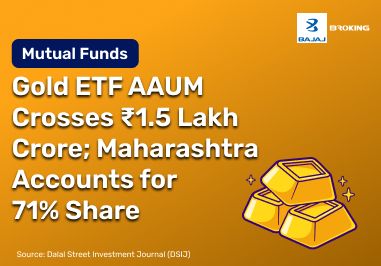
Gold ETF AAUM reached ₹1.5 lakh crore in January 2026, supported by monthly net inflows of ₹24,039.96 crore. Maharashtra alone accounted for 71% of AAUM. Data also shows steady growth across Tamil Nadu, Karnataka, West Bengal, Gujarat and other key states.
AMFI’s January 2026 data brought one key development to notice: investor interest in gold, widely seen as the ultimate safe haven, has surged.
Net inflows into Gold Exchange Traded Funds (ETFs) touched ₹24,040 crore during the month, a steep rise from ₹11,647 crore in December, meaning flows more than doubled month on month. The sheer size of the inflow places January among the strongest months on record for gold ETFs. This wave of buying has pushed Gold ETF assets under management (AUM) up to ₹1.84 lakh crore, while average assets under management (AAUM) stood at ₹1.5 lakh crore.
AAUM stands for Average Assets Under Management, while AUM refers to Assets Under Management. AUM is the total value of money a mutual fund manages on a specific date, making it a point-in-time snapshot that can change daily with market movements and investor inflows or redemptions. AAUM, in contrast, represents the fund’s average size over a period such as a month, quarter, or year. Because it is calculated across multiple days, AAUM smooths out short-term fluctuations and offers a steadier view of the fund’s typical scale. This is why the two figures can differ: AUM may rise or fall sharply due to a single-day market swing or a large transaction, whereas AAUM reflects a more balanced, representative average.
Month | Net Inflows ₹ in Cr | Net Assets Under Management ₹ in Cr | Average Net Assets Under Management ₹ in Cr |
Jan-25 | 3,751.42 | 51,839.39 | 47,940.63 |
Feb-25 | 1,979.84 | 55,677.25 | 55,001.75 |
Mar-25 | -77.21 | 58,887.99 | 57,101.29 |
Apr-25 | -5.82 | 61,422.19 | 60,631.37 |
May-25 | 291.91 | 62,452.94 | 62,124.93 |
Jun-25 | 2,080.85 | 64,777.23 | 64,833.43 |
Jul-25 | 1,256.09 | 67,634.52 | 66,664.07 |
Aug-25 | 2,189.51 | 72,495.60 | 69,918.72 |
Sep-25 | 8,363.13 | 90,135.98 | 81,700.39 |
Oct-25 | 7,743.19 | 1,02,119.86 | 1,02,088.99 |
Nov-25 | 3,741.79 | 1,10,517.76 | 1,06,020.76 |
Dec-25 | 11,646.74 | 1,27,896.38 | 1,20,867.22 |
Jan-26 | 24,039.96 | 1,84,276.96 | 1,50,380.66 |
Source: AMFI
Net inflows of gold ETFs were ₹3,751.42 crore in Jan 2025 and stayed positive in Feb 2025 at ₹1,979.84 crore. March and April were the only soft spots, and even then, the outflows were marginal (₹77.21 crore in Mar and ₹5.82 crore in Apr).
By May, inflows had returned (₹291.91 crore), and the following months showed consistent accumulation again:
Jun 2025: ₹2,080.85 crore
Jul 2025: ₹1,256.09 crore
Aug 2025: ₹2,189.51 crore
From Sep 2025, the trend changes decisively. Net inflows jump to ₹8,363.13 crore in September and remain elevated through the next four months:
Oct 2025: ₹7,743.19 crore
Nov 2025: ₹3,741.79 crore
Dec 2025: ₹11,646.74 crore
Jan 2026: ₹24,039.96 crore
In fact, about 83% of total net inflows since Jan 2025 arrived in the five months from Sep 2025 to Jan 2026 (roughly ₹55,535 crore out of ₹67,001 crore).
Flows are only part of the story. The rise in Net Assets Under Management (AUM) shows how quickly the category has expanded.
AUM in Jan 2025: ₹51,839.39 crore
AUM in Jan 2026: ₹1,84,276.96 crore
That is an increase of ₹1,32,437.57 crore, or about 255% over the period. A key milestone was crossed in Oct 2025, when AUM moved past ₹1 lakh crore (₹1,02,119.86 crore), and the build-up continued into December (₹1,27,896.38 crore) before the sharp jump in January 2026.
The Average AUM also steps up meaningfully, surging from ₹47,940.63 crore in Jan 2025 to ₹1,50,380.66 crore in Jan 2026.
State-wise Gold ETF AAUM: Maharashtra Leads as AAUM Crosses ₹1 Lakh Crore in January
Table showing State-wise / Union Territory-wise contribution to AAUM of Gold ETF AAMC (All figures in ₹ Crore) | |||||
Name of the States/ Union Territories | Jan-26 | Dec-25 | Nov-25 | Oct-25 | Sep-25 |
Andaman and Nicobar Islands | 2.63 | 2.28 | 2.06 | 1.90 | 1.49 |
Andhra Pradesh | 537.50 | 423.15 | 384.53 | 364.89 | 253.33 |
Arunachal Pradesh | 4.51 | 4.81 | 3.53 | 5.70 | 7.03 |
Assam | 101.68 | 79.80 | 71.51 | 69.05 | 55.92 |
Bihar | 272.02 | 212.46 | 192.23 | 181.69 | 136.27 |
Chandigarh | 318.06 | 258.67 | 241.72 | 253.46 | 214.12 |
Chhattisgarh | 199.32 | 155.40 | 143.73 | 119.78 | 77.57 |
Dadra and Nagar Haveli | 3.95 | 3.23 | 2.99 | 3.38 | 2.88 |
Daman and Diu | 0.79 | 0.66 | 0.60 | 0.63 | 0.44 |
Goa | 381.35 | 319.24 | 295.59 | 291.92 | 254.80 |
Gujarat | 2,605.06 | 1,792.37 | 1,558.71 | 1,500.87 | 1,197.27 |
Haryana | 1,547.60 | 1,091.98 | 934.30 | 946.07 | 616.74 |
Himachal Pradesh | 66.47 | 54.42 | 49.19 | 47.57 | 37.57 |
Jammu and Kashmir | 79.16 | 61.40 | 54.71 | 52.51 | 40.22 |
Jharkhand | 232.66 | 180.70 | 164.73 | 157.33 | 122.46 |
Karnataka | 4,289.10 | 3,646.04 | 3,230.29 | 3,075.26 | 2,550.81 |
Kerala | 686.42 | 589.81 | 546.19 | 527.82 | 420.18 |
Ladakh | 2.15 | 1.64 | 1.42 | 1.43 | 1.09 |
Lakshadweep | 0.26 | 0.23 | 0.21 | 0.19 | 0.10 |
Madhya Pradesh | 587.14 | 444.64 | 391.70 | 369.69 | 280.78 |
Maharashtra | 1,06,424.76 | 85,744.59 | 74,653.74 | 71,882.12 | 57,683.94 |
Manipur | 6.28 | 5.08 | 4.84 | 4.43 | 2.87 |
Meghalaya | 9.77 | 7.64 | 6.99 | 7.44 | 5.57 |
Mizoram | 1.08 | 0.84 | 0.89 | 0.82 | 0.51 |
Nagaland | 3.32 | 2.53 | 2.36 | 2.24 | 1.78 |
New Delhi | 3,419.51 | 2,695.84 | 2,374.52 | 2,295.54 | 1,694.85 |
Orissa | 218.33 | 177.85 | 162.39 | 153.22 | 112.02 |
Others | 14,124.29 | 12,102.22 | 11,135.49 | 10,614.29 | 9,105.54 |
Pondicherry | 67.49 | 56.36 | 52.85 | 51.17 | 38.56 |
Punjab | 504.19 | 367.71 | 320.66 | 311.93 | 223.39 |
Rajasthan | 809.70 | 637.76 | 566.38 | 538.76 | 374.14 |
Sikkim | 6.41 | 5.31 | 4.85 | 4.80 | 3.95 |
Tamil Nadu | 5,208.91 | 4,243.91 | 3,902.45 | 3,785.72 | 2,990.16 |
Telangana | 1,499.36 | 1,206.89 | 1,085.68 | 1,104.14 | 830.03 |
Tripura | 8.96 | 7.52 | 6.83 | 6.34 | 4.94 |
Uttar Pradesh | 2,025.55 | 1,542.56 | 1,324.93 | 1,304.45 | 983.33 |
Uttarakhand | 195.34 | 154.26 | 138.73 | 131.23 | 101.42 |
West Bengal | 3,929.59 | 2,585.33 | 2,006.23 | 1,919.17 | 1,272.33 |
The state-wise split of Gold ETF AAUM shows that the category’s growth is being driven by a handful of large centres, with Maharashtra overwhelmingly dominant. Maharashtra’s AAUM rose from ₹57,683.94 crore in Sep 2025 to ₹71,882.12 crore in Oct, ₹74,653.74 crore in Nov, ₹85,744.59 crore in Dec, and then surged to ₹1,06,424.76 crore in Jan 2026.
Beyond Maharashtra, the data also highlights a strong western and southern skew: Tamil Nadu climbed from ₹2,990.16 crore (Sep 2025) to ₹5,208.91 crore (Jan 2026), while Karnataka moved from ₹2,550.81 crore to ₹4,289.10 crore over the same months. West Bengal stands out as another fast riser, scaling from ₹1,272.33 crore in Sep 2025 to ₹3,929.59 crore in Jan 2026, suggesting widening adoption beyond the usual western corridor. Gujarat, Uttar Pradesh, Haryana and Telangana also show steady month-on-month build-up, indicating that Gold ETF ownership is broadening, but the balance of AAUM still remains concentrated in the top regions.
Top 5 contributors in January 2026 (AAUM, ₹ crore):
Maharashtra: ₹1,06,424.76 crore
Others: ₹14,124.29 crore
Tamil Nadu: ₹5,208.91 crore
Karnataka: ₹4,289.10 crore
West Bengal: ₹3,929.59 crore
Maharashtra’s dominance in Gold ETF ownership is hard to miss. With ₹1,06,424.76 crore of AAUM in January 2026, the state alone accounts for about 71% of the overall Gold ETF AAUM of roughly ₹1.5 lakh crore. The implication for readers is straightforward. While Gold ETF adoption is clearly spreading across states, the market’s centre of gravity still sits firmly in Maharashtra.
SEBI Registered Research Analyst (INH000006396).
Founded in 1986, Dalal Street Investment Journal (DSIJ) brings decades of experience in India’s equity markets. DSIJ's research combines fundamental analysis with price action, guided by disciplined risk management and capital preservation. They follow a structured, data-driven approach designed to help investors and traders make informed decisions beyond short-term market noise.

Disclaimer :
Investments in securities market are subject to market risk, read all related documents carefully before investing. This content is for educational purposes only. Securities quoted are exemplary and not recommendatory.
The information on this website is provided on "AS IS" basis. Bajaj Broking (BFSL) does not warrant the accuracy of the information given herein, either expressly or impliedly, for any particular purpose and expressly disclaims any warranties of merchantability or suitability for any particular purpose. While BFSL strives to ensure accuracy, it does not guarantee the completeness, reliability, or timeliness of the information. Users are advised to independently verify details and stay updated with any changes.
The information provided on this website is for general informational purposes only and is subject to change without prior notice. BFSL shall not be responsible for any consequences arising from reliance on the information provided herein and shall not be held responsible for all or any actions that may subsequently result in any loss, damage and/or liability. Interest rates, fees, and charges etc., are revised from time to time, for the latest details please refer to our Pricing page.
Neither the information, nor any opinion contained in this website constitutes a solicitation or offer by BFSL or its affiliates to buy or sell any securities, futures, options or other financial instruments or provide any investment advice or service.
BFSL is acting as distributor for non-broking products/ services such as IPO, Mutual Fund, Insurance, PMS, and NPS. These are not Exchange Traded Products. For more details on risk factors, terms and conditions please read the sales brochure carefully before investing.
Content Partner - Dalal Street Investment Journal Wealth Advisory Private Limited
This article is for educational purposes only and should not be considered investment advice. Market investments are subject to risks. DSIJ Wealth Advisory Private Limited is a SEBI-registered Research Analyst (Reg. No: INH000006396) and Investment Adviser (Reg. No: INA000001142). Please consult your financial adviser before investing.
For more disclaimer, check here : https://www.bajajbroking.in/disclaimer
Level up your stock market experience: Scan the QR to download the Bajaj Broking App for effortless investing and trading

Enjoy low brokerage on delivery trades
|
Open Your Free Demat Account
Enjoy low brokerage on delivery trades
|


