


Get Free Demat Account*











Open Your Free Demat Account
Enjoy low brokerage on delivery trades
By Dalal Street Investment Journal (DSIJ)
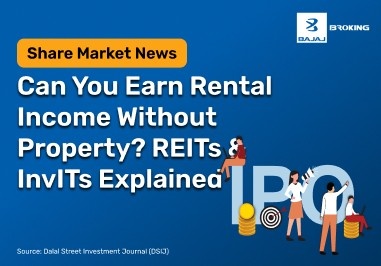
REITs and InvITs offer an alternative to owning property by allowing investors to earn income from real estate and infrastructure assets. These trusts invest in income-generating projects and distribute a large share of earnings. While they provide liquidity and lower entry cost, returns depend on asset performance, interest rates, and overall market conditions.
Source: SEBI, NHAI, Dalal Street Investment Journal (DSIJ)
Owning property has long been seen as one of the more reliable ways to build wealth. Buy a flat or a commercial unit, rent it out, and collect income every month. Simple enough in theory, but in practice it comes with a long list of complications: large upfront capital, stamp duty, maintenance costs, difficult tenants, and the challenge of selling quickly if you need the money. For most people, directly owning investment property is either out of reach or simply more trouble than it is worth.
But what if you could earn income that works similarly to rent, without actually buying a building? That is the idea behind Real Estate Investment Trusts (REITs) and Infrastructure Investment Trusts (InvITs). Both allow ordinary investors to put money into income-generating assets and receive regular payouts without the difficulties that come with direct ownership.
Real Estate Investment Trust is an entity that invests in income-generating properties. These include office buildings, shopping malls, warehouses, hospitals, hotels, residential flats, among others. Instead of directly owning these assets, one purchases shares in the REITs that own a diverse portfolio of such assets.
Income earned from rent received from tenants is pooled, and returns are given to the shareholders at regular intervals; every three months or six months, depending on location. In many jurisdictions, REITs have a legal obligation to make payouts from their earnings, and in India, SEBI stipulates that REITs pay out at least 90% of their net distributable income. This applies in other countries like the United Kingdom, the United States, Singapore, and Australia.
REITs are listed on stock exchanges, which means you can buy and sell units just as you would shares in a company. This gives them a key advantage over direct property investment liquidity. If you need to exit, you do not have to wait months to find a buyer and complete a conveyance. You sell your units on the exchange, often within the same trading day.
The minimum investment requirement is much easier to meet as well. Instead of requiring lakhs or crores of rupees in order to own a piece of land, you can begin by investing in smaller amounts yet still have access to top-notch commercial property investments.
An Infrastructure Investment Trust follows a very similar structure but invests in infrastructure assets rather than real estate. Roads, highways, power transmission lines, gas pipelines, renewable energy projects, and telecom towers are the kinds of assets held within an InvIT.
These are the types of investments that provide constant cash flows over an extended period through toll payments, capacity payments, or long-term contracts signed with the government or other businesses. This means that InvITs are more likely to provide reliable income since the payment agreements are often made in the form of long-term contractual arrangements.
The concept of InvIT is more prevalent in countries such as India, where the concept has been used by infrastructure developers to release their stranded investments in completed infrastructure projects. Developers earn money to invest in other infrastructure projects through InvIT by selling off their completed infrastructure projects to InvIT companies and listing them on the stock market.
Like REITs, InvITs are listed on exchanges, regulated by market authorities, and required to distribute a large proportion of income to unit holders.
The income from both REITs and InvITs is not guaranteed in the way a fixed deposit pays interest. It depends on the performance of the underlying assets; how fully occupied the properties are, whether tenants are paying rent on time, whether toll revenues are meeting projections, and so on. That said, because these trusts typically hold diversified portfolios of operational assets with existing tenants or contracts, the income tends to be more stable than investing in equities.
Distributions from REITs and InvITs can have different tax treatments depending on the country and the nature of the payout whether it is classified as dividend income, interest, or return of capital. It is worth understanding the tax position in your specific jurisdiction before investing, as this affects the actual return you take home.
Neither REITs nor InvITs are without risk. Since they are listed on exchanges, their unit prices can go up and down with market sentiment, sometimes independently of how the underlying assets are actually performing. During periods of market stress, REIT prices have been known to fall sharply even when the physical properties continued generating rental income.
Interest rates also matter. When rates rise, the appeal of fixed or predictable income instruments tends to fall relative to safer options like bonds or fixed deposits, which can put downward pressure on REIT and InvIT prices. Higher rates also increase borrowing costs for the trusts themselves, which can affect how much income is available for distribution.
For InvITs specifically, the risk profile depends heavily on the nature of the assets. A road project with a long toll concession from a government authority carries a different risk than a merchant power plant whose revenues fluctuate with electricity prices.
In most markets, investing in a listed REIT or InvIT is straightforward. You need a brokerage account, and you can buy units during an initial public offering or from the open market afterwards. Some REITs and InvITs also raise funds through follow-on offerings, giving existing and new investors additional opportunities to participate.
It is sensible to look at the trust's portfolio quality, occupancy rates or asset utilisation, the track record of the sponsor or manager, the distribution history, and the debt levels before putting money in. High debt within the trust can amplify risk, particularly in a rising interest rate environment.
REITs and InvITs do not replicate every aspect of owning property. You do not get to decide which tenants move in or renovate the building to your taste. But for those investors seeking periodic payments from real assets without making a capital investment and assuming operating responsibility, these are a convenient and realistic solution. The payments may not be exactly like rents, but the basic concept is quite similar – assets produce money, and that money flows into your pocket as an investor.
SEBI Registered Research Analyst (INH000006396).
Founded in 1986, Dalal Street Investment Journal (DSIJ) brings decades of experience in India’s equity markets. DSIJ's research combines fundamental analysis with price action, guided by disciplined risk management and capital preservation. They follow a structured, data-driven approach designed to help investors and traders make informed decisions beyond short-term market noise.

Disclaimer :
Investments in the securities market are subject to market risk, read all related documents carefully before investing. This content is for educational purposes only. Securities quoted are exemplary and not recommendatory.
The information on this website is provided on "AS IS" basis. Bajaj Broking (BFSL) does not warrant the accuracy of the information given herein, either expressly or impliedly, for any particular purpose and expressly disclaims any warranties of merchantability or suitability for any particular purpose. While BFSL strives to ensure accuracy, it does not guarantee the completeness, reliability, or timeliness of the information. Users are advised to independently verify details and stay updated with any changes.
The information provided on this website is for general informational purposes only and is subject to change without prior notice. BFSL shall not be responsible for any consequences arising from reliance on the information provided herein and shall not be held responsible for all or any actions that may subsequently result in any loss, damage and or liability. Interest rates, fees, and charges etc., are revised from time to time, for the latest details please refer to our Pricing page.
Neither the information, nor any opinion contained in this website constitutes a solicitation or offer by BFSL or its affiliates to buy or sell any securities, futures, options or other financial instruments or provide any investment advice or service.
BFSL is acting as distributor for non-broking products/ services such as IPO, Mutual Fund, Insurance, PMS, and NPS. These are not Exchange Traded Products. For more details on risk factors, terms and conditions please read the sales brochure carefully before investing.
Content Partner - Dalal Street Investment Journal Wealth Advisory Private Limited
This article is for educational purposes only and should not be considered investment advice. Market investments are subject to risks. DSIJ Wealth Advisory Private Limited is a SEBI-registered Research Analyst (Reg. No: INH000006396) and Investment Adviser (Reg. No: INA000001142). Please consult your financial adviser before investing.
For more disclaimer, check here : https://www.bajajbroking.in/disclaimer
Level up your stock market experience: Download the Bajaj Broking App for effortless investing and trading

Enjoy low brokerage on delivery trades
|
Open Your Free Demat Account
Enjoy low brokerage on delivery trades
|


