












Open Your Free Demat Account
Enjoy low brokerage on delivery trades
 April 07, 2026
 3 mins read
The crude oil futures curve is currently in steep backwardation, indicating tight near-term supply due to disruptions in West Asia. This structure reflects market expectations that the supply shock may be temporary. For India, higher oil prices impact inflation, currency, and corporate margins. This trend could shape market direction in the coming months.
Most investors tracking equity markets spend their time watching earnings numbers, FII data, or central bank statements. Fair enough, these things matter. But there is another indicator hiding in plain sight that many equity investors rarely pay attention to: the crude oil futures curve.
The ongoing Middle East crisis has disrupted crude oil supply, pushing prices sharply higher. And right now, the futures curve is flashing a signal worth noticing. Understanding it could help you make more prudent decisions as a market participant.
A crude oil futures contract is simply an agreement to buy or sell oil at a fixed price on a future date. At any given moment, dozens of these contracts are trading at the same time, one for next month, one for three months out, six months out, and so on. When you line up all these prices from the nearest contract to the farthest one, the resulting picture is called the futures curve.
The shape of this curve carries real information. It reflects what buyers and sellers in the oil market, including refiners, traders, and hedge funds, collectively believe about where supply and demand are headed.
1. Contango
Near-term price < Future price
Curve Shape: Upward sloping
Market Signal: Oversupply or normal conditions
Why it happens: Storage and financing costs push future prices higher
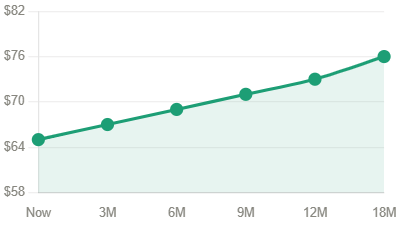
Under normal market conditions, oil futures for later delivery trade at slightly higher prices than near-term contracts. This is because storing oil is not free. It requires tanks, insurance, and financing. So the price difference between contracts simply reflects this cost of carry. This upward-sloping structure is called contango.
Illustration: For example, if the current (spot) price of crude oil is $64 per barrel, the 6-month futures contract may trade at $70. The extra $6 reflects storage costs, insurance, and interest expenses over those six months.
2. Backwardation
Current Scenario (West Asia War)
Near- term price> Future price
Curve Shape: Downward sloping
Market signal: Acute near-term supply shortage
Why it happens: Buyers pay a premium for immediate delivery
Investor implication: Supply stress - but may be temporary.
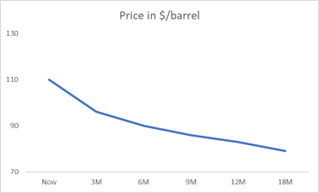
Backwardation is when this relationship flips. Near-term contracts start trading at a premium over longer-dated ones, producing a downward-sloping curve. This typically happens when the physical supply of oil tightens suddenly, either because demand has jumped sharply or because a major supply route has been disrupted. When buyers are scrambling for oil they need right now and are willing to pay a significant premium to get it, while the market still expects conditions to ease further out, you get backwardation.
Feature | Contango | Backwardation |
Curve Shape | Upward Sloping | Downward Sloping |
Near-term vs Far-term Price | Near < Far | Near > Far |
Market Condition | Oversupply / Normal | Tight Supply / Disruption |
Current Situation | No | Yes |
Signal for Investors | Stable/Soft Market | Supply Stress / Volatility |
The Brent crude futures market is currently in a state of steep backwardation, and by recent historical standards, the steepness is striking.
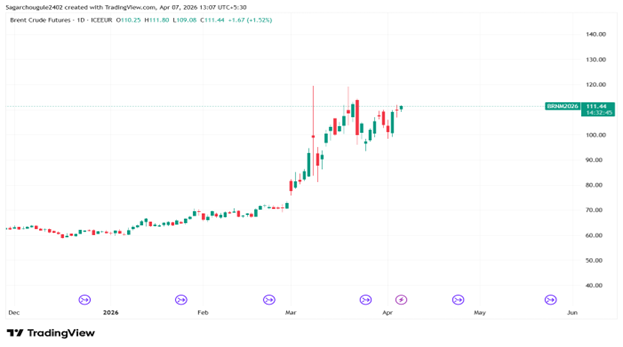
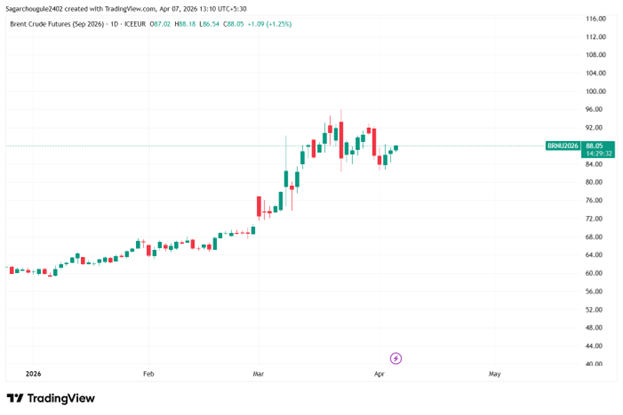
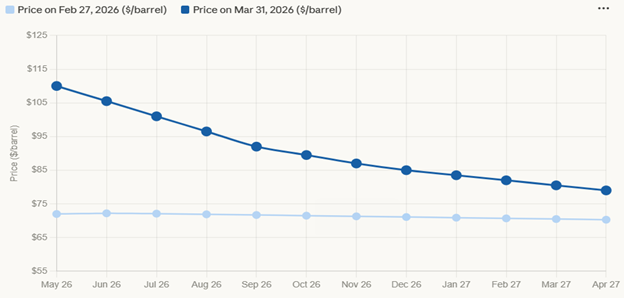
The nearest active contract is trading around $110 per barrel. The September 2026 contract sits near $88. By December, it is around $82. Further along the curve toward 2027, prices continue to drift lower. This is a sharply downward-sloping curve.
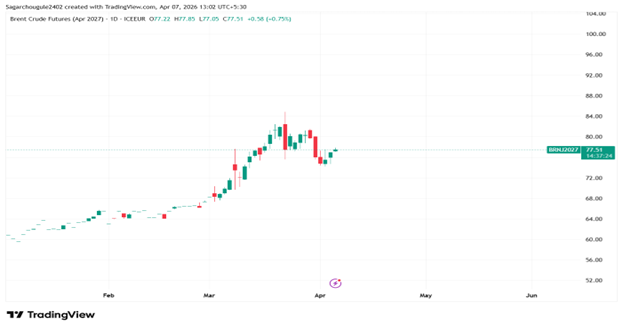
Chart 1: Brent Crude Futures (May)
Source: https://www.tradingview.com/
Chart 2: Brent Crude Futures (September)
Source: https://www.tradingview.com/
Chart 3: Brent Crude Futures (December)
Source: https://www.tradingview.com/
The trigger is well known. The disruption to shipping through the Strait of Hormuz following the US-Israel-Iran conflict has affected near-term supply flows. Roughly one-fifth of the world's crude oil moves through this narrow passage. When tankers began avoiding the route, the immediate availability of physical oil tightened sharply, pushing near-term contract prices up hard. Longer-dated contracts moved up too, but far less so, because the market's base case is still that this disruption will eventually pass.
The numbers tell this story clearly. From late February to the end of March 2026, the nearest contract gained around 46%. The December 2026 contract gained 24% over the same period. The uneven nature of that rally is precisely what defines backwardation. The further out you go, the more muted the move.
Brent Crude Futures Curve - The steep downward slope on the blue line clearly shows the backwardation, near-term contracts at $110 dropping all the way to $70 by April 2027, while the flat February line shows how normal the market was just two weeks earlier.
One practical way to gauge how tight things really are is to look at time spreads, which measure the price gap between near-term and far-dated contracts. The May to September spread currently sits at around $22 per barrel. May to December widens to approximately $28. All the way out to April 2027, the gap is close to $33.
Spread | Price Difference |
May 2026 vs Sep 2026 | ~$22/barrel |
May 2026 vs Dec 2026 | ~$28/barrel |
May 2026 vs Apr 2027 | ~$33/barrel |
Source: https://www.tradingview.com/
These are wide numbers by any recent benchmark. They reflect a market placing a steep premium on oil available right now, which in turn reflects genuine tightness in the physical market at this moment.
Crude Oil Supply Disruption: A Short-Term Shock or a Deeper Structural Change?
The current structure of the futures curve suggests the market leans toward the disruption being temporary. Longer-dated contracts have not rallied anywhere near as sharply as near-term ones, which would not be the case if the market genuinely believed supply would stay this tight for years.
The US Energy Information Administration's latest short-term outlook supports this reading. It projects global oil production to outpace consumption in both 2026 and 2027, with an estimated excess supply of around 1.87 million barrels per day this year and roughly 3 million barrels per day next year. If the Strait of Hormuz situation normalizes, this potential oversupply would likely push prices down significantly. The EIA's own forecast has Brent averaging around $70 per barrel by the fourth quarter of 2026 and $64 in 2027.
That said, the futures market itself is pricing something slightly higher. October through December contracts are currently above $80 per barrel, suggesting the market is not fully convinced the disruption ends cleanly. There is a gap between what the EIA projects and what the market is pricing, and that gap is worth watching.
India imports around 85%-88% of its crude oil requirement. This single fact makes every move in global oil prices a domestic event, not just a commodity market story.
When oil prices rise sharply, the import bill increases, the current account deficit widens, and the rupee comes under pressure. A weaker rupee then makes all imports more expensive, feeding into broader inflation. Companies across sectors, from paints to airlines to FMCG, face higher input costs. The RBI finds itself in the uncomfortable position of having to hold rates higher than it would otherwise want to, even when growth needs support. All of this creates a negative backdrop for equity valuations, and all of it reverses if oil prices come down.
If the futures curve's implied view plays out and supply does start normalising in the second half of 2026, the impact on Indian markets could be quite meaningful. Lower oil prices would ease inflation, give the RBI room to cut rates, take pressure off the rupee, and improve margins across a wide range of sectors. That combination historically tends to be a positive catalyst for equities.
The crude oil futures curve reflects current market positioning and expectations, both of which can shift quickly if the underlying situation changes.
Two scenarios are worth keeping in mind. If the conflict eases and oil flows through the Strait of Hormuz resume gradually, near-term contracts should start to come down, the backwardation should ease, and the curve will likely move toward a flatter shape. That would be a constructive signal for markets.
If the conflict deepens or drags on longer than expected, watch for the longer-dated contracts to start rising more sharply. A flattening of the curve caused by the back end rising rather than the front end falling would be a sign that the market is starting to price in a more sustained supply problem. That scenario would carry more serious implications for inflation, interest rates, and equity markets.
Disclaimer :
Investments in securities market are subject to market risk, read all related documents carefully before investing. This content is for educational purposes only. Securities quoted are exemplary and not recommendatory.
The information on this website is provided on "AS IS" basis. Bajaj Broking (BFSL) does not warrant the accuracy of the information given herein, either expressly or impliedly, for any particular purpose and expressly disclaims any warranties of merchantability or suitability for any particular purpose. While BFSL strives to ensure accuracy, it does not guarantee the completeness, reliability, or timeliness of the information. Users are advised to independently verify details and stay updated with any changes.
The information provided on this website is for general informational purposes only and is subject to change without prior notice. BFSL shall not be responsible for any consequences arising from reliance on the information provided herein and shall not be held responsible for all or any actions that may subsequently result in any loss, damage and/or liability. Interest rates, fees, and charges etc., are revised from time to time, for the latest details please refer to our Pricing page.
Neither the information, nor any opinion contained in this website constitutes a solicitation or offer by BFSL or its affiliates to buy or sell any securities, futures, options or other financial instruments or provide any investment advice or service.
BFSL is acting as distributor for non-broking products/ services such as IPO, Mutual Fund, Insurance, PMS, and NPS. These are not Exchange Traded Products. For more details on risk factors, terms and conditions please read the sales brochure carefully before investing.
Content Partner - Dalal Street Investment Journal Wealth Advisory Private Limited
This article is for educational purposes only and should not be considered investment advice. Market investments are subject to risks. DSIJ Wealth Advisory Private Limited is a SEBI-registered Research Analyst (Reg. No: INH000006396) and Investment Adviser (Reg. No: INA000001142). Please consult your financial adviser before investing.
For more disclaimer, check here : https://www.bajajbroking.in/disclaimer
Level up your stock market experience: Scan the QR to download the Bajaj Broking App for effortless investing and trading

Enjoy low brokerage on delivery trades
|
Open Your Free Demat Account
Enjoy low brokerage on delivery trades
|


