
Get Free Demat Account*











Open Your Free Demat Account
Enjoy low brokerage on delivery trades
By Dalal Street Investment Journal (DSIJ)
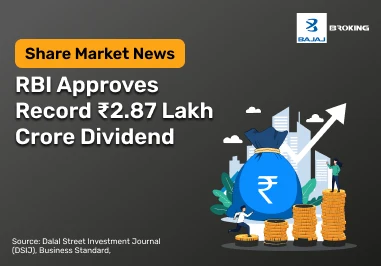
The RBI's Central Board approved a record surplus transfer of ₹2.87 lakh crore to the central government for FY2025-26, surpassing last year's ₹2.69 lakh crore payout. The transfer was driven by higher interest income, rupee depreciation-led valuation gains on foreign currency assets, and a 20.61% expansion in the RBI's balance sheet.
Every year, sometime in May, the Reserve Bank of India holds a board meeting to decide how much of its surplus it will transfer to the central government. It is one of those events that does not get as much public attention as it perhaps deserves, because the numbers involved are enormous and the impact on government finances is very real.
This year, the RBI approved a surplus transfer of ₹2.87 lakh crore to the central government for the financial year 2025-26. The decision was taken at the 623rd meeting of the Central Board of Directors of the RBI, under the chairmanship of Governor Sanjay Malhotra. It is the highest-ever dividend payout by the central bank to the government, surpassing last year's record of ₹2.69 lakh crore.
The RBI is not a profit-driven institution, but it does earn income — and quite a lot of it. The RBI makes its annual payout to the government from the surplus income it earns on investments, valuation changes on its foreign currency holdings including the dollar, and fees it receives from printing currency notes.
The net income, before risk provisioning and transfer to statutory funds, stood at ₹3.96 lakh crore in FY2025-26, up from ₹3.13 lakh crore in FY2024-25. That is a substantial jump, and it explains why the final payout came in higher than what even many analysts had expected.
An important factor that helped to increase the dividend was the almost 10% decline of the rupee against the US dollar in FY26, leading to valuation profits on the foreign exchange holdings of RBI and increasing the size of its balance sheet. The foreign exchange reserves of India were also up by around 3% to nearly $688 billion in FY26.
The RBI's balance sheet itself expanded by 20.61% to ₹91.97 lakh crore as on March 31, 2026.
To understand the scale of this transfer, it helps to look at the trend. Just three years ago, in FY23, the RBI had transferred ₹87,416 crore to the government. In FY24, that number jumped to ₹2.11 lakh crore. In FY25, it went up further to ₹2.69 lakh crore; a 27% increase. And now in FY26, it has climbed again to ₹2.87 lakh crore.
Over the past three financial years, RBI dividend payouts to the government have increased more than threefold, emerging as an increasingly important source of non-tax revenue for the Centre. That is a remarkable shift in how central bank surpluses have grown as a proportion of government receipts.
For the government, this transfer is non-tax revenue, money that comes in without any new borrowing or taxation. The windfall will provide a major boost to government finances, helping to keep the fiscal deficit in check amid global economic uncertainties without the need for increased market borrowing.
In the Union Budget for 2026-27, the government had estimated ₹3.16 lakh crore in dividends from state-owned companies and surplus transfers from the central bank. The RBI's ₹2.87 lakh crore contribution, combined with healthy dividends from public sector banks, which posted record aggregate net profits of ₹1.98 lakh crore in FY26; means the government is well placed to meet or exceed that estimate.
The timing matters too. Global conditions remain uncertain, with trade tensions and geopolitical pressures continuing to weigh on economic forecasts. Having a large, predictable inflow of non-tax revenue gives the government more room to manoeuvre without stretching its borrowing programme.
Every year, part of the debate around the RBI dividend involves the Contingency Risk Buffer, the reserve the central bank keeps as a cushion against unforeseen risks. Under the RBI's Economic Capital Framework, the central bank is required to maintain the Contingent Risk Buffer within a range of 4.5% to 7.5% of its balance sheet. The Central Board had raised it to 7.5% in FY25 from 6.5% in FY24.
The final payout of ₹2.87 lakh crore suggests the board found a level it was comfortable with while still delivering a higher-than-ever surplus to the government.
The number is large by any measure. Whether it gets used to reduce borrowing, fund infrastructure, or simply provide a cushion against fiscal slippage will be the next thing worth watching.
Source: Dalal Street Investment Journal (DSIJ), TradingView, NSE, BSE
SEBI Registered Research Analyst (INH000006396).
Founded in 1986, Dalal Street Investment Journal (DSIJ) brings decades of experience in India’s equity markets. DSIJ's research combines fundamental analysis with price action, guided by disciplined risk management and capital preservation. They follow a structured, data-driven approach designed to help investors and traders make informed decisions beyond short-term market noise.

Disclaimer :
Investments in securities market are subject to market risk, read all related documents carefully before investing. This content is for educational purposes only. Securities quoted are exemplary and not recommendatory.
The information on this website is provided on "AS IS" basis. Bajaj Broking (BFSL) does not warrant the accuracy of the information given herein, either expressly or impliedly, for any particular purpose and expressly disclaims any warranties of merchantability or suitability for any particular purpose. While BFSL strives to ensure accuracy, it does not guarantee the completeness, reliability, or timeliness of the information. Users are advised to independently verify details and stay updated with any changes.
The information provided on this website is for general informational purposes only and is subject to change without prior notice. BFSL shall not be responsible for any consequences arising from reliance on the information provided herein and shall not be held responsible for all or any actions that may subsequently result in any loss, damage and/or liability. Interest rates, fees, and charges etc., are revised from time to time, for the latest details please refer to our Pricing page.
Neither the information, nor any opinion contained in this website constitutes a solicitation or offer by BFSL or its affiliates to buy or sell any securities, futures, options or other financial instruments or provide any investment advice or service.
BFSL is acting as distributor for non-broking products/ services such as IPO, Mutual Fund, Insurance, PMS, and NPS. These are not Exchange Traded Products. For more details on risk factors, terms and conditions please read the sales brochure carefully before investing.
Content Partner - Dalal Street Investment Journal Wealth Advisory Private Limited
This article is for educational purposes only and should not be considered investment advice. Market investments are subject to risks. DSIJ Wealth Advisory Private Limited is a SEBI-registered Research Analyst (Reg. No: INH000006396) and Investment Adviser (Reg. No: INA000001142). Please consult your financial adviser before investing.
For more disclaimer, check here : https://www.bajajbroking.in/disclaimer
Level up your stock market experience: Scan the QR to download the Bajaj Broking App for effortless investing and trading

Enjoy low brokerage on delivery trades
|
Open Your Free Demat Account
Enjoy low brokerage on delivery trades
|


