
Get Free Demat Account*







Open Your Free Demat Account
Enjoy low brokerage on delivery trades
By Dalal Street Investment Journal (DSIJ)
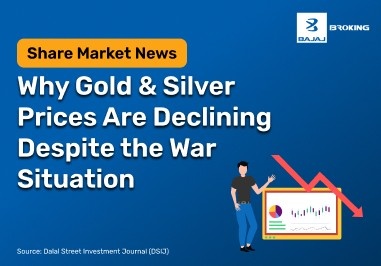
Gold and silver surged through 2025 but have plunged since March 2026 amid the West Asia conflict. Rising US bond yields, a stronger dollar, and leveraged investors unwinding positions are pressuring metals. Oil-driven inflation and market volatility have not boosted safe-haven demand, as the prior rally already priced in geopolitical risk, weakening gold and silver’s appeal.
Gold delivered returns of 68.66% through 2025. Silver rose around 130% in the same period, the largest annual gain on record for the metal. Both attracted a broad range of participants, leveraged ETF funds, institutional buyers, and retail investors. Over time, gold and silver began responding to flow and sentiment as much as to underlying supply and demand. They were being traded actively, much like any other financial asset.
That shift is now a key reason behind the current decline. Since March 2026, gold has fallen roughly 17% and silver has dropped nearly 30%. On January 30, silver declined 26% in a single session, its sharpest single-day fall since the 1980s. Spot silver prices fell below $65 and made a new recent low of $61 on March 23, 2026, leaving the metal more than 49% below its January peak of $121.65. Gold recorded its worst weekly performance since September 2011 and is on course for its weakest monthly showing since October 2008.
All of this is unfolding alongside an active conflict in West Asia. US and Israeli strikes on Iran began on February 28, 2026, and most market participants would have expected precious metals to move higher in response. Instead, selling pressure has remained elevated. Crude oil prices have risen sharply, feeding concerns about inflation. Bond yields have moved up in response. The US dollar has strengthened. And investors who built leveraged positions in gold and silver during the 2025 rally are now unwinding those trades.
The US Dollar Index was trading near 96 in mid-February 2026 before moving above 101 in March as the conflict intensified and yield expectations shifted. As of March 23, it was around 99.65, having recovered more than 5% from the February low.
Three factors are behind this move. US bond yields at 4.39% are drawing global capital into dollar-denominated assets. The dollar itself is receiving safe-haven flows during the West Asia conflict. And rate cut expectations have been pushed to December 2026, keeping the dollar supported.
A stronger dollar raises the cost of metals for international buyers, particularly in Asia and emerging markets, while making dollar-denominated fixed income instruments more competitive. Both effects are operating at the same time.
The war's most significant economic consequence has been its effect on energy markets, and through energy, on inflation and interest rate expectations. This sequence of developments has directly reduced the investment case for precious metals.
Energy Markets - Israeli strikes targeted South Pars, Iran's largest natural gas field. Iran's response extended to Qatar's LNG complex, a UAE gas field, a Saudi refinery, and two Kuwaiti gas facilities. Brent Crude futures reached above $115 per barrel at their highest point. US natural gas prices rose 90 cents in 19 days. The Strait of Hormuz, through which approximately 20% of global seaborne oil and LNG flows, was disrupted.
Inflation - Energy costs feed through into almost every part of an economy. Transportation, manufacturing, agriculture, and logistics all carry fuel as a cost input. When oil rises sharply, producer prices follow, and consumer prices eventually do too. US inflation was already at 2.4% year-over-year as of February 2026, slightly above the Federal Reserve's 2% target, before the full impact of the energy shock had been felt.
Interest Rates and Bond Yields – The Federal Reserve voted 11 to 1 at its March 18 meeting to leave the federal funds rate unchanged at 3.50% to 3.75%. Fed Chair Jerome Powell acknowledged that progress on inflation had been slower than anticipated. The Fed's own projections pointed to just one rate cut in 2026, with market pricing that cut no earlier than December. The 10-year US Treasury yield rose from approximately 3.96% before the conflict began to 4.39% by March 20, its highest level since July 2025.
Gold and silver produce no income. They pay no interest and offer no yield. When a risk-free government bond is paying 4.39%, holding a metal that pays nothing requires a strong view on price appreciation. As bonds become relatively more attractive, capital moves out of metals and into fixed income. That rotation adds consistent downward pressure on gold and silver prices.
When a conflict breaks out, investors have historically moved capital into gold and silver. As equity markets come under pressure, precious metals have tended to benefit. The West Asia situation had the conditions that would normally support higher metal prices: a major oil-producing region, disrupted supply chains, and the involvement of large global powers.
That has not happened.
The risk premium was already in the price. Gold and silver had been rising for months before the current conflict began. From July 2025 onwards, trade sanctions and growing instability across the Middle East were already pushing prices higher. By the time military action started in late February 2026, a significant portion of the potential upside had already been reflected in prices.
Gold and silver are being traded differently now. The investor base in precious metals changed during the 2025 rally. Systematic hedge funds, leveraged ETF managers, and retail traders entered these markets in large numbers. These participants are not holding metals for the long term and respond quickly to changing conditions.
Government bonds are offering a competitive return. The Federal Reserve is holding rates at 3.50% to 3.75%, and the 10-year Treasury yield stands at 4.39%. A risk-free government bond is now paying a return that is difficult to ignore. Capital that would previously have moved into gold during periods of uncertainty is going into fixed income instead. Gold generates no income, and when a low-risk alternative pays 4.39%, the case for holding it weakens.
Investors are selling to raise cash. When markets fall across equities, bonds, and commodities at the same time, investors tend to sell their best-performing positions first. Gold and silver returned between 68% and 130% through 2025. Selling those positions to raise cash has been the more common response in the current environment, rather than holding them as a hedge.
SEBI Registered Research Analyst (INH000006396).
Founded in 1986, Dalal Street Investment Journal (DSIJ) brings decades of experience in India’s equity markets. DSIJ's research combines fundamental analysis with price action, guided by disciplined risk management and capital preservation. They follow a structured, data-driven approach designed to help investors and traders make informed decisions beyond short-term market noise.
Disclaimer :
Investments in securities market are subject to market risk, read all related documents carefully before investing. This content is for educational purposes only. Securities quoted are exemplary and not recommendatory.
The information on this website is provided on "AS IS" basis. Bajaj Broking (BFSL) does not warrant the accuracy of the information given herein, either expressly or impliedly, for any particular purpose and expressly disclaims any warranties of merchantability or suitability for any particular purpose. While BFSL strives to ensure accuracy, it does not guarantee the completeness, reliability, or timeliness of the information. Users are advised to independently verify details and stay updated with any changes.
The information provided on this website is for general informational purposes only and is subject to change without prior notice. BFSL shall not be responsible for any consequences arising from reliance on the information provided herein and shall not be held responsible for all or any actions that may subsequently result in any loss, damage and/or liability. Interest rates, fees, and charges etc., are revised from time to time, for the latest details please refer to our Pricing page.
Neither the information, nor any opinion contained in this website constitutes a solicitation or offer by BFSL or its affiliates to buy or sell any securities, futures, options or other financial instruments or provide any investment advice or service.
BFSL is acting as distributor for non-broking products/ services such as IPO, Mutual Fund, Insurance, PMS, and NPS. These are not Exchange Traded Products. For more details on risk factors, terms and conditions please read the sales brochure carefully before investing.
Content Partner - Dalal Street Investment Journal Wealth Advisory Private Limited
This article is for educational purposes only and should not be considered investment advice. Market investments are subject to risks. DSIJ Wealth Advisory Private Limited is a SEBI-registered Research Analyst (Reg. No: INH000006396) and Investment Adviser (Reg. No: INA000001142). Please consult your financial adviser before investing.
For more disclaimer, check here : https://www.bajajbroking.in/disclaimer
Level up your stock market experience: Scan the QR to download the Bajaj Broking App for effortless investing and trading

Enjoy low brokerage on delivery trades
|
Open Your Free Demat Account
Enjoy low brokerage on delivery trades
|


