
Get Free Demat Account*







Open Your Free Demat Account
Enjoy low brokerage on delivery trades
By Dalal Street Investment Journal (DSIJ)
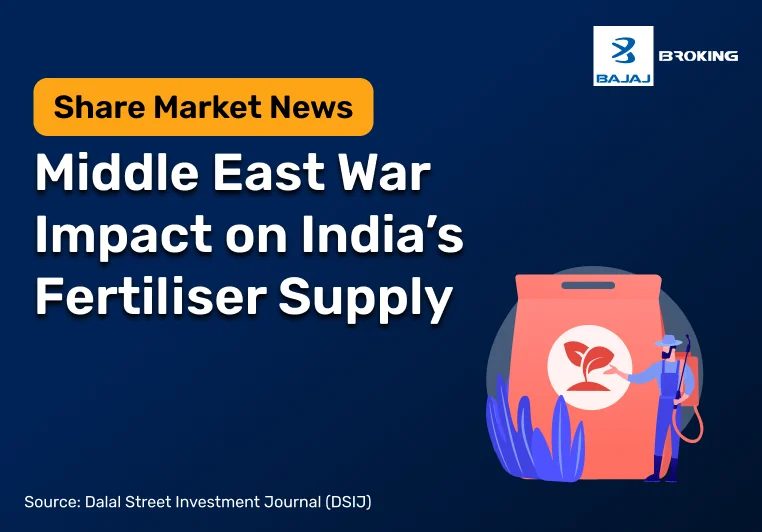
The Middle East conflict has exposed vulnerabilities in India’s fertiliser supply chain, heavily reliant on the Strait of Hormuz. Rising LNG shortages and disrupted trade routes have pushed fertiliser prices higher, impacting domestic production and imports. With stocks at risk and Kharif season nearing, government measures aim to stabilise supply and protect agricultural productivity.
The war in the Middle East has created worry in financial markets. Strained relations among significant Gulf countries have impacted trading routes through the Strait of Hormuz. The Strait of Hormuz is one of the world’s most important shipping lanes. It connects the Persian Gulf with the Gulf of Oman. The Strait is only 29 nautical miles wide (54 km) and it consists of 2-mile-wide navigable channels (3.7 km) for inbound and outbound shipping as well as a 2-mile-wide buffer zone. Around 25% of global seaborne crude passes through it. Fertilisers and key chemicals also use this route. Any disruption can affect global supply chains and India’s imports.
Fertilisers play a crucial role in enhancing agricultural productivity. Along with quality seeds and reliable irrigation, they are one of the key factors driving higher crop yields. The use of fertilisers has grown steadily over the years, particularly after the Green Revolution. Their impact has been significant in helping India move closer to self-reliance in food production.
Fertilisers contain three key nutrients, often called NPK: Nitrogen (N), Phosphorus (P), and Potassium (K). Nitrogen, mostly from urea, helps plants grow leaves and stems. Phosphorus, mainly in DAP, supports roots and flowering. Potassium, from potash, strengthens plants and improves fruit and grain quality.
As of August 09, 2025, according to a PIB publication, India has achieved near self-sufficiency in key fertilisers:
Around 87% of urea consumption is domestically met.
90% of NPK fertilisers are also produced within the country.
However, for DAP, only about 40% comes from local production.
In the case of Muriate of Potash (MOP), 100% is still imported.
According to reports, India remains the second-largest consumer and third-largest producer of fertilisers globally. A large portion of raw materials and finished products passes through the Persian Gulf. The Strait of Hormuz has become a critical “fertiliser choke point,” meaning any disruption there directly affects India’s supply.
While the war may seem distant, its effects are reaching India. Not only the energy sector, but it is also important to take note of the fertiliser sector that would be impacted due to this.
In just a few days of the conflict, fertiliser prices in India have surged by 20% to 30%. The urea affordability index has dropped to its second-lowest level since 2010, close to the lows seen during the Russia-Ukraine war.
Additionally, India produces about 80% of its urea domestically, but production relies heavily on Liquefied Natural Gas (LNG). Over 85% of LNG for Asia’s fertiliser plants comes from West Asia, mainly Qatar. Qatar contributes over 50% for India. Unlike previous trade disruptions that could be rerouted, a closure of the Strait of Hormuz is a “hard stop” for natural gas. With Petronet LNG invoking force majeure and plants like GNFC facing gas rationing, domestic production has slowed. The government holds around 180 LMT of fertilisers, higher than last year. But it is estimated that a prolonged blockade could deplete these stocks before the Kharif sowing season, which starts from June.
The war affects different fertiliser nutrients in unique ways. Nitrogen (urea) production is directly tied to LNG supply, so any gas shortage slows output. Phosphorus (DAP), imported mainly from Saudi Arabia and the Middle East, is subject to transportation risks. Similarly, the import of potassium (potash), which is entirely imported, does not face the impact of the war directly. However, the cost of transportation and insurance, as well as the increased delivery times, have increased.
Currently, India is already facing a gas shortage. On March 03, 2026, Petronet invoked a "force majeure" after vessels were unable to reach Qatar safely. GNFC had a 60% reduction in gas allocation from GAIL. The government issued the "Natural Gas Supply Regulation Order 2026." Under this order, gas allocation for various sectors is prioritised: 100% for residential use, 70% of their six-month average consumption for the fertiliser sector, and only 65% for the refining sector.
The Union Agriculture Minister, Shivraj Singh, has stressed the importance of ensuring the availability of fertilisers in a fair and uninterrupted manner. He has asked his officials to speed up the process of creating Farmer IDs to make the system more transparent. He also wants to hold a meeting soon with the chief ministers and agriculture ministers of different states to strengthen the supply chain so that farmers are not deprived of fertilisers.
In the end, the current conflict in the Gulf has shown weakness of global supply chains, particularly in areas such as fertilisers. In the case of India, which is a major importer and has a low number of supply routes, any issue could impact the market and supply of such products. The above situation illustrated the impact of geopolitical events beyond one’s shores. In this case, the impact of such events could be seen on the market and supply of such products, and hence it could be a major area of concern.
SEBI Registered Research Analyst (INH000006396).
Founded in 1986, Dalal Street Investment Journal (DSIJ) brings decades of experience in India’s equity markets. DSIJ's research combines fundamental analysis with price action, guided by disciplined risk management and capital preservation. They follow a structured, data-driven approach designed to help investors and traders make informed decisions beyond short-term market noise.
Disclaimer :
Investments in securities market are subject to market risk, read all related documents carefully before investing. This content is for educational purposes only. Securities quoted are exemplary and not recommendatory.
The information on this website is provided on "AS IS" basis. Bajaj Broking (BFSL) does not warrant the accuracy of the information given herein, either expressly or impliedly, for any particular purpose and expressly disclaims any warranties of merchantability or suitability for any particular purpose. While BFSL strives to ensure accuracy, it does not guarantee the completeness, reliability, or timeliness of the information. Users are advised to independently verify details and stay updated with any changes.
The information provided on this website is for general informational purposes only and is subject to change without prior notice. BFSL shall not be responsible for any consequences arising from reliance on the information provided herein and shall not be held responsible for all or any actions that may subsequently result in any loss, damage and/or liability. Interest rates, fees, and charges etc., are revised from time to time, for the latest details please refer to our Pricing page.
Neither the information, nor any opinion contained in this website constitutes a solicitation or offer by BFSL or its affiliates to buy or sell any securities, futures, options or other financial instruments or provide any investment advice or service.
BFSL is acting as distributor for non-broking products/ services such as IPO, Mutual Fund, Insurance, PMS, and NPS. These are not Exchange Traded Products. For more details on risk factors, terms and conditions please read the sales brochure carefully before investing.
Content Partner - Dalal Street Investment Journal Wealth Advisory Private Limited
This article is for educational purposes only and should not be considered investment advice. Market investments are subject to risks. DSIJ Wealth Advisory Private Limited is a SEBI-registered Research Analyst (Reg. No: INH000006396) and Investment Adviser (Reg. No: INA000001142). Please consult your financial adviser before investing.
For more disclaimer, check here : https://www.bajajbroking.in/disclaimer
Level up your stock market experience: Scan the QR to download the Bajaj Broking App for effortless investing and trading

Enjoy low brokerage on delivery trades
|
Open Your Free Demat Account
Enjoy low brokerage on delivery trades
|


