
Get Free Demat Account*










Open Your Free Demat Account
Enjoy low brokerage on delivery trades
By Dalal Street Investment Journal (DSIJ)
RBI Bulletin highlights early signs of slowdown due to the West Asia conflict, with March high-frequency indicators showing a mixed picture. E-way bills, GST collections, fuel consumption and digital payments remained strong, while port cargo, air passenger traffic, electricity demand, core industries and PMI readings showed moderation.
The Indian economy continues to demonstrate resilience despite a significant supply shock triggered by the ongoing conflict in West Asia. Reinforcing this stability, the International Monetary Fund (IMF) has marginally upgraded India’s GDP growth forecast for FY27 to 6.5%, from 6.4%. However, beneath this steady headline number, early signs of moderation are beginning to surface across select high-frequency indicators.
According to the Reserve Bank of India’s latest monthly bulletin, indicators such as port cargo volumes, air passenger traffic, and purchasing managers’ outlook point towards a gradual loss of momentum. While the economy is not weakening materially, the pace of expansion appears to be easing in pockets.
Inflation remains within the RBI’s tolerance band, supported by timely government interventions and efficient supply management. However, risks are gradually building. Supply-side disruptions ranging from geopolitical tensions to weather uncertainties are beginning to exert upward pressure.
The RBI has also flagged the possibility of second-round effects, where initial supply shocks could spill over into demand conditions. This transmission, if sustained, could complicate the inflation outlook and warrant closer policy monitoring.
Domestic demand continues to hold up well, with rural consumption playing a key stabilising role. Automobile sales and vehicle registrations remain robust, aided in part by GST-related benefits.
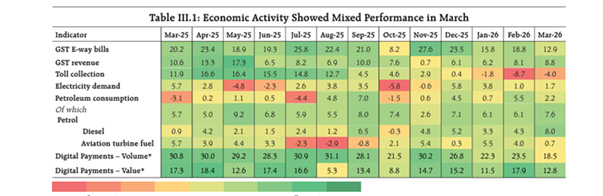
High-frequency indicators of economic activity painted a mixed picture in March. E-way bills continued to record double-digit growth, supported by GST rate rationalisation and strong goods movement. GST revenues also surged, reflecting sustained consumption demand and better compliance.
Fuel consumption, however, showed a more uneven trend. Petrol and diesel demand rose, partly due to precautionary buying amid fears of supply disruptions. Overall petroleum consumption moderated, mainly because aviation turbine fuel demand fell sharply after widespread flight suspensions linked to the West Asia conflict.
Digital payments remained strong in both value and volume terms. Electricity demand stayed moderate, largely due to above-normal rainfall during the first 25 days of March, which reduced cooling demand. Meanwhile, toll collections continued to decline, reflecting the impact of the FASTag Annual Pass scheme introduced in August 2025.
Source: RBI
While both manufacturing and services sectors remain in expansionary territory, the pace of growth has moderated. The manufacturing PMI slipped to a near four-year low, reflecting softer new orders and output growth amid rising cost pressures. Similarly, the services PMI eased to a 14-month low, indicating some cooling in new business activity.
The index of eight core industries also declined to a 19-month low, led by reduced output in fertilisers, crude oil, coal, and electricity; pointing towards broader industrial softness.
Agricultural prospects remain mixed. While favourable summer sowing for pulses, oilseeds, and coarse cereals provides some comfort, concerns persist over input supply disruptions linked to the West Asia conflict.
More importantly, the possibility of below-normal monsoon rainfall due to El Niño conditions poses a downside risk to agricultural output. That said, adequate reservoir levels and healthy foodgrain stocks offer a buffer against immediate supply concerns.
India’s trade deficit narrowed to a nine-month low in March, supported by sequential growth in exports and a contraction in imports. However, trade flows with West Asia have been impacted due to the ongoing conflict, highlighting vulnerabilities in regional linkages.
In this evolving macro environment, the Monetary Policy Committee has opted to keep policy rates unchanged while maintaining a ‘neutral’ stance. This approach provides the RBI with flexibility to respond to incoming data, particularly as growth and inflation signals remain mixed.
Forward-looking surveys indicate softening consumer confidence and moderation in business optimism, alongside rising cost pressures; factors that the central bank will monitor closely in the coming months.
India’s macroeconomic narrative remains one of resilience, but not without emerging fault lines. Demand conditions are holding firm, supported by rural recovery and stable consumption trends. However, moderation in industrial activity, rising cost pressures, and global uncertainties suggest that the growth trajectory may become more uneven going forward.
The key monitorables now include inflation trends, monsoon progression, and the extent of geopolitical disruptions; each of which could shape the next phase of India’s economic cycle.
SEBI Registered Research Analyst (INH000006396).
Founded in 1986, Dalal Street Investment Journal (DSIJ) brings decades of experience in India’s equity markets. DSIJ's research combines fundamental analysis with price action, guided by disciplined risk management and capital preservation. They follow a structured, data-driven approach designed to help investors and traders make informed decisions beyond short-term market noise.
Disclaimer :
Investments in the securities market are subject to market risk, read all related documents carefully before investing. This content is for educational purposes only. Securities quoted are exemplary and not recommendatory.
The information on this website is provided on "AS IS" basis. Bajaj Broking (BFSL) does not warrant the accuracy of the information given herein, either expressly or impliedly, for any particular purpose and expressly disclaims any warranties of merchantability or suitability for any particular purpose. While BFSL strives to ensure accuracy, it does not guarantee the completeness, reliability, or timeliness of the information. Users are advised to independently verify details and stay updated with any changes.
The information provided on this website is for general informational purposes only and is subject to change without prior notice. BFSL shall not be responsible for any consequences arising from reliance on the information provided herein and shall not be held responsible for all or any actions that may subsequently result in any loss, damage and or liability. Interest rates, fees, and charges etc., are revised from time to time, for the latest details please refer to our Pricing page.
Neither the information, nor any opinion contained in this website constitutes a solicitation or offer by BFSL or its affiliates to buy or sell any securities, futures, options or other financial instruments or provide any investment advice or service.
BFSL is acting as distributor for non-broking products/ services such as IPO, Mutual Fund, Insurance, PMS, and NPS. These are not Exchange Traded Products. For more details on risk factors, terms and conditions please read the sales brochure carefully before investing.
Content Partner - Dalal Street Investment Journal Wealth Advisory Private Limited
This article is for educational purposes only and should not be considered investment advice. Market investments are subject to risks. DSIJ Wealth Advisory Private Limited is a SEBI-registered Research Analyst (Reg. No: INH000006396) and Investment Adviser (Reg. No: INA000001142). Please consult your financial adviser before investing.
For more disclaimer, check here : https://www.bajajbroking.in/disclaimer
Level up your stock market experience: Download the Bajaj Broking App for effortless investing and trading

Enjoy low brokerage on delivery trades
|
Open Your Free Demat Account
Enjoy low brokerage on delivery trades
|


