












Open Your Free Demat Account
Enjoy low brokerage on delivery trades
 April 08, 2026
 3 mins read
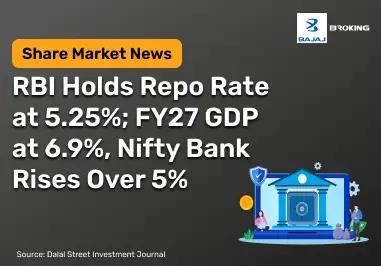
The RBI’s Monetary Policy Committee keeps the repo rate at 5.25% and maintains a neutral stance, projecting FY27 GDP growth at 6.9%. Risks from West Asia tensions and potential El Niño impacts on inflation remain. Meanwhile, Nifty Bank surged over 5% today, with private sector banks leading the gains, reflecting improved market sentiment following geopolitical developments.
April 08, 2026, the Reserve Bank of India's Monetary Policy Committee (MPC) voted unanimously to keep the policy repo rate unchanged at 5.25%. The rate for the standing deposit facility (SDF) stays at 5.00%. The Bank Rate and the marginal standing facility (MSF) rate stay at 5.50%. The MPC also maintained its neutral stance. This shows a careful approach that balances strong domestic fundamentals with rising global risks
The RBI Governor, Sanjay Malhotra, said that India’s economy did well in 2025-26. Real GDP growth is estimated to be 7.6% year-on-year, as per the Second Advance Estimates (SAE) of the new GDP series (base year 2022-23). Private consumption and fixed investment contributed significantly to overall growth, while net external demand remained soft. On the supply side, estimated real GVA growth of 7.7% was driven by buoyant services sector and robust manufacturing activity.
Moving ahead, growth is expected to moderate in 2026-27. Real GDP growth is projected at 6.9% for 2026-27. Quarterly estimates show Q1 2026-27 at 6.8%, slightly lower than the earlier 6.9%. Q2 2026-27 is at 6.7%, revised down from 7%. Q3 and Q4 2026-27 are expected to pick up and report 7.0% and 7.2%, respectively. That said, further escalation of the conflict, its continuation over a wider geographical spread and uncertainty regarding the damage to the energy infrastructure, apart from weather related events, pose downside risks to the domestic growth outlook.
The growth numbers are revised down because of the tensions in the Middle East since March 2026. Possible disruptions in the Strait of Hormuz could have an effect on energy supplies and trade around the world. Higher prices for energy and goods, supply shocks, and rising costs for shipping and insurance are all expected to hurt domestic production and exports. India may also be affected by changes in the global financial market.
Considering all of this, the inflation is still under control, but it is being watched closely. In February 2026, the headline CPI went up from 2.7% in January to 3.2%. Most of the rise is because of base effects. Food prices went up a little, but core inflation, which doesn't include food and fuel, stayed the same. Excluding precious metals, core inflation is thought to be 2.1%.
For 2026-27, CPI inflation is projected at 4.6%. The quarterly path shows that Q1 is at 4.0%, Q2 is at 4.4%, Q3 is at 5.2%, and Q4 is at 4.7%. If you ignore precious metals, core inflation is expected to be 4.4%.
The RBI warned of risks to inflation. High energy prices from West Asia and possible El Niño effects on the southwest monsoon could push prices higher. Domestic factors such as GST rationalisation, rising manufacturing capacity, healthy corporate balance sheets, and strong services growth may ease the pressure.
High-frequency indicators up to February 2026 suggest that India’s economy maintained strong momentum. Growth was supported by strong private consumption and healthy investment demand. Malhotra noted that growth momentum was strong before March. However, external shocks now pose risks to growth and may add pressure on inflation, even as headline figures remain below target. The central bank is watching the situation closely and will act as needed to maintain stability.
Short-term money market rates, including commercial papers and certificates of deposit, remained high. Government securities yields were largely stable. They softened in February but rose later due to the West Asia conflict, higher global yields, and rising energy prices. Credit market transmission remained satisfactory.
The Reserve Bank of India ensured ample liquidity in the system. Since the last MPC meeting, the net position under the Liquidity Adjustment Facility (LAF) averaged a daily surplus of ₹2.3 lakh crore. The weighted average call rate (WACR) mostly stayed in the lower half of the corridor, except at the end of March.
The banking system remains strong. Scheduled Commercial Banks are well-capitalised, liquid, and profitable, with good asset quality. Non-Banking Financial Companies also maintain sound capital and improved asset quality.
Credit growth remains healthy. Credit from all sources rose 14.3% year-on-year, compared with 11.7% a year ago. Bank credit continues to grow across sectors, supporting both investment and consumption.
The RBI announced measures to ease capital requirements for banks, aiming to free up capital for lending and other productive activities. Banks will find it easier to include quarterly profits in the calculation of their Capital-to-Risk-Weighted Assets Ratio (CRAR). The central bank also removed the requirement to maintain an Investment Fluctuation Reserve (IFR).
Currently, quarterly profits can be added to capital, provided incremental provisions for non-performing assets (NPAs) at the end of any quarter in the previous financial year do not deviate more than 25% from the quarterly average. These changes are intended to improve banks’ lending capacity and strengthen financial stability.
The RBI also took measures to maintain liquidity and said it would continue to act proactively to meet the needs of the economy.
With regard to the current situation and the ceasefire announced by the USA and Iran, sentiments across the markets have turned positive. Notable performers were the Nifty Bank, which saw a sharp appreciation of more than 5%. The positive move was led by several private banks, which gained up to 6%.
On Wednesday, 8 April 2026, at 11:35 am, Nifty Bank was trading at 55,463.35, which is a jump of 2,747.10 points or about 5.21%.
Stock Name | CMP (₹) | Change (%) |
Axis Bank | 1,326.30 | 6.10 |
ICICI Bank | 1,307.60 | 4.99 |
HDFC Bank | 808.55 | 4.73 |
SBIN | 1,070.80 | 3.92 |
Kotak Bank | 376.05 | 3.61 |
The West Asia war has impacted the global economy and hampered sentiment across regions. This has also raised concerns for the growth and inflation in India. Higher crude oil prices, supply disruptions, and global market fluctuations may harm domestic production and increase costs.
The Reserve Bank of India is watchful and prepared to take action to protect economic stability. At the same time, domestic markets have reacted positively to reduced geopolitical tensions, with Nifty Bank rising over 5% today. Private sector banks drove the gains today.
Disclaimer :
Investments in securities market are subject to market risk, read all related documents carefully before investing. This content is for educational purposes only. Securities quoted are exemplary and not recommendatory.
The information on this website is provided on "AS IS" basis. Bajaj Broking (BFSL) does not warrant the accuracy of the information given herein, either expressly or impliedly, for any particular purpose and expressly disclaims any warranties of merchantability or suitability for any particular purpose. While BFSL strives to ensure accuracy, it does not guarantee the completeness, reliability, or timeliness of the information. Users are advised to independently verify details and stay updated with any changes.
The information provided on this website is for general informational purposes only and is subject to change without prior notice. BFSL shall not be responsible for any consequences arising from reliance on the information provided herein and shall not be held responsible for all or any actions that may subsequently result in any loss, damage and/or liability. Interest rates, fees, and charges etc., are revised from time to time, for the latest details please refer to our Pricing page.
Neither the information, nor any opinion contained in this website constitutes a solicitation or offer by BFSL or its affiliates to buy or sell any securities, futures, options or other financial instruments or provide any investment advice or service.
BFSL is acting as distributor for non-broking products/ services such as IPO, Mutual Fund, Insurance, PMS, and NPS. These are not Exchange Traded Products. For more details on risk factors, terms and conditions please read the sales brochure carefully before investing.
Content Partner - Dalal Street Investment Journal Wealth Advisory Private Limited
This article is for educational purposes only and should not be considered investment advice. Market investments are subject to risks. DSIJ Wealth Advisory Private Limited is a SEBI-registered Research Analyst (Reg. No: INH000006396) and Investment Adviser (Reg. No: INA000001142). Please consult your financial adviser before investing.
For more disclaimer, check here : https://www.bajajbroking.in/disclaimer
Level up your stock market experience: Scan the QR to download the Bajaj Broking App for effortless investing and trading

Enjoy low brokerage on delivery trades
|
Open Your Free Demat Account
Enjoy low brokerage on delivery trades
|


