
Get Free Demat Account*














Open Your Free Demat Account
Enjoy low brokerage on delivery trades
By Dalal Street Investment Journal (DSIJ)
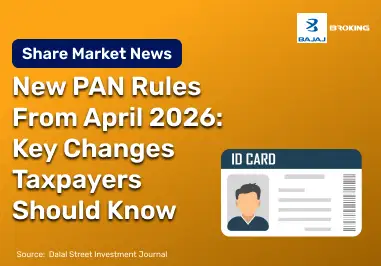
New PAN rules will come into effect from April 1, 2026, changing both the application process and PAN quoting thresholds for several high-value transactions. Notably, PAN will be required for cash deposits of ₹10 lakh or more in a financial year, replacing the earlier ₹50,000-a-day trigger. Here’s a quick look at what changes and why it matters.
The Central Board of Direct Taxes (CBDT) has notified the Income-tax Rules, 2026, which will come into force on April 1, 2026, under the Income-tax Act, 2025. The new framework changes the PAN application process and revises several rules relating to PAN quoting in specified transactions.
From April 1, 2026, a Permanent Account Number (PAN) application cannot be filed on the basis of Aadhaar alone. Applicants will have to furnish additional supporting documents, including proof of date of birth, such as a birth certificate, voter ID, Class 10 certificate, passport, or driving licence. The official PAN FAQs under the new regime also make it clear that documentary proof will be mandatory, and any incomplete application will be treated as invalid.
For Indian individuals, the new system does not support an Aadhaar-only approach in the way many applicants had come to rely on earlier. Aadhaar remains mandatory for most applicants, but it now sits within a broader documentation framework rather than acting as a stand-alone route for obtaining PAN.
The earlier PAN forms have now been replaced with category-specific forms. Form No. 93 is meant for Indian individuals, Form No. 94 for Indian non-individual entities, Form No. 95 for foreign individuals, and Form No. 96 for foreign entities. These forms are prescribed under the Income-tax Rules, 2026 and are available through authorised service providers such as Protean and UTIITSL.
That means applicants filing for PAN on or after April 1, 2026 must use the revised form that matches their category. The official FAQs also state that incomplete or deficient applications will be treated as invalid, which raises the importance of choosing the correct form and attaching the right records.
The fresh PAN framework also leaves less room for casual mismatch in personal details. The FAQs clarify that initials are generally not allowed in PAN applications, although there is limited accommodation where Aadhaar itself contains initials, provided the applicant submits the expanded full name with supporting documents.
Earlier, you could have "R.P. Kumar" on PAN and "Ram Prakash Kumar" on Aadhaar. No more.
In practical terms, applicants should ensure that the name carried across Aadhaar and supporting records is consistent before filing. Even where the system permits limited flexibility, documentary backing will be important.
Cash Deposits or Withdrawal: For cash deposits and withdrawal, PAN becomes mandatory when the total amount deposited or withdrawn in a financial year reaches ₹10 lakh or more in one or more accounts of a person. Earlier it was required for ₹50,000 per day.
Mutual Fund: PAN is mandatory where an amount of ₹50,000 or more is paid to a mutual fund for purchasing its units
Unlisted Shares: PAN must be quoted for any sale or purchase of shares of a company not listed on a recognised stock exchange if the transaction amount exceeds ₹1 lakh.
Motor Vehicles: The new rules have also narrowed the PAN requirement for motor vehicles and motorcycles. PAN will now be needed only where the transaction value exceeds ₹5 lakh, instead of applying more broadly to all such purchases.
Spending on Hotels, Restaurants Etc: For spending on hotels, restaurants, convention centres, banquet halls, and event management services, PAN must be quoted where the cash payment exceeds ₹1 lakh against a bill or bills at any one time.
Immovable Property Transaction: In the case of immovable property, PAN is required where the value of the transaction exceeds ₹20 lakh. The requirement also applies if the property’s stamp valuation crosses the same threshold, and it covers not just purchase and sale, but also gift and joint development agreement transactions
Anyone planning to apply for a new PAN should keep all core documents ready well before April 1, 2026. For individuals, that means proof of identity, proof of address, and proof of date of birth. For entities, incorporation-related documents will also be necessary.
It would also be wise to review how your name appears across Aadhaar and other official records before submitting the application. Small inconsistencies that were earlier overlooked could now delay the process or force a fresh filing.
SEBI Registered Research Analyst (INH000006396).
Founded in 1986, Dalal Street Investment Journal (DSIJ) brings decades of experience in India’s equity markets. DSIJ's research combines fundamental analysis with price action, guided by disciplined risk management and capital preservation. They follow a structured, data-driven approach designed to help investors and traders make informed decisions beyond short-term market noise.

Disclaimer :
Investments in the securities market are subject to market risk, read all related documents carefully before investing. This content is for educational purposes only. Securities quoted are exemplary and not recommendatory.
The information on this website is provided on "AS IS" basis. Bajaj Broking (BFSL) does not warrant the accuracy of the information given herein, either expressly or impliedly, for any particular purpose and expressly disclaims any warranties of merchantability or suitability for any particular purpose. While BFSL strives to ensure accuracy, it does not guarantee the completeness, reliability, or timeliness of the information. Users are advised to independently verify details and stay updated with any changes.
The information provided on this website is for general informational purposes only and is subject to change without prior notice. BFSL shall not be responsible for any consequences arising from reliance on the information provided herein and shall not be held responsible for all or any actions that may subsequently result in any loss, damage and or liability. Interest rates, fees, and charges etc., are revised from time to time, for the latest details please refer to our Pricing page.
Neither the information, nor any opinion contained in this website constitutes a solicitation or offer by BFSL or its affiliates to buy or sell any securities, futures, options or other financial instruments or provide any investment advice or service.
BFSL is acting as distributor for non-broking products/ services such as IPO, Mutual Fund, Insurance, PMS, and NPS. These are not Exchange Traded Products. For more details on risk factors, terms and conditions please read the sales brochure carefully before investing.
Content Partner - Dalal Street Investment Journal Wealth Advisory Private Limited
This article is for educational purposes only and should not be considered investment advice. Market investments are subject to risks. DSIJ Wealth Advisory Private Limited is a SEBI-registered Research Analyst (Reg. No: INH000006396) and Investment Adviser (Reg. No: INA000001142). Please consult your financial adviser before investing.
For more disclaimer, check here : https://www.bajajbroking.in/disclaimer
Level up your stock market experience: Download the Bajaj Broking App for effortless investing and trading

Enjoy low brokerage on delivery trades
|
Open Your Free Demat Account
Enjoy low brokerage on delivery trades
|


