
Get Free Demat Account*












Open Your Free Demat Account
Enjoy low brokerage on delivery trades
By Dalal Street Investment Journal (DSIJ)
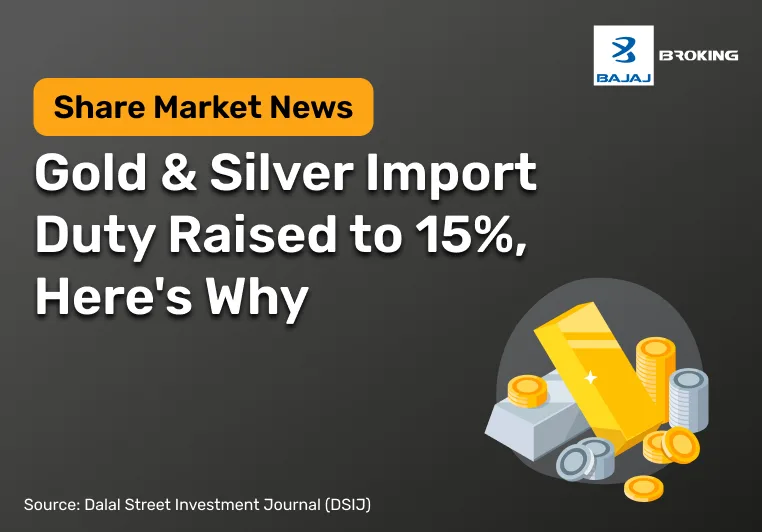
The Government has sharply raised import duty on gold and silver to 15% effective May 13, 2026. The decision comes amid record gold imports, rising crude prices, and growing pressure on India’s foreign exchange reserves.
Source: Live Mint, ET, Dalal Street Investment Journal (DSIJ)
Gold has always occupied a special place in India. It sits in wedding jewellery, temple vaults, family lockers, and increasingly, in investment portfolios. But the government has now drawn a line. Effective May 13, 2026, the import duty on gold and silver has been raised sharply from 6% to 15%, a move that touches nearly every corner of the economy, from the jewellery shop on the high street to the country's foreign exchange reserves.
The Finance Ministry issued a notification combining a 10% basic customs duty with a 5% Agriculture Infrastructure and Development Cess on gold and silver imports, taking the total effective import tax to 15%, more than doubling the previous rate of 6%. Platinum imports have also been revised upward to 15.4% from 6.4%.
The revised duty applies not just to raw gold and silver but also to gold and silver dore, coins, jewellery findings, and several other precious metal-related imports. The government has additionally revised the duty applicable to gold imported from the United Arab Emirates under the fixed-quantity quota arrangement, which previously enjoyed a lower concessional rate.
The numbers behind this decision are hard to ignore. India's gold imports rose more than 24% to a record $71.98 billion in FY26, compared to $58 billion in FY25. The value of gold makes up over 9% of the total Indian imports, which was worth $775 billion during FY2026. Meanwhile, the trade deficit in the country grew to $333.2 billion. The Indian rupee is one of the worst-performing currencies in Asia, hitting a high of ₹95.74 to the US dollar, and each dollar spent on gold imports increases the strain.
The West Asia crisis has made things worse. Crude oil above $105 per barrel is already straining the foreign exchange account, and with gold being the second-largest import item after oil, it became the obvious target for the government's push. Prime Minister Narendra Modi had, just days before the announcement, made a rare public appeal urging Indians to avoid buying gold for a year, underlining just how seriously the government is treating the pressure on the country's reserves.
It is also worth recalling that the government had cut gold duty to 6% in the FY25 Budget, with the stated intention of curbing illegal smuggling and supporting the gems and jewellery sector. Less than two years later, that decision has been fully reversed.
For the everyday buyer, this is straightforward. Gold and silver are going to cost more. With a 900 bps increase (from 6% to 15%) in import duty on top of an already elevated price base means jewellery, coins, and bullion bars will all carry heavier price tags. For someone planning a wedding purchase or simply looking to add to their holdings, the timing is particularly difficult.
On May 13, 2026, MCX Silver prices advanced by ₹18,000, or over 7%, to approximately ₹2,97,000 per kg. Whereas MCX Gold stood at around ₹1,63,000 per 10 grams. As per Economic Times, the duty hike could lead to a decline in gold import volumes of approximately 10% to 15%. Noteworthy here is that almost half of the jewellery needs of the Indian market are already being fulfilled through the recycling of gold. As per Economic Times, the import demand for jewellery consumption had already decreased by almost 20% prior to this move, by early 2026, mainly due to the high costs involved. As a result, the jewellery sector has started manufacturing lighter and lower carat items.
The duty hike has direct consequences for commodity market participants. MCX gold and silver contracts are priced in rupees and factor in the import duty as part of their domestic pricing. The duty was cut from 15% to 6% in the FY25 Budget. The reverse is now playing out. With the duty back at 15%, expect MCX prices to reflect the higher import cost, which adds to already-elevated spot prices. The domestic price premium over international rates is set to widen again, introducing fresh volatility into MCX contracts and complicating spread trading between domestic and global benchmarks.
Demand for gold as an investment has surged over the past year, driven by a sustained price rally and weak returns from equities. According to the World Gold Council, inflows into India's gold exchange-traded funds jumped 186% YoY in the March quarter, reaching a historic 20 metric tonnes. This tells you something important: Indians have been turning to gold not just for tradition but as a genuine financial hedge amid uncertain markets.
Before today's announcement, the government had already begun tightening the screws. As per Reuters, a 3% integrated goods and services tax levied on gold and silver imports prompted banks to pause purchases for over a month, pushing April imports to a near 30-year low. Banks have since resumed buying, but dealers say volumes are likely to fall sharply again now.
There is a broader message embedded in this policy move. The government is not asking people to stop valuing gold, it is asking them to stop importing new gold at a time when the macroeconomic situation demands restraint. As per ET Now, India is estimated to hold around 20,000 tonnes of gold stored in households alone.
More effective use, recycling, exchange, and monetisation of that existing gold could meaningfully reduce the country's reliance on fresh bullion imports and ease the strain on the rupee and foreign exchange reserves. The longer-term goal is to gradually transform dormant household gold into productive domestic liquidity, while reducing unnecessary dollar outflows and strengthening long-term economic stability.
The government's decision to raise gold and silver import duties to 15% is a direct response to a real and pressing problem. Whether it achieves what it sets out to do will depend largely on how the market responds. If legal demand falls and grey market activity rises to fill the gap, the policy may need revisiting sooner than expected.
For now, buyers will feel it in their pockets, commodity traders will reprice their positions, and the jewellery trade will watch closely to see which way demand shifts.
SEBI Registered Research Analyst (INH000006396).
Founded in 1986, Dalal Street Investment Journal (DSIJ) brings decades of experience in India’s equity markets. DSIJ's research combines fundamental analysis with price action, guided by disciplined risk management and capital preservation. They follow a structured, data-driven approach designed to help investors and traders make informed decisions beyond short-term market noise.

Disclaimer :
Investments in the securities market are subject to market risk, read all related documents carefully before investing. This content is for educational purposes only. Securities quoted are exemplary and not recommendatory.
The information on this website is provided on "AS IS" basis. Bajaj Broking (BFSL) does not warrant the accuracy of the information given herein, either expressly or impliedly, for any particular purpose and expressly disclaims any warranties of merchantability or suitability for any particular purpose. While BFSL strives to ensure accuracy, it does not guarantee the completeness, reliability, or timeliness of the information. Users are advised to independently verify details and stay updated with any changes.
The information provided on this website is for general informational purposes only and is subject to change without prior notice. BFSL shall not be responsible for any consequences arising from reliance on the information provided herein and shall not be held responsible for all or any actions that may subsequently result in any loss, damage and or liability. Interest rates, fees, and charges etc., are revised from time to time, for the latest details please refer to our Pricing page.
Neither the information, nor any opinion contained in this website constitutes a solicitation or offer by BFSL or its affiliates to buy or sell any securities, futures, options or other financial instruments or provide any investment advice or service.
BFSL is acting as distributor for non-broking products/ services such as IPO, Mutual Fund, Insurance, PMS, and NPS. These are not Exchange Traded Products. For more details on risk factors, terms and conditions please read the sales brochure carefully before investing.
Content Partner - Dalal Street Investment Journal Wealth Advisory Private Limited
This article is for educational purposes only and should not be considered investment advice. Market investments are subject to risks. DSIJ Wealth Advisory Private Limited is a SEBI-registered Research Analyst (Reg. No: INH000006396) and Investment Adviser (Reg. No: INA000001142). Please consult your financial adviser before investing.
For more disclaimer, check here : https://www.bajajbroking.in/disclaimer
Level up your stock market experience: Download the Bajaj Broking App for effortless investing and trading

Enjoy low brokerage on delivery trades
|
Open Your Free Demat Account
Enjoy low brokerage on delivery trades
|


