
Get Free Demat Account*







Open Your Free Demat Account
Enjoy low brokerage on delivery trades
By Dalal Street Investment Journal (DSIJ)
The ongoing Iran–Middle East conflict has disrupted global LNG markets, driving exports to a six-month low. Missile strikes on Qatar’s LNG facilities and a near-total blockade of the Strait of Hormuz have halted production and shipping. This supply shock is pushing energy prices higher, threatening industrial costs, household budgets, and global economic stability if tensions persist.
As of March 23, 2026, the Iran–Middle East conflict has been ongoing for 24 days. Gulf states continued intercepting drones and missiles early Monday morning, after enduring Iranian attacks for more than three weeks. The human toll is rising, with thousands reported killed in Iran and Lebanon since the start of the conflict. Meanwhile, anti-war protests have taken place in several cities around the world over the weekend. These developments, coupled with fears of rising inflation, have rattled global stock markets.
Over the weekend, US President Donald Trump said the US would “obliterate” Iran’s power plants if the strait isn’t reopened by Monday evening, at 7:44 p.m. ET – 48 hours from the time he posted the threat on Truth Social. Iran responded that if Trump follows through with his threat, it would close the vital waterway indefinitely and attack regional infrastructure. Separately, an Iranian source said that Tehran is moving forward with monetising control of the strait.
This has had significant effects on global markets. Some of the hardest-hit sectors include crude oil, energy, and liquefied natural gas (LNG). Among these, the LNG market shows one of the clearest signs of disruption. Global LNG output had been steadily rising over the past year, primarily due to new projects in the US and Canada. Despite this, the loss of Qatari LNG and the effective closure of the Strait of Hormuz have offset these gains. The Strait of Hormuz is one of the world’s most consequential energy chokepoints, carrying roughly 20% of global energy flows, including petroleum liquids and LNG.
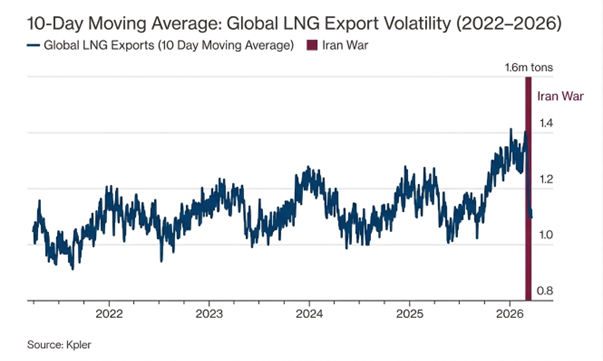
Global LNG exports have slumped to a six‑month low, largely as a direct consequence of the war. Global LNG export volumes have fallen to around a 10‑day moving average of ~1.1 million tonnes per day (the lowest since last September 2025). This drop is due to the physical and logistical breakdown in the world’s LNG supply chain that markets rely on to meet demand across Asia, Europe and beyond.
Iran’s campaign against Qatari infrastructure began on March 1 with drone strikes against state facilities, including a QatarEnergy site at Ras Laffan and the Mesaieed power plant. Qatar intercepted additional waves on March 9 and March 15. But on the evening of March 18, one Iranian missile broke through defenses and struck the Ras Laffan complex, the world’s largest LNG export hub, after four others were intercepted. Fires broke out, and QatarEnergy described the damage as extensive. By March 19, authorities confirmed a full halt to gas production.
This destruction of production capability has sharply increased energy prices and shaken confidence in LNG supply security.
Even the LNG that can still be produced faces major barriers to export. The Strait of Hormuz, a narrow passage between Iran and Oman, is the only route for LNG tankers leaving Qatar, the UAE, and other Gulf producers. Since early March, shipping traffic through the strait has collapsed, with tanker transits falling by more than 90% as vessels avoid the area. Iran’s threats and attacks on ships have prompted insurers to withdraw war‑risk coverage, leaving tankers unable to obtain the insurance needed to sail safely.
Before February 28, it averaged 120 transits per day in both directions. Since the start of the war, that number has fallen to just 6.9.
This blockade has a knock‑on effect far beyond the Gulf, with Asia and Europe feeling the squeeze as LNG shipments dry up and gas inventories shrink.
In the end, if the conflict in the Middle East is not resolved soon, the disruption to energy supplies could trigger widespread economic consequences. Prices for LNG may rise further, driving up costs across industries and putting additional pressure on household budgets, manufacturing, and transportation. In the absence of a swift resolution, the ripple effects could fuel global inflation and impact nearly all sectors of the world economy.
SEBI Registered Research Analyst (INH000006396).
Founded in 1986, Dalal Street Investment Journal (DSIJ) brings decades of experience in India’s equity markets. DSIJ's research combines fundamental analysis with price action, guided by disciplined risk management and capital preservation. They follow a structured, data-driven approach designed to help investors and traders make informed decisions beyond short-term market noise.
Disclaimer :
Investments in securities market are subject to market risk, read all related documents carefully before investing. This content is for educational purposes only. Securities quoted are exemplary and not recommendatory.
The information on this website is provided on "AS IS" basis. Bajaj Broking (BFSL) does not warrant the accuracy of the information given herein, either expressly or impliedly, for any particular purpose and expressly disclaims any warranties of merchantability or suitability for any particular purpose. While BFSL strives to ensure accuracy, it does not guarantee the completeness, reliability, or timeliness of the information. Users are advised to independently verify details and stay updated with any changes.
The information provided on this website is for general informational purposes only and is subject to change without prior notice. BFSL shall not be responsible for any consequences arising from reliance on the information provided herein and shall not be held responsible for all or any actions that may subsequently result in any loss, damage and/or liability. Interest rates, fees, and charges etc., are revised from time to time, for the latest details please refer to our Pricing page.
Neither the information, nor any opinion contained in this website constitutes a solicitation or offer by BFSL or its affiliates to buy or sell any securities, futures, options or other financial instruments or provide any investment advice or service.
BFSL is acting as distributor for non-broking products/ services such as IPO, Mutual Fund, Insurance, PMS, and NPS. These are not Exchange Traded Products. For more details on risk factors, terms and conditions please read the sales brochure carefully before investing.
Content Partner - Dalal Street Investment Journal Wealth Advisory Private Limited
This article is for educational purposes only and should not be considered investment advice. Market investments are subject to risks. DSIJ Wealth Advisory Private Limited is a SEBI-registered Research Analyst (Reg. No: INH000006396) and Investment Adviser (Reg. No: INA000001142). Please consult your financial adviser before investing.
For more disclaimer, check here : https://www.bajajbroking.in/disclaimer
Level up your stock market experience: Scan the QR to download the Bajaj Broking App for effortless investing and trading

Enjoy low brokerage on delivery trades
|
Open Your Free Demat Account
Enjoy low brokerage on delivery trades
|


