
Get Free Demat Account*








Open Your Free Demat Account
Enjoy low brokerage on delivery trades
By Dalal Street Investment Journal (DSIJ)
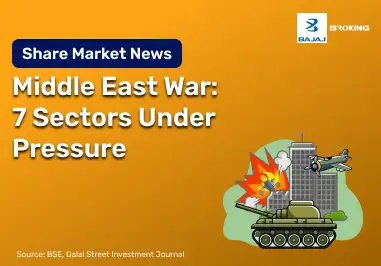
The Middle East conflict has disrupted global energy markets, pushing crude oil prices higher and raising LNG supply concerns via the Strait of Hormuz. While markets have rebounded on easing tensions, several Indian sectors, including aviation, chemicals, auto, and hospitality, continue to face cost pressures, supply risks, and margin compression, with the full impact likely to reflect in upcoming quarterly earnings.
The war in the Middle East has affected stock markets worldwide. The main reason for this was strikes on strategic and energy-related infrastructure in Iran and the surrounding countries. The war also impacted critical supply routes. It raised concerns over the security of oil and gas flows through the Strait of Hormuz. The Strait is an important trade route for oil and gas supply. Last year, 110 billion cubic metres of LNG passed through the Strait, almost a fifth of the world’s total LNG supply.
At the same time, the war had an equally significant impact on crude oil markets. Crude oil markets have also been significantly impacted by the conflict. Oil prices have surged to about $119 per barrel and are now trading around $100 due to supply risks and uncertainty.
Although recent conversations between the US and Iran have led to a temporary pause in strikes, and mediation efforts from Pakistan have helped ease tensions.
For global stock markets, the immediate reaction was that the markets followed a familiar pattern. The markets had an initial spike and brought back confidence of the investors.
Under such circumstances, market experts have always said, "Buy when there is blood in the streets." Although hopes of stabilisation and geopolitical easing have led to a rally in the markets, it is important to note that the reality on the ground often normalises much later.
Not all sectors, however, are expected to recover at the same rate, and some may continue to face pressure. India's dependence on LPG imports is one such major area of concern. India meets approximately 60% of its LPG requirements through imports. A large part of LPG passes through the Strait of Hormuz. Supply chain volatility will arise if this route is affected further. India has a small buffer to withstand prolonged shocks because its LPG reserves can only cover roughly five days' worth of demand.
Furthermore, high crude oil prices and a shortage of LPG are expected to directly affect logistics, transportation, and input costs across industries. Even if the war eases, high input costs and supply uncertainty may impact profitability across these industries.
Hotels and restaurants are dependent on LPG for basic operations such as cooking and heating. With the increase of ₹115 per cylinder on March 7, 2026, the cumulative price exceeds ₹300. Uncertainty in supply exacerbates the problem. Due to the prioritization of household consumption, commercial LPG has not been widely available. Additionally, food inflation is adding another layer of pressure.
Geopolitical tensions in the Middle East have begun to impact international travel as well. This has led to flight cancellations and reduced tourism. Leading players have already indicated the impact on revenues.
Just like hospitality, the aviation industry is facing the brunt of the current war. Here, the impact is more immediate and significantly larger. The primary pressure point is fuel. Aviation Turbine Fuel (ATF) constitutes nearly 35–45% of an airline’s operating costs. Any disruptions would have a direct impact on ATF prices, which would impact the margins of the industry.
Adding to this is currency pressure. ATFs are priced in US dollars, and hence any weakness in the Indian rupee inflates costs for domestic airlines.
The impact of the war is perhaps most visible in India’s ceramics industry, particularly in Morbi, Gujarat. It is said that it is the world’s second-largest ceramic hub. It accounts for nearly 80% of India’s tile production. Ceramics is a heavily gas-dependent industry, particularly for kiln firing. This is because gas is a primary source of high temperatures required for quality production. This makes it difficult for the industry to substitute gas in the short term. Energy accounts for 30% of the total cost of production.
Glass manufacturing relies on furnaces. Furnaces must run continuously at high temperatures (above 1,500°C). This makes it virtually impossible to pause production during periods of fuel shortage or price spikes. It is not feasible to shut down these furnaces because restarting them can take months, cost a lot of money, and run the risk of causing irreversible structural damage. Manufacturers are therefore compelled to continue operating in spite of growing energy expenses. Natural gas supplies are being reduced as a result of the current crisis, while LPG prices have skyrocketed. Furnace oil is one type of alternative fuel that some plants can partially switch to, but this is limited and may affect the quality of the final product.
Processes like cutting, welding, and forging are LPG-dependent. Fabricators, who work on the raw materials to produce structural parts, are witnessing the primary input costs shift from "expensive" to "unstable." The concentration of small-scale units in the clusters of Rajkot, Ludhiana, and Pune makes these units extremely vulnerable to price increases, as they have no bargaining power to pass on costs to customers.
India's automotive sector is currently in a 'triple threat' situation, with an energy crunch in the factories, a logistics crunch in exports, and a rise in the cost of raw materials due to the conflict. The automotive sector in India is a gas-scarce business, and with the government's priority given to domestic homes, the factories are in a difficult situation. The automobile factories require PNG and Commercial LPG for paint shops, casting, and forging units.
Chemicals is one of the sectors that is most exposed to this new geopolitical crisis. Higher oil prices are having a strong impact on costs, including fuel used for processing, as well as transportation costs for raw materials and finished products. At the same time, disruptions in LNG supply are creating acute shortages of natural gas, a critical input for fertilisers, methanol, ethylene glycol, and other chemicals.
In the near term, the chemicals sector is likely to remain under pressure. This is because of the elevated feedstock & energy prices, supply uncertainty, and rising logistics costs. In essence, the sector’s outlook remains cautious. Margin compression, working capital stress, and supply-side challenges are expected to persist.
Although temporary stoppages in the conflict may bring temporary relief, the problem with the energy infrastructure still remains unsolved. The high prices of crude oil and the scarcity of LPG are problems that will still have repercussions for a range of industries.
The actual effects, especially margin compression, growing input costs, and operational bottlenecks, are probably going to show up in the next quarter's earnings. Even if geopolitical tensions ease, normalising supply chains, replenishing reserves, and stabilising energy-dependent operations will take months.
SEBI Registered Research Analyst (INH000006396).
Founded in 1986, Dalal Street Investment Journal (DSIJ) brings decades of experience in India’s equity markets. DSIJ's research combines fundamental analysis with price action, guided by disciplined risk management and capital preservation. They follow a structured, data-driven approach designed to help investors and traders make informed decisions beyond short-term market noise.

Disclaimer :
Investments in securities market are subject to market risk, read all related documents carefully before investing. This content is for educational purposes only. Securities quoted are exemplary and not recommendatory.
The information on this website is provided on "AS IS" basis. Bajaj Broking (BFSL) does not warrant the accuracy of the information given herein, either expressly or impliedly, for any particular purpose and expressly disclaims any warranties of merchantability or suitability for any particular purpose. While BFSL strives to ensure accuracy, it does not guarantee the completeness, reliability, or timeliness of the information. Users are advised to independently verify details and stay updated with any changes.
The information provided on this website is for general informational purposes only and is subject to change without prior notice. BFSL shall not be responsible for any consequences arising from reliance on the information provided herein and shall not be held responsible for all or any actions that may subsequently result in any loss, damage and/or liability. Interest rates, fees, and charges etc., are revised from time to time, for the latest details please refer to our Pricing page.
Neither the information, nor any opinion contained in this website constitutes a solicitation or offer by BFSL or its affiliates to buy or sell any securities, futures, options or other financial instruments or provide any investment advice or service.
BFSL is acting as distributor for non-broking products/ services such as IPO, Mutual Fund, Insurance, PMS, and NPS. These are not Exchange Traded Products. For more details on risk factors, terms and conditions please read the sales brochure carefully before investing.
Content Partner - Dalal Street Investment Journal Wealth Advisory Private Limited
This article is for educational purposes only and should not be considered investment advice. Market investments are subject to risks. DSIJ Wealth Advisory Private Limited is a SEBI-registered Research Analyst (Reg. No: INH000006396) and Investment Adviser (Reg. No: INA000001142). Please consult your financial adviser before investing.
For more disclaimer, check here : https://www.bajajbroking.in/disclaimer
Level up your stock market experience: Scan the QR to download the Bajaj Broking App for effortless investing and trading

Enjoy low brokerage on delivery trades
|
Open Your Free Demat Account
Enjoy low brokerage on delivery trades
|


