
Get Free Demat Account*














Open Your Free Demat Account
Enjoy low brokerage on delivery trades
SIP inflows in February 2026 dipped to ₹29 ,845 cr from January’s ₹31 ,002 cr but remained robust. Foreign portfolio investors returned with ₹22 ,615 cr net inflows, directing funds toward capital goods, financials and other cyclical sectors while exiting IT and consumer stocks, signalling rotation.
This report summarises the key data points from “Bajaj Broking – Mutual Fund and FPI Data for the month of February 2026”. It focuses solely on factual information contained in the report and does not include any external speculation or interpretation.
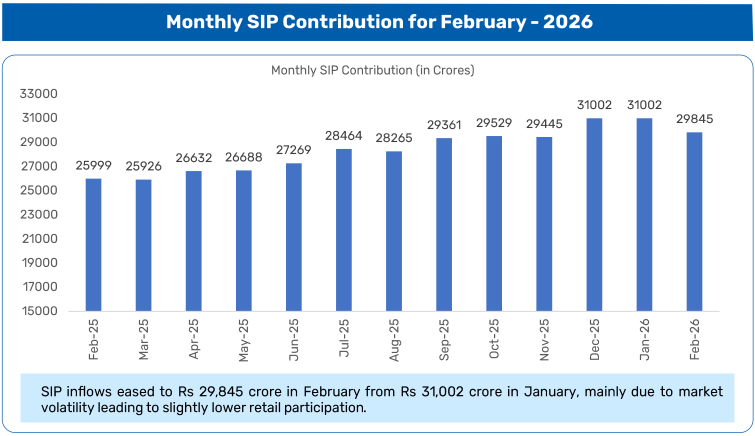
SIP inflows moderated: Monthly contributions to mutual fund systematic investment plans (SIPs) fell to ₹29 845 cr in February 2026 from ₹31 002 cr in January. The report attributes this decline to short‑term market volatility, which reduced retail participation.
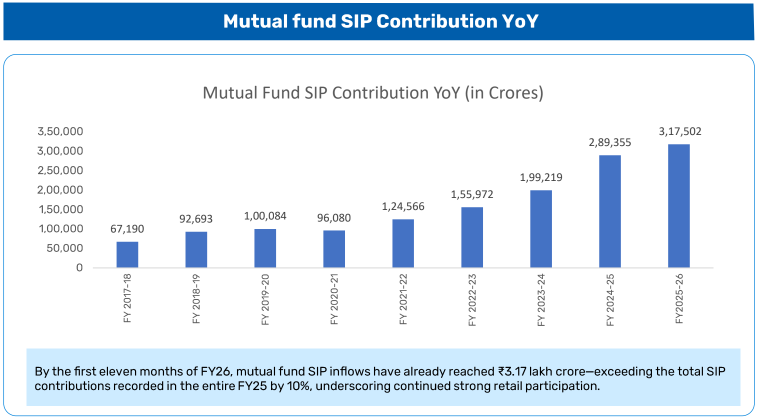
FY26 SIP momentum: Despite the monthly dip, cumulative SIP contributions in the first eleven months of FY26 reached ₹3.17 lakh cr, surpassing the full FY25 total by roughly 10%. This underscores resilient domestic investment flows.
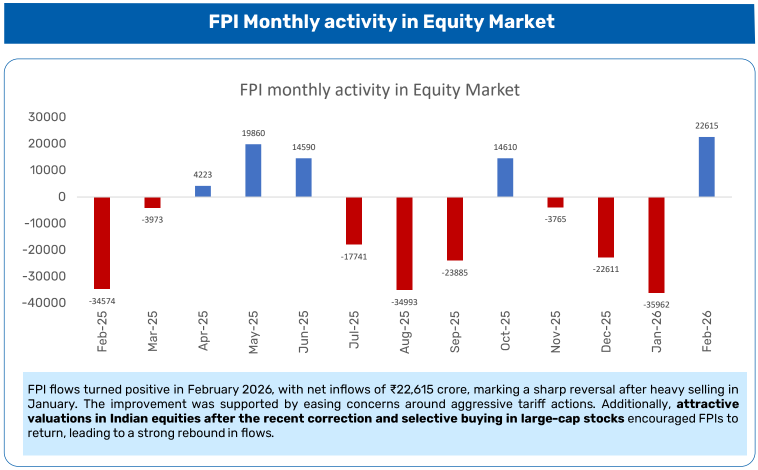
FPI flows turn positive: Foreign Portfolio Investors (FPIs) recorded net inflows of ₹22,615 cr in February 2026 after heavy selling in January. The report notes that easing concerns about tariff actions, attractive post‑correction valuations, and improved global risk appetite supported this rebound.
Sector rotation: FPI flows were concentrated in capital‑intensive and cyclical sectors, while information technology and other defensive segments saw outflows. This pattern suggests investors are positioning for an investment‑led recovery.
SIP inflows fluctuated around ₹25–31 k cr over the last year. The table below lists monthly SIP contributions (in crores) from February 2025 through February 2026 as presented in the report.
The February decline follows a high level of inflows in January and may reflect short‑term market volatility. Nevertheless, the overall SIP trend remains robust.
The report highlights a sustained expansion in retail participation through SIPs. Over several years, SIP inflows have grown markedly from ₹67,190 cr in FY 2017‑18 to ₹3,17,502 cr in FY 2025‑26 (till February). The continued rise is attributed to increased investor awareness, improved accessibility to financial products, and the growing preference for disciplined, long‑term investing.
FPIs were net sellers through most of FY26, but February 2026 marked a temporary reversal. The chart below (derived directly from the report’s numbers) plots monthly net FPI flows in the equity market from February 2025 to February 2026.
The report attributes the February inflow to factors such as easing tariff‑related concerns, attractive valuations after a market correction, stabilisation of the rupee, and a general improvement in global risk appetite. Despite this one‑off inflow, the report notes that FPIs remained net sellers for most of FY26 due to elevated valuations and profit booking following the 2025 rally.
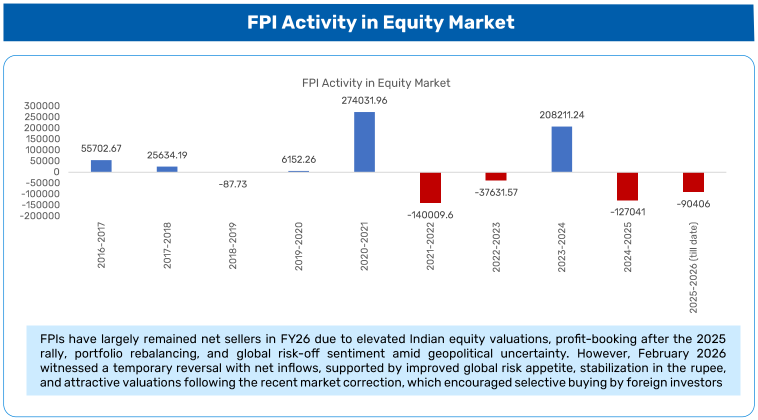
FPIs have exhibited large year‑to‑year swings. The table below lists net FPI equity flows by fiscal year as reported.
The swings illustrate the sensitivity of foreign flows to global risk sentiment and domestic equity valuations.
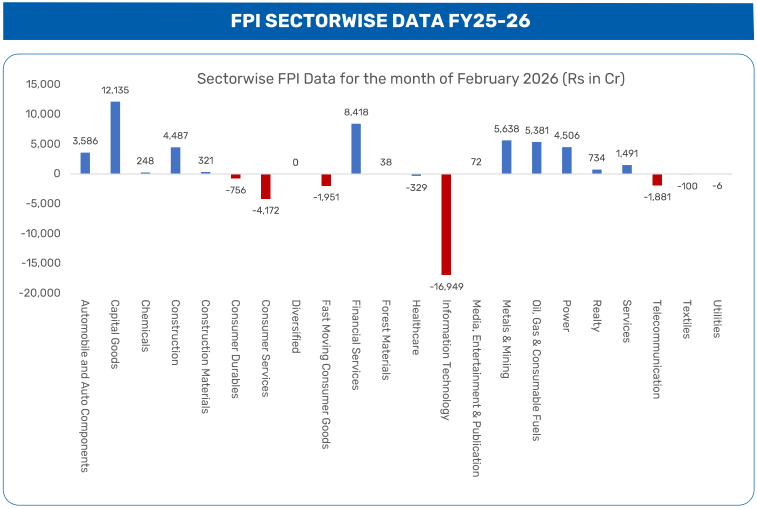
According to the report, FPI flows in February 2026 concentrated on sectors linked to capital expenditure and industrial growth. Key inflow sectors included:
Capital Goods: The largest inflow at ₹12,135 cr, reflecting foreign confidence in India’s investment cycle and infrastructure spending.
Financial Services: ₹8,418 cr inflow, highlighting the resilience of the banking sector.
Metals & Mining: ₹5,638 cr inflow.
Oil, Gas & Consumable Fuels: ₹5,381 cr inflow.
Power: ₹4,506 cr inflow.
Construction: ₹4,487 cr inflow.
Automobile & Auto Components: ₹3,586 cr inflow.
Other sectors with moderate inflows included Services (₹1,491 cr) and Realty (₹734 cr). Smaller allocations were observed in Chemicals, Construction Materials, and Media & Entertainment.
Several sectors experienced FPI selling:
Information Technology: The largest outflow at ₹16,949 cr, attributed to caution around global tech spending and slower demand expectations in developed markets.
Consumer Services: ₹4,172 cr outflow.
Fast‑Moving Consumer Goods (FMCG): ₹1,951 cr outflow.
Telecommunication: ₹1,881 cr outflow.
Consumer Durables: ₹756 cr outflow.
Healthcare: ₹329 cr outflow.
Textiles and Utilities: Minor outflows of ₹100 cr and ₹6 cr, respectively, suggesting neutral positioning.
The report concludes that the February sector-wise flows signal a shift toward cyclical and infrastructure-linked sectors, while technology and defensive consumption segments faced profit-booking.
Resilient domestic investment: Although SIP inflows moderated month‑over‑month, the first eleven months of FY26 already exceed FY25’s total, underscoring strong and growing retail participation.
Selective foreign participation: February 2026 saw FPIs return as net buyers, driven by valuation comfort and improved global conditions. However, FPIs remained net sellers over most of FY26 due to high valuations and profit‑booking.
Sector rotation evident: FPIs channelled funds into capital goods, financials, metals, energy, and other cyclical sectors, while reducing exposure to information technology and defensive consumption sectors.
Outlook anchored in facts: The data in the report point to continued confidence in India’s long‑term growth trajectory, supported by resilient domestic SIP contributions and selective foreign inflows.
Disclaimer :
Investments in the securities market are subject to market risk, read all related documents carefully before investing. This content is for educational purposes only. Securities quoted are exemplary and not recommendatory.
The information on this website is provided on "AS IS" basis. Bajaj Broking (BFSL) does not warrant the accuracy of the information given herein, either expressly or impliedly, for any particular purpose and expressly disclaims any warranties of merchantability or suitability for any particular purpose. While BFSL strives to ensure accuracy, it does not guarantee the completeness, reliability, or timeliness of the information. Users are advised to independently verify details and stay updated with any changes.
The information provided on this website is for general informational purposes only and is subject to change without prior notice. BFSL shall not be responsible for any consequences arising from reliance on the information provided herein and shall not be held responsible for all or any actions that may subsequently result in any loss, damage and or liability. Interest rates, fees, and charges etc., are revised from time to time, for the latest details please refer to our Pricing page.
Neither the information, nor any opinion contained in this website constitutes a solicitation or offer by BFSL or its affiliates to buy or sell any securities, futures, options or other financial instruments or provide any investment advice or service.
BFSL is acting as distributor for non-broking products/ services such as IPO, Mutual Fund, Insurance, PMS, and NPS. These are not Exchange Traded Products. For more details on risk factors, terms and conditions please read the sales brochure carefully before investing.
Content Partner - Dalal Street Investment Journal Wealth Advisory Private Limited
This article is for educational purposes only and should not be considered investment advice. Market investments are subject to risks. DSIJ Wealth Advisory Private Limited is a SEBI-registered Research Analyst (Reg. No: INH000006396) and Investment Adviser (Reg. No: INA000001142). Please consult your financial adviser before investing.
For more disclaimer, check here : https://www.bajajbroking.in/disclaimer
Level up your stock market experience: Download the Bajaj Broking App for effortless investing and trading

Enjoy low brokerage on delivery trades
|
Open Your Free Demat Account
Enjoy low brokerage on delivery trades
|


