


How is MTF different from regular margin trading or intraday leverage?
Answer Field
MTF allows holding positions beyond one day, while intraday leverage is closed within the same trading session.
 May 06, 2025
 6 mins read
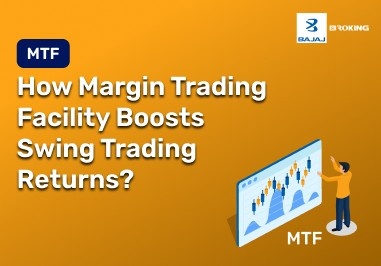
Margin Trading Facility allows traders to take larger positions using limited capital and hold them for a few days or weeks. When used in swing trading, it can improve buying power and flexibility, but it also adds cost and risk that need careful handling.
Swing trading sits somewhere between intraday and long-term investing. It is not rushed like intraday. It is not patient like investing. It works in the middle, where timing matters, but not every minute.
Now, when traders start exploring leverage, one question comes up. Can MTF be used for swing trading? The short answer is yes. But the real answer is a bit layered. Tools like an MTF Calculator can help estimate exposure, funding, and holding costs before taking such positions.
Because MTF does not just increase exposure. It changes how you think about trades.
Swing trading is about catching short- to medium-term price moves. Not hours. Not years. Usually a few days, sometimes a couple of weeks.
The idea is simple. Markets move in waves. Prices rise, pause, fall, and rise again. Swing traders try to capture these “swings.” They do not track every tick. They focus on broader price moves.
A typical swing trader looks for patterns. Breakouts. Pullbacks. Trend reversals. Then they enter, hold for a few sessions, and exit.
It requires patience, but not long-term patience. You need timing, but not constant monitoring. And that balance is what makes swing trading attractive.
Margin Trading Facility, or MTF, allows traders to buy stocks by paying only a part of the total value. The remaining amount is funded.
So if a stock is worth ₹1,00,000, you may not need the full amount. You pay a portion, and the rest is financed.
This is what makes margin trading for swing traders interesting. It increases buying power. But it also introduces cost.
MTF is not free. There is interest on the funded amount. And that cost depends on how long you hold the position.
So MTF is not just about leverage. It is also about managing time and cost together.
Additional Read: What is Margin Trading Facility
When a swing trader uses MTF, the trade structure changes slightly. You identify a stock that looks ready for a move. Instead of using full capital, you use partial funds and take the position using MTF.
This allows you to take a larger position than your actual capital. You then hold the position for a few days or weeks, depending on the setup.
During this time, two things happen. Price movement affects your profit or loss. Interest cost keeps adding up in the background.
If the trade works quickly, the effect of interest is small. If the trade takes time, the cost becomes noticeable.
Also, margin requirements need to be maintained. If the stock moves against you, additional funds may be required.
So MTF in swing trading is not just about entry. It is about managing the position throughout.
MTF can feel useful, especially when opportunities come but capital is limited. It allows traders to act without waiting.
You can take positions even when your funds are partially deployed elsewhere. It also helps in spreading capital across multiple trades.
Instead of putting everything into one trade, you can participate in a few setups.
Some practical advantages include:
You get higher buying power without full capital
You can hold positions beyond intraday
You can diversify across trades instead of concentrating risk
You do not need to liquidate existing investments immediately
But there is another side to this. MTF also changes how profits and losses behave. Even small price moves can feel larger because your position size is bigger.
So the benefit is not just in scale. It is also in flexibility.
The risks of MTF are not always visible at the start. They build slowly. Interest cost is one of them. It may seem small daily, but over time, it adds up.
Then there is price movement. If the stock moves against your position, losses can grow quickly because of leverage.
Margin calls are another challenge. If your margin falls below required levels, you may need to add funds or reduce your position.
There is also timing pressure. Swing trades do not always move immediately. But MTF makes time a factor because interest keeps running.
So the main challenges include:
Interest cost increasing over holding period
Higher exposure leading to larger losses
Margin calls during adverse movement
Pressure to exit early due to cost
Swing trading itself depends on analysis. MTF does not change that. It only changes position size and cost. So tools still matter.
Most swing traders rely on basic indicators. Moving averages help identify trends. Support and resistance levels show entry and exit zones.
Volume gives clues about strength. Momentum indicators help confirm moves.
Some commonly used tools include:
Moving averages for trend direction
RSI for overbought or oversold signals
Support and resistance levels for entries
Volume to confirm price action
But one thing changes with MTF. You need to be slightly more selective. Because every trade now has a cost attached.
MTF allows holding positions beyond one day, while intraday leverage is closed within the same trading session.
Margin depends on stock and risk factors. It usually requires partial capital with funding support.
Leverage varies across stocks and conditions, depending on risk and regulatory limits.
Interest is charged on the funded amount for the duration the position is held.
You may need to add funds or reduce your position to maintain required margin.
Yes, but interest cost increases with time, which needs to be considered.
Use moderate leverage, keep buffer funds, and choose trades carefully.
Other charges may include brokerage, taxes, and transaction-related costs.
Disclaimer :
Investments in securities market are subject to market risk, read all related documents carefully before investing. This content is for educational purposes only. Securities quoted are exemplary and not recommendatory.
The information on this website is provided on "AS IS" basis. Bajaj Broking (BFSL) does not warrant the accuracy of the information given herein, either expressly or impliedly, for any particular purpose and expressly disclaims any warranties of merchantability or suitability for any particular purpose. While BFSL strives to ensure accuracy, it does not guarantee the completeness, reliability, or timeliness of the information. Users are advised to independently verify details and stay updated with any changes. The securities are quoted as an example and not as a recommendation. Past performance is not necessarily a guide to future performance.
The information provided on this website is for general informational purposes only and is subject to change without prior notice. BFSL shall not be responsible for any consequences arising from reliance on the information provided herein and shall not be held responsible for all or any actions that may subsequently result in any loss, damage and/or liability. Interest rates, fees, and charges etc., are revised from time to time, for the latest details please refer to our Pricing page.
Neither the information, nor any opinion contained in this website constitutes a solicitation or offer by BFSL or its affiliates to buy or sell any securities, futures, options or other financial instruments or provide any investment advice or service.
BFSL is acting as distributor for non-broking products/ services such as IPO, Mutual Fund, Insurance, PMS, and NPS. These are not Exchange Traded Products. For more details on risk factors, terms and conditions please read the sales brochure carefully before investing.
Content Partner - Dalal Street Investment Journal Wealth Advisory Private Limited
This article is for educational purposes only and should not be considered investment advice. Market investments are subject to risks. DSIJ Wealth Advisory Private Limited is a SEBI-registered Research Analyst (Reg. No: INH000006396) and Investment Adviser (Reg. No: INA000001142). Please consult your financial adviser before investing.
For more disclaimer, check here : https://www.bajajbroking.in/disclaimer
Level up your stock market experience: Scan the QR to download the Bajaj Broking App for effortless investing and trading


Enjoy low brokerage on delivery trades
|
Open Your Free Demat Account
Enjoy low brokerage on delivery trades
|