









Open Your Free Demat Account
Enjoy low brokerage on delivery trades
 February 03, 2026
 2 mins read
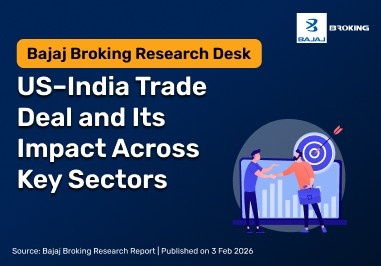
India and the United States have announced a bilateral trade agreement under which US reciprocal tariffs on Indian goods have been reduced to 18% and the penal tariff withdrawn, lowering the effective burden from 50%. India has committed to reducing tariffs and non-tariff barriers to zero, with sector-specific details awaited.
Source: Bajaj Broking Research Report
India and the United States have concluded a bilateral trade agreement that materially alters the tariff framework governing Indian exports to the US. Under the agreement, the United States has reduced the reciprocal tariffs on Indian goods to 18%, down from the previously announced 25%. In addition, the penal tariff of 25% has been withdrawn.
As a result, the overall effective tariff burden on Indian exports has declined sharply from 50% to 18%. This reduction addresses a key overhang that had weighed on export-linked industries and had compressed margins across several sectors with significant exposure to the US market.
In exchange, India has agreed to reduce its tariffs and non-tariff barriers to zero, with detailed implementation mechanisms yet to be announced. India has also committed to halting imports of Russian crude oil, increasing energy purchases from the United States and Venezuela, and expanding imports of US goods across energy, technology, agriculture, and other sectors to over USD 500 billion. Given that current import levels are materially lower, this commitment is expected to be a long-term objective, with industry-specific details likely to emerge progressively as the agreement evolves.
The finalized tariff rate of 18% is lower than those agreed by several other Asian economies, including Bangladesh (20%), Sri Lanka (20%), Pakistan (19%), and Thailand (19%). This places India in a relatively favorable competitive position within global trade flows. Another tariff development to monitor is the potential evolution of a US–China tariff agreement, given its broader implications for global trade and spillover effects on India.
From an equity market perspective, clarity on the India–US trade agreement, along with the recently concluded EU–India Free Trade Agreement, strengthens India’s positioning in global trade. The impact of the revised tariff rate is also likely to be partially offset by the 5.4% depreciation of the Indian rupee against the US dollar over the past year since the initial tariff announcement.
Before the agreement, Indian exporters faced tariffs of up to 50%, which undermined competitiveness in the US market, compressed margins, and increased uncertainty across export-linked industries. Elevated duties affected landed pricing, reduced order visibility, and constrained profitability for companies with meaningful US exposure.
The sharp reduction in tariffs is expected to improve landed-price competitiveness for Indian exporters materially. Lower tariff incidence enhances order visibility and supports margin recovery, particularly in sectors where pricing power had been limited due to cost pressures.
As trade economics improve, investor focus may shift toward export-oriented segments that had been under pressure from elevated duties. Improved pricing dynamics and clearer demand visibility have the potential to translate into better profitability and a more stable growth outlook across these segments, subject to sector-specific execution and global demand conditions.
Textiles and Garments
The textiles and garments sector has a high dependence on the US market, particularly in home textiles, made-ups, and apparel. Lower tariffs improve India’s landed-price competitiveness relative to exporters from Bangladesh, Vietnam, and China.
This improvement is expected to support higher-order inflows, better capacity utilization, and margin expansion. Given the labor-intensive nature of the sector and its thin margins, even modest tariff reductions can influence sourcing decisions by US retailers.
Auto Ancillaries
Indian auto component manufacturers export forgings, castings, axles, tyres, and precision components to US OEMs and Tier-1 suppliers. Reduced tariffs enhance cost competitiveness relative to suppliers from Mexico and China, potentially increasing sourcing from India.
This may lead to higher export volumes, longer-term supply contracts, and improved operating leverage. However, companies with manufacturing facilities in the US may see limited incremental benefits, as they are already insulated from import duties.
Pharmaceuticals
The agreement is relevant for the pharmaceutical sector, with the US remaining the largest market for Indian generics and APIs. Lower duties improve price competitiveness relative to China and other suppliers in a highly price-sensitive market.
Improved trade economics may support margins and encourage increased sourcing from India amid ongoing global supply-chain diversification.
Chemicals
Exporters of specialty chemicals, agrochemicals, and fluorochemicals with exposure to the US stand to benefit from improved trade economics and continued diversification away from China.
Tariff relief can support better pricing, higher volumes, and stronger customer relationships, particularly for companies operating in niche and high-value applications.
IT Services
Although tariffs do not directly apply to services, the US is the largest revenue contributor for Indian IT services companies. Improved bilateral trade relations and a more favorable economic environment could indirectly support enterprise technology spending.
This may influence decision-making on digital transformation initiatives and support order inflows over time.
Seafood
Seafood exports, particularly shrimp and processed marine products, are heavily dependent on US demand. Tariff rationalization is expected to improve realizations, reduce pricing pressure from Latin American competitors, and enhance demand visibility.
Given the sector’s thin margins and sensitivity to trade and currency movements, improved access to the US market could directly support earnings stability.
Disclaimer :
Investments in securities market are subject to market risk, read all related documents carefully before investing. This content is for educational purposes only. Securities quoted are exemplary and not recommendatory.
The information on this website is provided on "AS IS" basis. Bajaj Broking (BFSL) does not warrant the accuracy of the information given herein, either expressly or impliedly, for any particular purpose and expressly disclaims any warranties of merchantability or suitability for any particular purpose. While BFSL strives to ensure accuracy, it does not guarantee the completeness, reliability, or timeliness of the information. Users are advised to independently verify details and stay updated with any changes.
The information provided on this website is for general informational purposes only and is subject to change without prior notice. BFSL shall not be responsible for any consequences arising from reliance on the information provided herein and shall not be held responsible for all or any actions that may subsequently result in any loss, damage and/or liability. Interest rates, fees, and charges etc., are revised from time to time, for the latest details please refer to our Pricing page.
Neither the information, nor any opinion contained in this website constitutes a solicitation or offer by BFSL or its affiliates to buy or sell any securities, futures, options or other financial instruments or provide any investment advice or service.
BFSL is acting as distributor for non-broking products/ services such as IPO, Mutual Fund, Insurance, PMS, and NPS. These are not Exchange Traded Products. For more details on risk factors, terms and conditions please read the sales brochure carefully before investing.
Content Partner - Dalal Street Investment Journal Wealth Advisory Private Limited
This article is for educational purposes only and should not be considered investment advice. Market investments are subject to risks. DSIJ Wealth Advisory Private Limited is a SEBI-registered Research Analyst (Reg. No: INH000006396) and Investment Adviser (Reg. No: INA000001142). Please consult your financial adviser before investing.
For more disclaimer, check here : https://www.bajajbroking.in/disclaimer
Level up your stock market experience: Scan the QR to download the Bajaj Broking App for effortless investing and trading

Enjoy low brokerage on delivery trades
|
Open Your Free Demat Account
Enjoy low brokerage on delivery trades
|


